The fastest way to learn quantum computing is to do it and then reflect and learn from the experience. The IBM Composer is the ideal way to start for a Novice. No need to install Qiskit and Python and spent a lot of time getting connected to one of the IBM Quantum Computers.
Just follow the 9 steps in the quick guide cheat sheet below:
Let’s build your first quantum program on IBM Quantum Composer!
1. Head to your IBM Quantum Learning account: https://quantum.ibm.com/composer
2. Pick a gate: Think of gates as tools that manipulate Qubits (Classical Computer Bits = 0 or 1). In this example, we’ll use the “RZ” gate.
3. Drag the “RZ” gate to the first Qubit line. This puts the Qubit in a special state called superposition, like a coin spinning in the air (both heads and tails at the same time!).
4. Add a measurement: Drag the “Measure” icon to the same Qubit line. This lets us see the outcome of the program.
5. Run the program! You can choose a real quantum computer (like the one in Brisbane, Australia) or a simulator.
6. Wait your turn! Since the computer is shared, there might be a waiting queue for your program to run. You can check the status on the left panel.
Reflection
Reflecting on the first experience with quantum computing might lead to some of the following questions:
Why so many measurements (100) and not just 1 when you run the program on the IBM Quantum computer ?
Notice the many icons in the Operations block of the IBM Composer interface? Are all these quantum gates like the RZ gate besides the icon for measurement? What is their purpose?
What are Qubits and why only 4 Qubits?
What is the c line below the Qubits that the measure icon is pointing to with a line?
What does RZ Gate stand for?
First let’s take a look at the results:
Check your results:
After running the program and measuring repeatedly for 100 times the results show a probability above 100% for the bit value of 0 and a negativ probability for a bit value of 1!
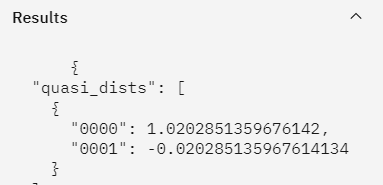
Negativ probability of 0.02 (2%)
Welcome, you are entering a world where your everyday intuition will not work. And you are not alone. Not even Albert Einstein based on his scientific intuition could accept quantum mechanics as a complete theory during his lifetime.
In this first program only one RZ gate was created. What would happen to the negativ probability if more RZ gates are usded?

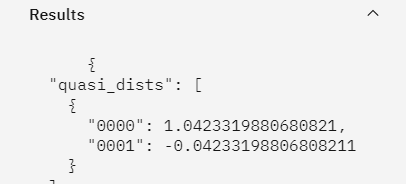
The negativ probability increased to over 4%.
This is even more strange as the probability before computing was calculated to be 100% for zero (0) by the IBM Qunatum Composer in the Probabilities pane:
Could it be that the measuring system of the IBM Quantum Computer in Brisbane, Australia has a defect?
Let’s run the same program at the IBM Quantum Computer in Osaka, Japan.

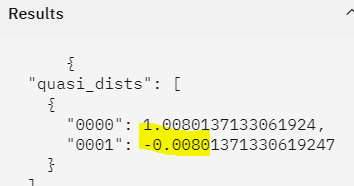
Different result, but still a negativ probability. Does it mean IBM Osaka has a better quantum computer than IBM Brisbane?
Probably not. Let’s run the same quantum program again at the IBM Brisbane Quantum Computer. Voilà:
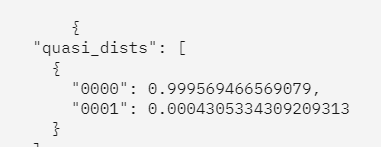
A new result and this time no negativ probability. In 99.95% cases the measurement got you a 0 as predicted but not all. Get used to the noise. Many see it as an error and want to correct it but there are a few scientist who see as a benefit of quantum computing.
First Principle: Quantum Computing is counterintuitive and noisy.
 Circular Astronomy