Fomalhaut A is a bright star and was known to the Persian and Arabic Astronomers. The name of the star is Arabic and means “mouth of the fish”. It belongs to a Tripple Star System 25 light-years away from earth.
Formalhaut A has several notable characteristics:
- Location and visibility: It is the brightest star in the constellation Piscis Austrinus (the Southern Fish) and one of the brightest stars in the night sky. Fomalhaut is often called the “Autumn Star” or “Loneliest Star” due to its solitary appearance in a relatively empty region of the sky.
- It is part of a triple star system, with two companion stars: Fomalhaut B (TW Piscis Austrini) and Fomalhaut C.
- Physical characteristics: Fomalhaut A is a main sequence star slightly larger than the Sun. It is considerably more luminous, shining about 16 times brighter than the Sun in visible light.
- Age: The star is relatively young, with an estimated age of 400-450 million years.
- Debris disk: Fomalhaut A is surrounded by a massive and complex debris disk, first detected in the 1980s and later imaged by the Hubble Space Telescope. This disk is composed of multiple rings or belts of different materials and is not centered on the star itself.
- Planetary system: In 2008, astronomers announced a potential extrasolar planet candidate orbiting Fomalhaut A. However, subsequent observations suggested this object, known as Fomalhaut b, may actually be the debris from a collision between two large bodies rather than a planet.
- Cultural significance: Fomalhaut has played a role in various cultures throughout history. Its name derives from Arabic, meaning “mouth of the fish,” and it was considered one of the four “royal stars” by ancient Persians.
Fomalhaut Dusty Debris Disk (MIRI Image), James Webb Telescope first image of a protoplanetary disk.
Astronomers used NASA’s James Webb Space Telescope to image the warm dust around Fomalhaut, revealing three nested belts extending out to 14 billion miles (23 billion kilometers) from the star. These belts are analogous to debris disks found elsewhere in our galaxy and provide insights into planetary system formation. The inner belts, which had never been seen before, were revealed by Webb for the first time. Overall, Fomalhaut’s dusty structures are much more complex than the asteroid and Kuiper dust belts in our solar system.
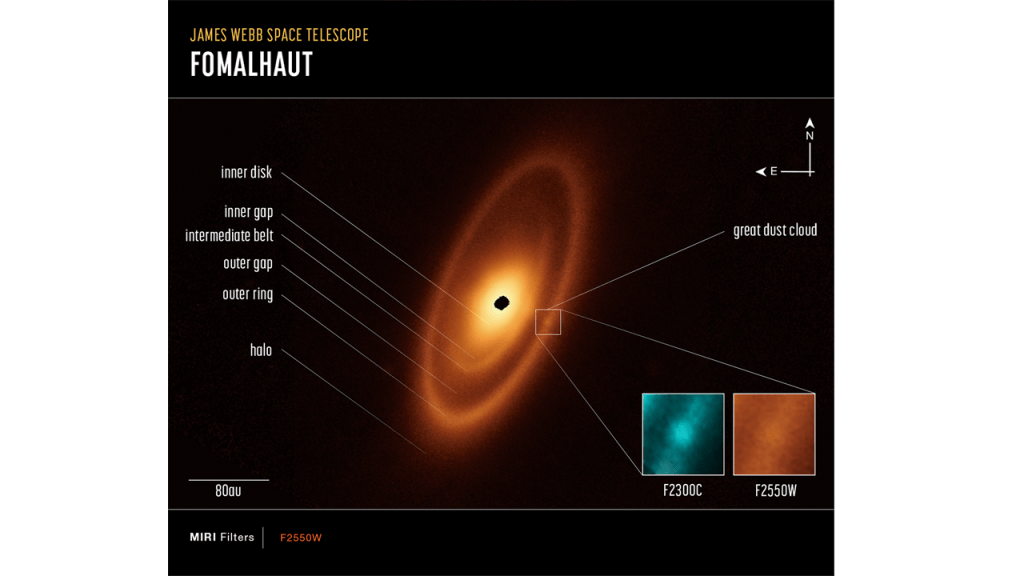
Credits: NASA, ESA, CSA, A. Gáspár (University of Arizona). Image processing: A. Pagan (STScI) Link
Astronimcal filters used in the JWST image above
F2300C can also represent a specific filter used in astronomy with the Mid-InfraRed Instrument (MIRI) on the James Webb Space Telescope (JWST). This filter allows astronomers to observe objects at a specific infrared wavelength (around 22.75 micrometers) to study faint celestial bodies.
F2550W refers to a specific filter used in astronomy with the Mid-InfraRed Instrument (MIRI) on the James Webb Space Telescope (JWST).
- 2550: Indicates the central wavelength of the filter in nanometers (nm). In this case, it’s around 2.55 micrometers (µm).
- W: Potentially stands for “Wide” bandpass, suggesting the filter captures a broader range of infrared wavelengths around the central point.
This filter allows astronomers to observe celestial objects in the mid-infrared spectrum, specifically around 2.55 micrometers. This wavelength range is useful for studying faint and distant objects, such as:
- Cool stars and brown dwarfs
- Dust clouds surrounding young stars
- Interstellar gas and dust
- The atmospheres of exoplanets (planets outside our solar system)
Scientists use data collected through F2550W alongside observations from other JWST filters to:
- Understand the formation and evolution of stars and planetary systems
- Characterize the composition of interstellar dust and gas
- Analyze the atmospheres of exoplanets and search for potential signs of habitability
References:
Fomalhaut: Not So Lonely After All
https://nightsky.jpl.nasa.gov/news-display.cfm?News_ID=1002
Fomalhaut is the loneliest star in the southern sky
https://earthsky.org/brightest-stars/solitary-fomalhaut-guards-the-southern-sky/
 Circular Astronomy