Objectives, Instrumentation, and Contributions to Heliophysics
The heliosphere, the colossal magnetic bubble created by the Sun’s constant solar wind, acts as our solar system’s first and most critical line of defense, deflecting the majority of harmful galactic cosmic radiation.
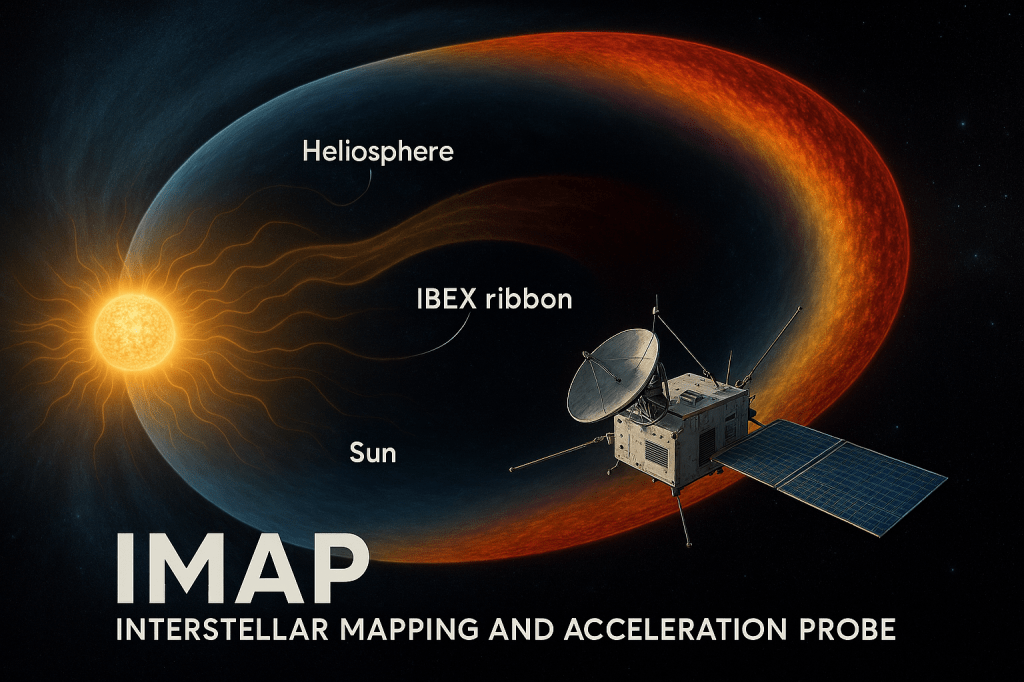
Despite decades of exploration, from the pioneering, single-point measurements of the Voyager missions to the groundbreaking all-sky maps produced by the Interstellar Boundary Explorer (IBEX), a central enigma has persisted: the origin of a puzzling, bright structure of energetic neutral atoms known as the “IBEX ribbon.”
Current literature remains divided on this fundamental issue.
One dominant hypothesis, the “spatial retention” model, posits that the ribbon is a physical phenomenon where solar wind particles become trapped by intense waves in the interstellar magnetic field just beyond our heliosphere’s edge.
An alternative viewpoint proposes that the ribbon is a mere “geometrical illusion,” an artifact of our solar system’s position relative to the boundary of distant interstellar gas clouds.
NASA’s Interstellar Mapping and Acceleration Probe (IMAP) is a revolutionary new mission designed to definitively resolve this controversy. As a successor to IBEX, IMAP will combine an unprecedented suite of ten instruments to provide both high-resolution, all-sky maps of the heliosphere’s boundaries and simultaneous, real-time measurements of the solar wind. This synergistic approach will allow scientists to directly correlate conditions inside the heliosphere with the remote observations of its outer edge, providing the data necessary to test and validate competing theories.
Beyond resolving this core scientific debate, IMAP will make profound contributions to our understanding of energetic particle acceleration, a process that creates a radiation threat to astronauts and satellites. Strategically positioned at the Sun-Earth L1 Lagrange point, IMAP will also serve as a crucial early warning system, transmitting vital space weather data that can provide up to 30 minutes of lead time before solar disturbances impact Earth.
In essence, IMAP is poised to not only redraw our map of the heliosphere but also to establish a new paradigm for protecting our cosmic neighborhood.
 Circular Astronomy