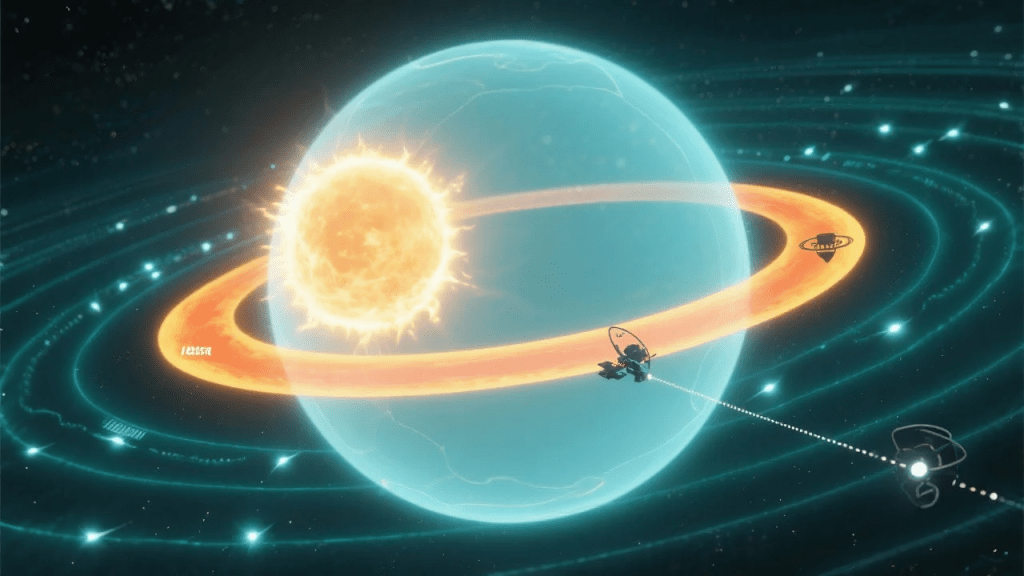
Over a decade ago, a small NASA satellite, the Interstellar Boundary Explorer (IBEX), made a revolutionary discovery that fundamentally changed our understanding of the heliosphere, the protective bubble of solar wind that envelops our solar system. Rather than the smooth, predictable boundary scientists had modeled for years, IBEX’s first all-sky map revealed a startling and unpredicted feature: a bright, narrow, arc-shaped “ribbon” of energetic neutral atoms (ENAs) stretching across the sky.1 This ENA emissions from the ribbon were hundreds of percents larger than what was predicted by previous models.3 The discovery was analogous to the first mapping of Earth’s radiation belts, providing a new way to visualize our cosmic neighborhood using particles instead of light.4
The existence of this ribbon pointed to a powerful, previously unknown influence on the heliosphere: the local interstellar magnetic field.3 Subsequent analysis by Funsten et al. in 2013 revealed the ribbon’s precise, “extraordinarily circular” geometry, with its center aligning with the direction of this interstellar field.1 This unique property has since transformed the ribbon into a crucial cosmic compass, acting as a new tool to study the magnetic landscape beyond our solar system.5 This was dramatically demonstrated when IBEX data helped resolve a long-standing debate, confirming that the Voyager 1 spacecraft had indeed crossed into interstellar space, even though its magnetic field readings were initially perplexing.6 The ribbon provided the “true magnetic north” that revealed Voyager was traveling through a region where the magnetic field was deflected by the heliopause, much like an elastic cord stretched around a beach ball.6
While a consensus has formed around the ribbon’s magnetic ordering, its exact physical origin remains a central debate.7 Two primary theories dominate the discussion:
- The Secondary ENA Mechanism, the most widely accepted model, posits a three-step process where solar wind particles travel outward, become neutral, then re-ionize in the interstellar medium before a final charge exchange sends them back toward the Sun as a focused ribbon of ENAs.5 This model effectively reproduces the ribbon’s geometry but struggles to explain certain high-latitude fluxes.8
- The Spatial Retention Model suggests the ribbon forms just beyond the heliopause in a region where newly ionized solar wind particles are temporarily “retained” or “trapped” by waves in the magnetic field.9 This model excels at reproducing the observed latitudinal ordering of ENA energies, but relies on complex plasma physics that are not yet fully understood.4
The ongoing mission longevity of IBEX has highlighted the complexity of the ribbon’s time variability, with its intensity and width evolving over the solar cycle.11 This dynamic nature, along with the remaining discrepancies in current models, points to a need for a more comprehensive understanding of the interplay between multiple heliospheric processes.8
Looking ahead, the upcoming Interstellar Mapping and Acceleration Probe (IMAP) mission is poised to build upon IBEX’s legacy.13 IMAP will be positioned at the L1 Lagrange point, providing a clearer, unimpeded view of the heliosphere’s boundaries with improved instruments.15 With its ability to provide real-time observations of solar disturbances and their effect on ENA fluxes, IMAP is set to deliver the data needed to finally solve the ribbon’s enduring mysteries and create a dynamic, rather than static, map of our home in the galaxy.13
 Circular Astronomy
One response to “A Decade of Discovery: A Literature Review on the IBEX Ribbon and its Implications for the Heliosphere”
Wonderful post
LikeLike