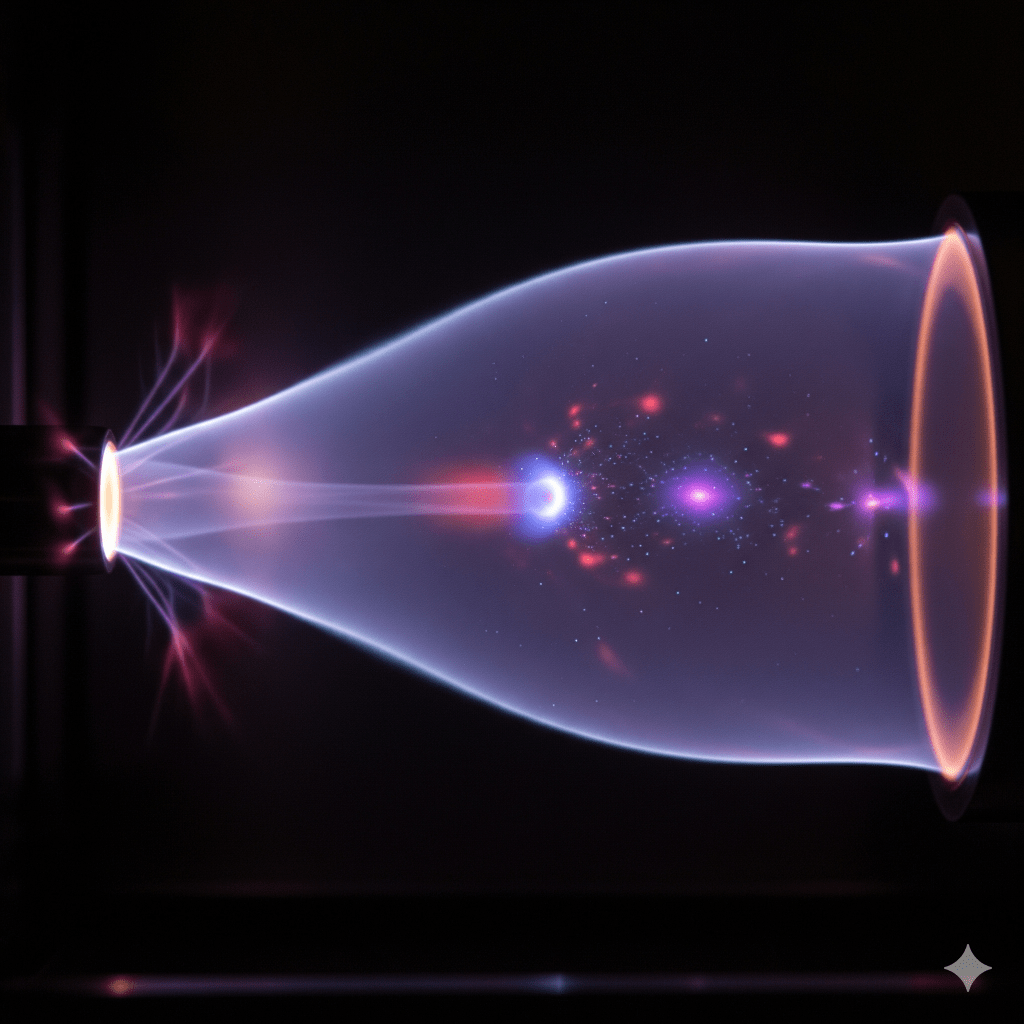
Executive Summary: A New Frontier in Engineering and Physics
Plasma, the “fourth state of matter,” has emerged from the confines of astrophysics and fusion research to become a transformative technology at the heart of modern industry and advanced science. When harnessed in a vacuum or low-pressure environment, its unique properties offer an unparalleled degree of control and precision, enabling breakthroughs that were once confined to the pages of science fiction. This literature review, “Plasma Jets in Vacuum: A Comprehensive Review of Generation, Characterization, and Applications,” synthesizes decades of research to provide a holistic understanding of this critical field.
Our review reveals a discipline at the intersection of fundamental physics and applied engineering. From the high-stakes world of deep-space propulsion to the meticulous requirements of semiconductor manufacturing and the delicate domain of biomedical engineering, vacuum-based plasma jets are the common denominator. In space, they power the most ambitious missions, with gridded ion thrusters delivering extraordinary fuel efficiency and Hall thrusters providing a balance of thrust and longevity. On Earth, their precision enables atomic-level control over materials, allowing for the creation of next-generation microelectronics and advanced surface coatings. A particularly promising frontier lies in biomedicine, where non-thermal (cold) plasma is revolutionizing sterilization techniques and accelerating wound healing without thermal damage.
Despite these remarkable advancements, the field is not without its challenges. The literature identifies significant knowledge gaps and unresolved debates, particularly in the development of predictive computational models. The complex, coupled feedback loops that govern plasma-induced erosion in Hall thrusters, for example, have thus far resisted complete theoretical description. Furthermore, a lack of standardized, comparative studies across different plasma jet devices and operating parameters complicates the generalization and reproducibility of research findings.
The path forward for plasma science lies in a profound synergy of advanced diagnostics and high-fidelity modeling. To bridge the gap between microscopic physical processes and macroscopic device performance, the field requires multi-channel diagnostic systems with higher spatiotemporal resolution and integrated, multi-scale computational models. By addressing these foundational challenges, researchers can move from a state of empirical optimization to one of predictive design, unlocking the full potential of this versatile and powerful technology.
 Circular Astronomy