For centuries, mathematicians and physicists have used equations like the Euler and Navier-Stokes equations to describe how fluids move. A big mystery is whether these equations can predict that a smooth, well-behaved flow will suddenly develop a “singularity”—a point where things like velocity become infinite in a finite amount of time.
Most previous research has only found stable singularities—special solutions that still appear even if you slightly change the starting conditions. However, for the most important open problems (like the famous Millennium Prize Problem for Navier-Stokes), experts believe that if singularities exist, they must be unstable: they only happen if the initial conditions are tuned with extreme, almost impossible precision. These unstable singularities are extremely hard to find and study, especially with traditional mathematical or numerical methods.
Stable vs Unstable Singularities
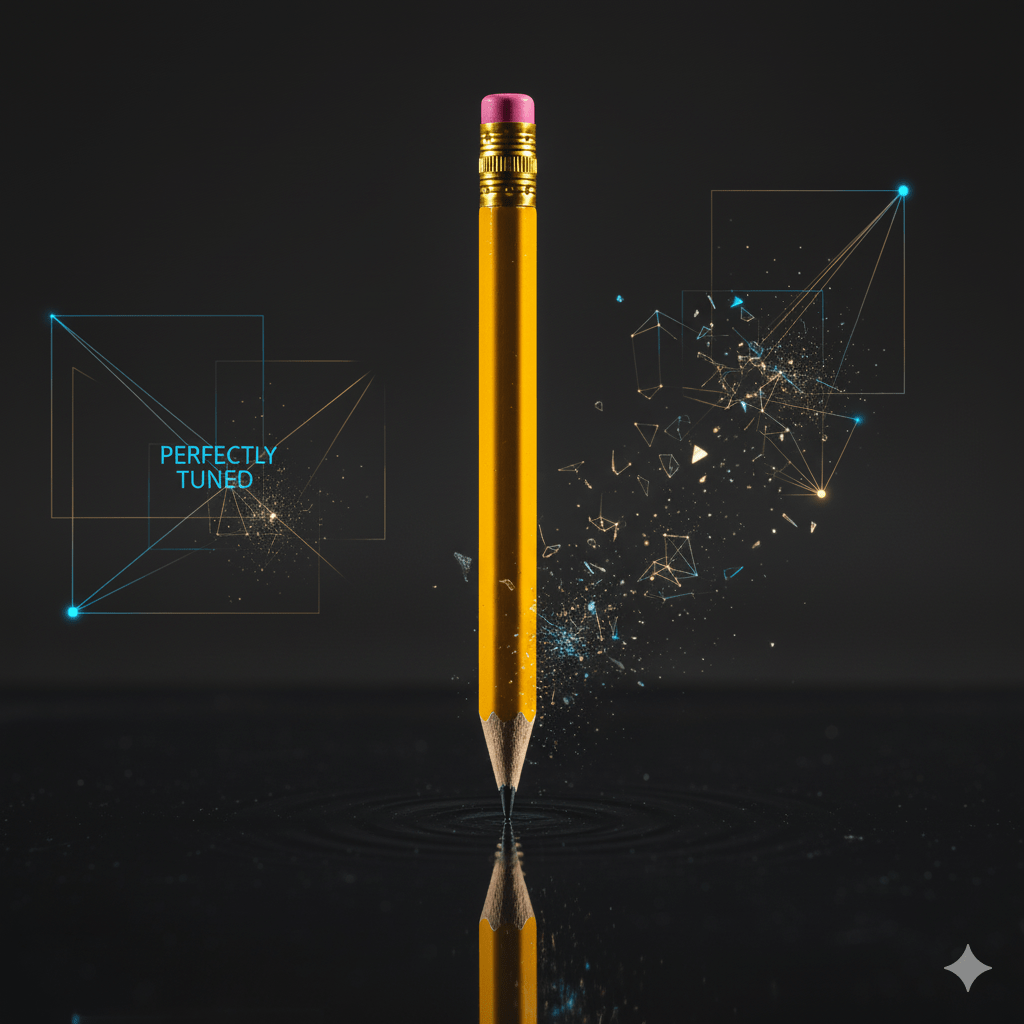
Imagine you’re trying to balance a pencil perfectly upright on its tip.
- Stable singularity:
If the pencil is slightly tilted, it still stands up straight—small mistakes don’t matter much. This is like a stable singularity: it appears even if your starting point isn’t perfect. - Unstable singularity:
But in reality, if you try to balance a pencil on its tip, even the tiniest breeze or vibration will make it fall. You’d need impossibly precise conditions to keep it balanced. This is like an unstable singularity: it only happens if everything is tuned exactly right, and any tiny disturbance destroys it.
How can we systematically discover and precisely characterize these elusive, unstable singularities in fluid equations, and what can we learn from them?
The authors of this paper developed a new approach using physics-informed neural networks (PINNs) and high-precision optimization to search for self-similar singularities. They successfully discovered and validated multiple families of unstable singularities for several important fluid equations, providing the first systematic evidence of their existence. Their method not only finds these rare solutions but also measures their properties with enough accuracy to support rigorous mathematical proofs. This breakthrough opens new doors for tackling some of the deepest questions in mathematics and physics.
By combining modern machine learning with mathematical insight, the paper shows how to find and understand the most delicate and important types of singularities—those that only appear under perfect conditions—in the equations that govern fluid motion.
Discovering new solutions to century-old problems in fluid dynamics – Google DeepMind
Discovery of Unstable Singularities
Yongji Wang, Mehdi Bennani, James Martens, Sébastien Racanière, Sam Blackwell, Alex Matthews, Stanislav Nikolov, Gonzalo Cao-Labora, Daniel S. Park, Martin Arjovsky, Daniel Worrall, Chongli Qin, Ferran Alet, Borislav Kozlovskii, Nenad Tomašev, Alex Davies, Pushmeet Kohli, Tristan Buckmaster, Bogdan Georgiev, Javier Gómez-Serrano, Ray Jiang, Ching-Yao Lai
 Circular Astronomy