Summary, Step-by-Step Guide to JWST Proposal Success, and Comprehensive Proposal Checklist
The James Webb Space Telescope (JWST) was designed with multiple, complementary access policies—primarily the General Observer (GO) program (open competition), the Guaranteed Time Observations (GTO) (rewarding instrument developers with about 16% of the first three cycles), and Director’s Discretionary Time (DDT) (reserved for time-critical events or exceptional urgency)—AND these policies were implemented using a rigorous, bias-mitigating Dual-Anonymous Peer Review (DAPR) system with clear evaluation criteria, successfully delivering groundbreaking initial science across core themes like high-redshift galaxy formation and exoplanet atmospheric chemistry.
Summary
The launch of the James Webb Space Telescope (JWST) provided the astronomical community with a revolutionary, but finite, resource capable of unlocking the universe’s most profound secrets, from the first galaxies to the atmospheres of exoplanets. Access to this time is managed by the Space Telescope Science Institute (STScI) through well-defined, multi-faceted policies, including the competitive General Observer (GO) program, the legacy Guaranteed Time Observations (GTO) for instrument builders, and the opportunistic Director’s Discretionary Time (DDT). The selection process relies on the stringent, bias-mitigating Dual-Anonymous Peer Review (DAPR) system, judged on three core criteria: In-field Impact, Out-of-field Impact, and Feasibility.
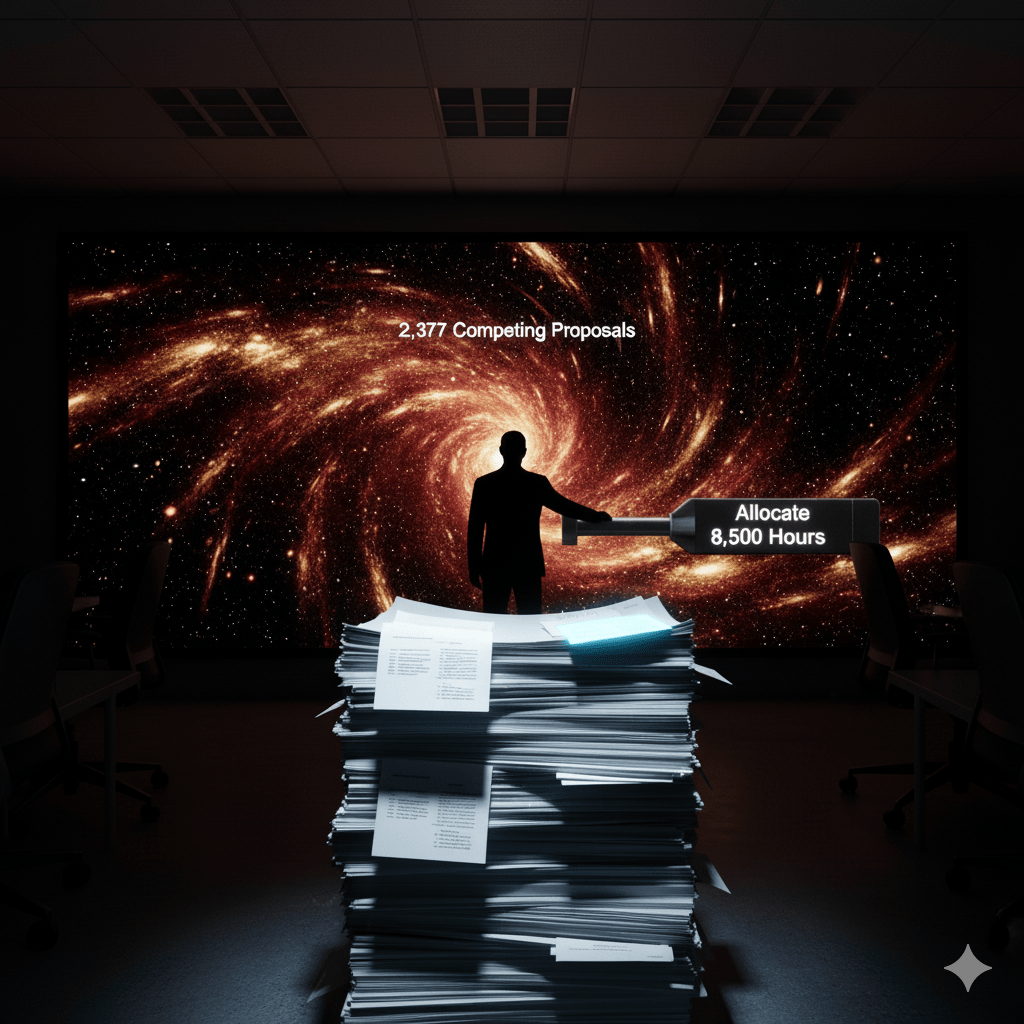
Despite these rigorous policies, the sheer scientific ambition of the global community has led to unprecedented demand, with recent proposal cycles (e.g., Cycle 4) receiving over 2,300 submissions and generating a persistent ≈9:1 oversubscription rate (by requested hours). This hyper-competitive environment has strained the traditional review process by dramatically increasing the workload on the Time Allocation Committee (TAC) and challenging the efficacy of the original proposal structure and science categories, threatening the long-term sustainability and fairness of the system.
How is the JWST time allocation system evolving its policies and procedures—particularly in response to severe oversubscription—to maintain efficiency, fairness, and maximize the revolutionary scientific return across key research themes?
In response to challenges documented by the JWST Users Committee (JSTUC), the system is demonstrating rapid and concrete policy adaptation. Key changes introduced in Cycle 4 (and continuing into future cycles) include:
- Process Efficiency: Reducing proposal page limits by nearly 50% to lessen TAC burden.
- Targeted Science: Restructuring the Science Categories to better align with JWST’s unique breakthrough areas, such as High-Redshift Galaxies and Exoplanet Atmospheres.
- Increased Capacity: Substantially increasing the total allocated hours (e.g., from ≈5,500 in Cycle 3 to ≈8,500 in Cycle 4) to absorb some of the immense demand.
The literature review shows that the system is not static; it is actively adjusting its mechanics to ensure that the scientific breakthroughs—like the papers by Oesch & Adamo (2025) rewriting cosmology and the Wakeford/Ohno teams characterizing exoplanet chemistry—continue to be selected and executed efficiently.
Based on the structured literature review, here is a step-by-step guide for a new astronomer to maximize the value of this information and significantly improve their chances of winning highly competitive James Webb Space Telescope (JWST) observation time.
Step-by-Step Guide to JWST Proposal Success
Phase 1: Understand the Battlefield (The 9:1 Challenge)
The core finding of the review is the sheer intensity of the competition: the oversubscription rate is roughly 9:1 (90% of requested hours are rejected). You must aim not just for “good” science, but for “transformative” science.
- Acknowledge the Competition (≈9:1): Immediately discard the idea of submitting a “safe” or incremental proposal. Your proposal must target a Grade 1: Transformative score, meaning its potential scientific return would fundamentally rewrite a field of study.
- Define Your Program Type:
- General Observer (GO): This is the standard, competitive route (the bulk of the time). Focus on small programs, as they are often easier to schedule.
- Director’s Discretionary Time (DDT): Only pursue this if your target is truly urgent (e.g., a newly detected supernova, a rapidly fading transient). Do not use DDT to bypass the GO program.
- GTO: This time is no longer being allocated for new groups (it was reserved for instrument developers), so focus your strategy on GO programs.
- Benchmark Against Key Themes: Your topic should align with or advance the most successful current themes. The review highlights:
- High-Redshift Galaxies and the Distant Universe (Rewriting cosmology).
- Exoplanet Atmospheres and Habitability (Detailed chemical characterization).
- Focus your science on unique JWST capabilities (mid-infrared, high sensitivity).
Phase 2: Master the Evolving Procedure
The system is adaptive. Success requires adherence to the newest, strictest policies, many of which were introduced to cope with the high submission volume.
- Strictly Follow Cycle 4/5 Rules (Policy Adaptation): The review emphasized that proposal page limits were halved and new categories were introduced.
- Conciseness is Critical: Learn to write your scientific justification in the reduced page count. Every sentence must maximize impact.
- Align with New Categories: Ensure your proposal fits precisely into the newly restructured Science Categories (e.g., Exoplanet Atmospheres) to ensure it reaches the right specialized panel.
- Focus Solely on Scientific Merit (Dual-Anonymous Peer Review – DAPR): The system is designed to judge the idea, not the person.
- Scientific Justification: This must be impeccable. Do not include any identifying information (names, institutions, specific publication references that only your team could write) in the science section.
- Evaluation Criteria: Structure your proposal content around the three core TAC criteria: In-field Impact, Out-of-field Impact, and Suitability & Feasibility. Address each one explicitly.
- Team Expertise: Your team’s qualifications are only reviewed after the proposal is scientifically ranked. Win on the science first.
- Verify Technical Feasibility: The technical justification must be sound. Use the Exposure Time Calculator (ETC) meticulously. Any technical flaw will be grounds for immediate rejection, regardless of scientific merit.
Phase 3: Writing for the TAC and Maximizing Impact
- Emphasize “Out-of-Field Impact”: Since the TAC uses this as a key ranking criterion, clearly explain how your niche observation will impact a broader field (e.g., observing a single protoplanetary disk doesn’t just impact planet formation, it constrains disk chemistry models relevant to stellar evolution).
- Structure Your Narrative (ABT Framework): Use the And–But–Therefore (ABT) structure to tell a concise story:
- AND: (The current state of knowledge is X).
- BUT: (JWST’s unique capability is needed to resolve the critical flaw/gap Y in knowledge X).
- THEREFORE: (This observation will lead directly to the transformative result Z).
- Use STScI Reports as Your Guide (JSTUC): Access the JWST Users Committee (JSTUC) Reports and official STScI policy documents. These are the sources that critique the system and announce future policy changes. They provide the most authoritative insight into what the TAC and the Director are prioritizing.
By following these steps, you shift your mindset from merely submitting a proposal to strategically competing within a rapidly evolving, high-stakes system, dramatically increasing the potential value of your submission.
Comprehensive Proposal Checklist for JWST (or Similar Observatories)
1. Understand the Program Structure
- [ ] Identify the correct program type:
- General Observer (GO)
- Guaranteed Time Observations (GTO)
- Director’s Discretionary Time (DDT or DD-ERS)
- [ ] Confirm eligibility and submission windows for the selected program.
2. Align with Proposal Size Categories
- [ ] Choose the appropriate size category:
- Very Small (≤20 hrs)
- Small (>20–50 hrs)
- Medium (>50–130 hrs)
- Large (>130 hrs)
- [ ] Be aware of oversubscription rates (e.g., Medium proposals face the highest competition at 11.4:1)[1].
3. Follow Dual Anonymous Peer Review (DAPR) Guidelines
- [ ] Do not include any identifying information:
- No names, institutions, prior work, or funding sources.
- No mention of team roles (e.g., student, postdoc).
- [ ] Ensure all scientific justification is anonymous and focused on merit.
- [ ] Use the “Team Expertise and Background” section only for post-review visibility.
4. Address the Three Core Evaluation Criteria
- [ ] In-field Impact: Demonstrate transformative potential in your sub-field.
- [ ] Out-of-field Impact: Show broader relevance across astronomy.
- [ ] Suitability & Feasibility:
- Justify why JWST is uniquely required.
- Prove that archival data is insufficient.
- Present a clear, efficient observing plan.
5. Comply with Structural and Formatting Requirements
- [ ] Adhere strictly to page limits (Cycle 4 saw disqualifications for exceeding them).
- [ ] Use concise, high-impact writing to fit within reduced space.
- [ ] Avoid formatting that could hint at identity or affiliations.
6. Optimize for Review Panel Matching
- [ ] Select accurate science categories (e.g., “High-Redshift Galaxies” or “Exoplanet Atmospheres”).
- [ ] Use precise keywords to ensure domain experts review your proposal.
7. Avoid Common Pitfalls
- [ ] Double-check for DAPR violations.
- [ ] Ensure proposal length is within limits.
- [ ] Avoid vague or overly technical justifications that lack clarity under anonymity constraints.
8. Strategic Considerations
- [ ] Consider submitting Medium-sized proposals with extra care due to high competition.
- [ ] Leverage early access programs (e.g., DD-ERS) if applicable.
- [ ] Monitor policy updates (e.g., Cycle 5 may adjust Medium program allocations and DAPR guidance).
 Circular Astronomy