Our observable structures in space are going through a life cycle. They are no longer regarded as separate entities that derive solely from the Big Bang event; instead, they increasingly seem to be the result of a continuous collapsing process until a black hole forms. Following this, a thermodynamic transformation process, connected to theories such as Stephen Hawking’s on black hole evaporation, is thought to bring forth gas clouds (nebulae) from the ‘vanishing’ black hole. Then, the cycle can start again.
https://futurism.com/the-life-cycle-of-a-star
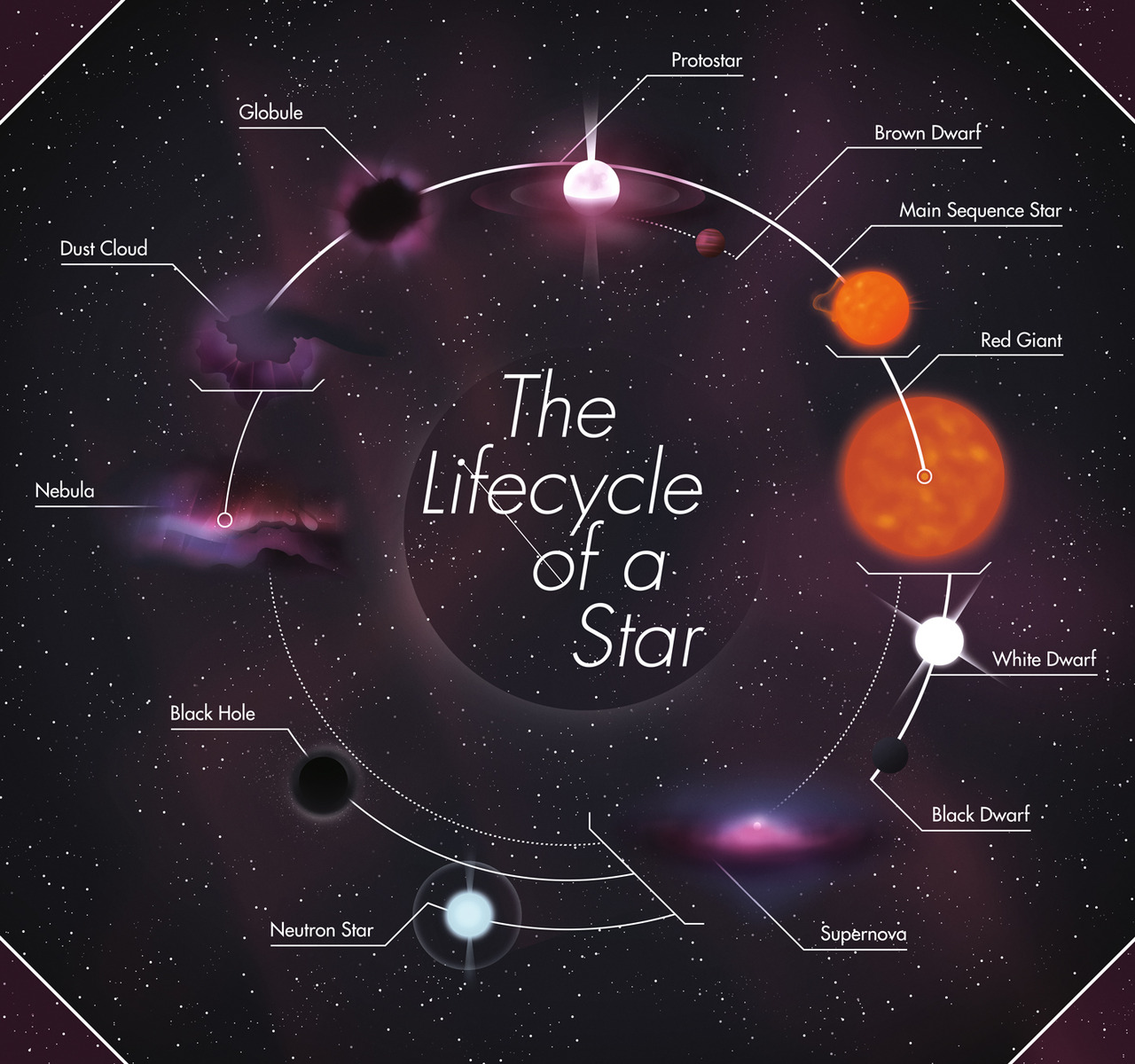
A dust cloud condenses to a globule. The increasing gravity in the globule leads to the formation of a protostar.
In the protostar the heat is produced by a reaction cycle known as Bethe-Weizsäcker cycle : https://sternentstehung.de/von-wasserstoff-zu-helium-der-cno-zyklus
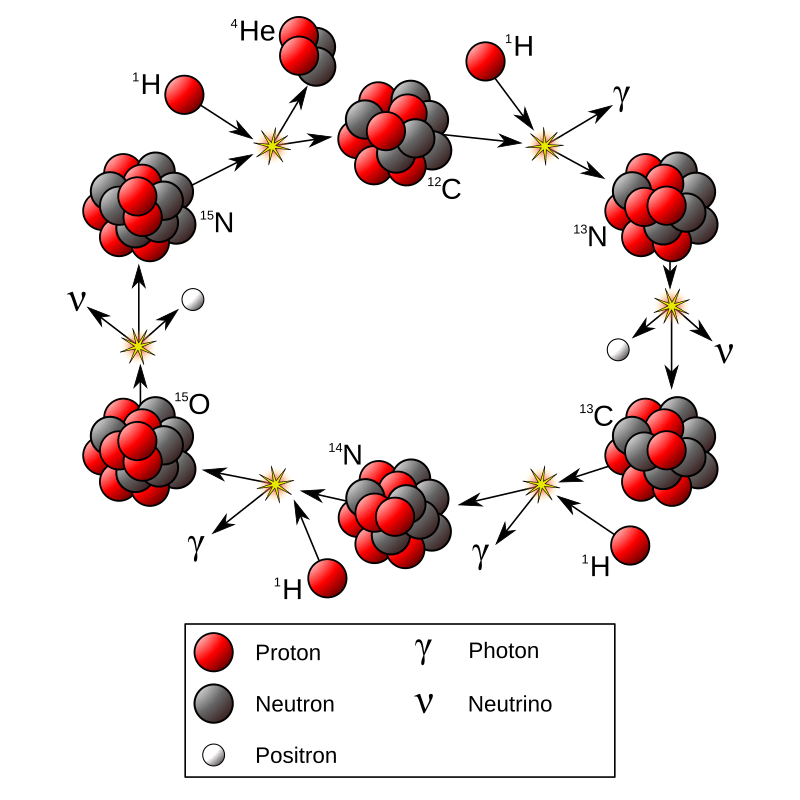
Image Wikimedia: Bethe Weizsäcker CNO Cycle.
Actually Einstein was opposed to the idea of black holes. “On a Stationary System With Spherical Symmetry Consisting of Many Gravitating Masses,” published in the Annals of Mathematics, Volume 40, Number 4, pages 922-936, in October 1939.(Reference to paper).
The formation of a Black Hole must not necessary be the result of gravity alone.
We tend to see the void or vacuum as a state of nothingness, lacking the inherent means to form any structures. This perspective may be holding us back. By now, the existence of virtual particles is widely accepted, yet these particles never seem to form lasting structures in space. However, it has not been widely considered under which conditions such a void, if it is large enough or meets certain inherent conditions, would eventually experience an event where a virtual particle turns into a real particle. If this were to happen, it could lead to a gigantic energetic event, like a colossal flash—a foaming of the void into instantly dispersed, lasting structures.
Fast radio bursts (FRBs) were observed close to the center of the nearest star formation region. [2]
Probably, some virtual particles act as catalysts. These would form before catalysing the transformation of virtual electrons into real particles.
The ideal state is the vacuum state. The structures we observe are disruptions of this ideal state. To return to this ideal state is the key driver of these dynamic, structure-forming cycles.
To summarize it: “fluid” dynamic processes create all observable structures (bodies) in the universe. All structures are part of a fluid-dynamic cycle of formation, decay, and reformation.
These types of fluid-dynamic, structure-forming processes are observable at various scales.
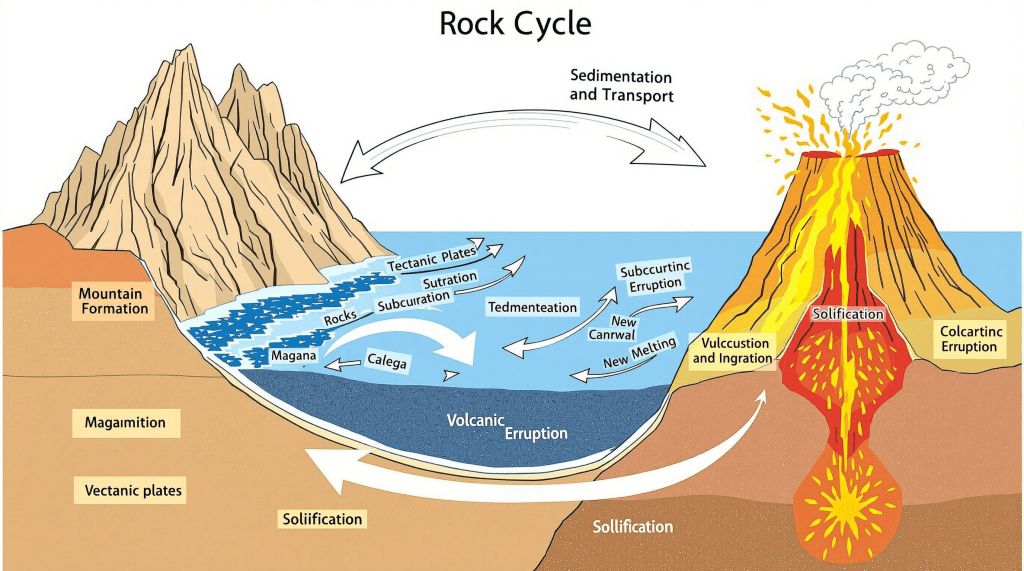
As an example, consider the formation of solids, such as rocks, on our planet. To paint it very simplistically: Seismic events like tectonic shifts enable the formation of mountains. Sedimentation by wind and water will eventually transport tiny rocks from the mountains to the sea. Tectonic movements will then transport these rocks below the Earth’s crust. There, the rocks will melt. With the next seismic event or volcanic eruption, this molten material will be returned to the surface, where it will form new solids, such as rocks, through cooling or high pressure. The cycle can then start again.
References:
[2] FRB 20250316A: A Brilliant and Nearby One-off Fast Radio Burst Localized to 13 pc Precision
The CHIME/FRB Collaboration:, Thomas C. Abbott, Daniel Amouyal, Bridget C. Andersen, Shion E. Andrew, Kevin Bandura, Mohit Bhardwaj, Kalyani Bhopi, Yash Bhusare, Charanjot Brar, Alice Cai, Tomas Cassanelli, Shami Chatterjee, Jean-François Cliche, Amanda M. Cook, Alice P. Curtin, Evan Davies-Velie, Matt Dobbs, Fengqiu Adam Dong, Yuxin Dong (董雨欣), Gwendolyn Eadie, Tarraneh Eftekhari, Wen-fai Fong, Emmanuel Fonseca, B. M. Gaensler, Nina Gusinskaia, Jason W. T. Hessels, Danté M. Hewitt, Jeff Huang, Naman Jain, Ronniy. C. Joseph, Lordrick Kahinga, Victoria M. Kaspi, Afrasiyab (Afrokk) Khan, Bikash Kharel, Adam E. Lanman, Magnus L’Argent, Mattias Lazda, Calvin Leung, Robert Main, Lluis Mas-Ribas, Kiyoshi W. Masui, Kyle McGregor, Ryan Mckinven, Juan Mena-Parra, Daniele Michilli, Nicole Mulyk, Mason Ng, Kenzie Nimmo, Ayush Pandhi, Swarali Shivraj Patil, Aaron B. Pearlman, Ue-Li Pen, Ziggy Pleunis, J. Xavier Prochaska, Masoud Rafiei-Ravandi, Scott M. Ransom, Gurman Sachdeva, Mawson W. Sammons, Ketan R. Sand, Paul Scholz, Vishwangi Shah, Kaitlyn Shin, Seth R. Siegel, Sunil Simha, Kendrick Smith, Ingrid Stairs, David C. Stenning, Haochen Wang, Thomas Boles, Ismaël Cognard, Tammo Jan Dijkema, Alexei V. Filippenko, Marcin P. Gawroński, Wolfgang Herrmann, Charles D. Kilpatrick, Franz Kirsten, Shawn Knabel, Omar S. Ould-Boukattine, Hadrien Paugnat, Weronika Puchalska, William Sheu, Aswin Suresh, Aaron Tohuvavohu, Tommaso Treu, and WeiKang Zheng
https://iopscience.iop.org/article/10.3847/2041-8213/adf62f
 Circular Astronomy