
-
Solving the Clay Millennium Problem 3D incompressible Navier–Stokes equations
Solving the Millennium Problem with AI is not new. Javier Gómez Serrano (Mathematician, Brown University) teamed up with the Google DeepMind team. Below, I propose a conceptual whitepaper—created with OpenAI ChatGPT—to address one of the Millennium Prize Problems. Introduction The Clay Millennium Problem on the 3D incompressible Navier–Stokes equations asks whether smooth solutions with smooth…
-
The Fastest Way to Understand Any Mathematical Function
Decode any math function in minutes: A Step-by-Step Framework powered by AI Example Navier-Stokes equation: Show an example of the output or outcome of this function? Example: 2D Vortex Flow Let’s consider a simple 2D example: a decaying vortex in a viscous fluid. This is a classic solution to the Navier-Stokes equations in two dimensions.…
-
Solar Activity Affects Earth’s Spin and Length of Day
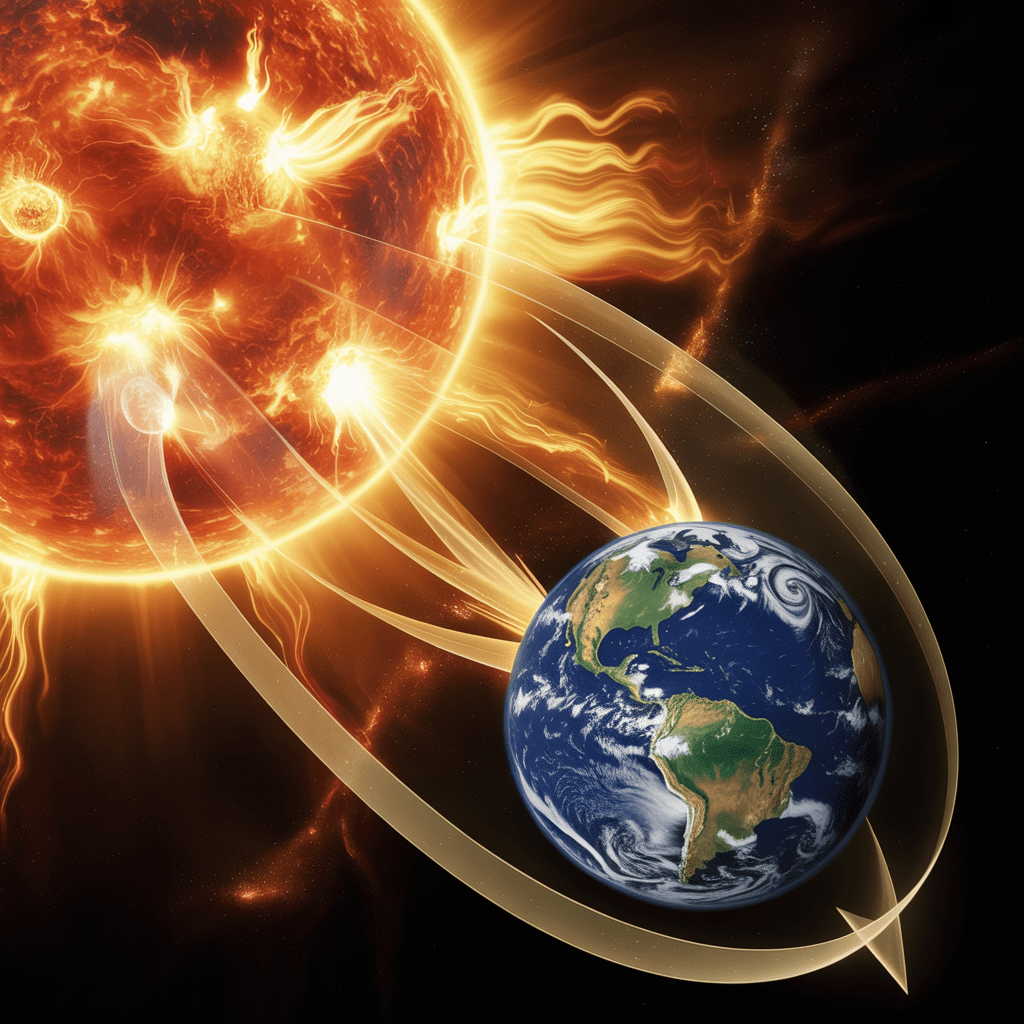
As always, post is in beta mode (work in progress) The solar wind impacts the shape and behavior of the objects in our solar system. See Reference: Sunlight puts asteroids in a spin and Sunlight makes asteroids spin in strange ways Does it also impact Earth’s spin? Created with the assitance of: https://storm.genie.stanford.edu/article/earth-spin-length-of-day-and-sun-activity-since-1995-1318710 Further reading:…
-
The Mysterious Discovery of JWST That No One Saw Coming

Are We Inside a Cosmic Whirlpool? Recent JWST Advanced Deep Extragalactic Survey (JADES) observations of mysterious cosmological anomalies in the rotational patterns of galaxies challenge our understanding of the universe and reveal surprising connections to natural growth patterns. The rotation of 263 galaxies has been studied by Lior Shamir of Kansas State University, with 158…
-
What are the Key Components of the Interstellar Mapping and Acceleration Probe (IMAP)
Livestream of the IMAP Assembly https://imap.princeton.edu/clean-room-video-feed The Interstellar Mapping and Acceleration Probe (IMAP) is a NASA mission designed to study the heliosphere and its interaction with the interstellar medium. The spacecraft comprises several key components: 1. Scientific Instruments: IMAP is equipped with ten specialized instruments to achieve its scientific objectives: Charged Particle-Sensing Instrument Installed on…
-
What Are The Primary Objectives of the NASA’s IMAP Mission in 2025?
The Interstellar Mapping and Acceleration Probe (IMAP) is a NASA heliophysics mission scheduled for launch on April 29, 2025. Falcon 9 will launch @NASA’s super cool Interstellar Mapping and Acceleration Probe (IMAP), which will help researchers better understand the boundary of the heliosphere, a magnetic barrier surrounding our solar system → https://t.co/HfQaFt4l6Y pic.twitter.com/ORKeuZc1bK — SpaceX…
-
Protoplanetary Disc Oph163131 – Surface Layers Lack Grains Larger than 1 µm
JWST imaging of edge-on protoplanetary disks. III. Drastic morphological transformation across the mid-infrared in Oph163131. Marion Villenave et. al. https://t.co/aMCnahCjLs pic.twitter.com/NZDlPOVrjK — AstroArxiv (@AstroArxiv) October 2, 2024 https://platform.twitter.com/widgets.js “The lack of sharp-edged structures in the extended patchy emission argues against the presence of shocks and suggests photoexcitation or stochastic heating of material smoothly flowing away…
-
Accretion Only Planet Formation Models will Slowly be Replaced by Hydrodynamic Hybrid Models…
“Our results demonstrate that even intermediate-mass protoplanets — less detectable, but more ubiquitous, than super-Jupiters — are capable of indirectly inducing large-scale spiral disk features, and underscore the importance of including radiation physics in efforts to reproduce observations.” Reference: Can gap-edge illumination excite spirals in protoplanetary disks? Three-temperature radiation hydrodynamics and NIR image modelling Dhruv…
-
Impact of Circumstellar Debris Disk on the Atmosphere of Exoplanet WASP-39b
Even faint debris disks can contaminate MIRI exoplanet spectra. WASP-39b is a gas giant exoplanet orbiting a G-type star, located about 700 light-years away in the constellation Virgo. It has a mass of approximately 0.28 times that of Jupiter and a radius 1.27 times that of Jupiter. The planet orbits its star every 4.1 days…
 Circular Astronomy