Log of insights:
| Date | Insight / Source | Used in / Will be used in |
| 13.01.2026 | https://www.eso.org/public/news/eso2601/ – Observation of dead star RXJ0528+2838 Simone Scaringi, associate professor at Durham University, UK and co-lead author of the study published today in Nature Astronomy. “Our observations reveal a powerful outflow that, according to our current understanding, shouldn’t be there,” says Krystian Iłkiewicz, a postdoctoral researcher at the Nicolaus Copernicus Astronomical Center in Warsaw, Poland and study co-lead. – | |
| 09.01.2026 | Colloquium: The Cosmic Dipole Anomaly – https://arxiv.org/abs/2505.23526 – Conclusion that the cosmic dipole anomaly poses a serious challenge to Friedmann-Lemaitre-Robertson-Walker (FLRW) cosmologies – Nathan Secrest, Sebastian von Hausegger, Mohamed Rameez, Roya Mohayaee, Subir Sarkar | https://circularastronomy.com/2026/01/09/unraveling-the-cosmic-dipole-anomaly-a-comprehensive-literature-review-of-challenges-to-the-cosmological-principle/ |
| 06.01.2026 | CP Violation: Precision measurements of CKM angle γ, charm mixing and CP violation – second publication more precise data – improved determination of the CKM angle γ with a precision of 2.6° – key for matter formation – maybe a catalyst still necessary – need to be verified – means: CP Violation is necessary but not sufficient | |
| 03.12.2025 | Solar System is travelling through the universe faster than current models predict. https://journals.aps.org/prl/abstract/10.1103/6z32-3zf4 The dipole in the number counts of distant radio galaxies is about 3.7 times stronger than what standard cosmology predicts – when you infer our motion from the distribution of radio galaxies , you get something like a 3–4× larger velocity | |
| 09.10.2025 | Gravity could arise from the entropic rearrangement of information: On the Quantum Mechanics of Entropic Forces https://journals.aps.org/prx/abstract/10.1103/y7sy-3by1 | |
| 29.09.2025 | Magnetic Field Flip of Black Hole https://www.smithsonianmag.com/smart-news/astronomers-watched-a-black-hole-unexpectedly-flip-its-magnetic-field-challenging-theoretical-models-180987397/#:~:text=In%202017%2C%20the%20black%20hole’s,less%20stable%20than%20previously%20thought. | |
| 31.08.2025 | FRB 20250316A: A Brilliant and Nearby One-off Fast Radio Burst Localized to 13 pc Precision – nearest star forming region https://iopscience.iop.org/article/10.3847/2041-8213/adf62f | Circular Astronomy (Draft) |
| 14.06.2025 | Scientists don’t know why the Earth is spinning faster than ever https://x.com/forallcurious/status/1931817713812607141?s=43 Paper: https://arxiv.org/abs/2404.06343 | |
| 20.05.2025 | “The interstellar medium (ISM) of our Galaxy is magnetized, compressible and turbulent, influencing many key ISM properties, such as star formation, cosmic-ray transport, and metal and phase mixing.” https://www.nature.com/articles/s41550-025-02551-5 | https://circularastronomy.wordpress.com/wp-admin/post.php?post=17&action=edit and https://circularastronomy.com/2024/06/06/what-einstein-newton-and-kepler-did-not-know-about-the-solar-system/ |
| 17.05.2025 | “protoplanetary disks are highly dynamic environments which exhibit a striking level of structure in their gas distributions” https://www.almaobservatory.org/en/press-releases/exoalma-survey-reveals-incredible-images-of-structures-in-protoplanetary-disks/ | https://circularastronomy.com/planet-and-comet-formation-process-in-convection-cell-rings/ |
| 17.05.2025 | Milky Way Central Molecular Zone (CMZ) near the galactic center: Star and likely planet formation (not explicit mentioned in research paper) in conditions that include strong magnetic fields, intense turbulence, elevated cosmic ray flux https://www.aanda.org/articles/aa/pdf/2025/05/aa53601-24.pdf Planet Formation mentioned in Post on X with Image https://x.com/explorecosmos_/status/1923407862539178121?s=43 | |
| 16.05.2025 | “Venusian basaltic crust cannot be thicker than 20–65 km without either causing delamination and crustal recycling or melting and producing volcanic eruptions.” https://www.nature.com/articles/s41467-025-58324-1 | |
| 15.05.2025 | Water ice in the debris disk around HD 181327 – “The icy bodies that release water ice in HD 181327 are probably the extra-solar counterparts of water-ice-rich Kuiper belt objects in our Solar System.” https://www.nature.com/articles/s41586-025-08920-4 | |
| 15.05.2025 | JWST discovers presence of hydrated minerals on Psyche. “Endogenous OH-bearing minerals would indicate a composition more similar to E-or P-class asteroids. If the hydration is endogenous, it supports the theory that Psyche originated beyond the snow line and later migrated to the outer main belt.” https://arxiv.org/abs/2407.12162 | |
| 14.05.2025 | oxygen in the most distant galaxy ever found, suggesting that early galaxies formed more rapidly than previously thought. https://www.aanda.org/articles/aa/full_html/2025/04/aa52451-24/aa52451-24.html | |
| 13.05.2025 | “interpretation of these observations is that large planets, likely similar in size and composition to Neptune or Saturn, form quickly, much faster than current theory would allow. “ | |
| 13.05.2025 | “Recent subarcsecond resolution surveys of the dust continuum emission from nearby protoplanetary disks show a strong correlation between the sizes and luminosities of the disks.” https://scholar.google.com/scholar?hl=en&as_sdt=0%2C5&q=protoplanetary+disk+size-mass+discrepancy&btnG=#d=gs_qabs&t=1747076257800&u=%23p%3DrIaU2wUOv3oJ | To use in: Planet and Comet Formation |
| 12.05.2025 | Vesta’s interior structure is more uniform than previously thought and not a protoplanet because it lacks a core: https://msutoday.msu.edu/news/2025/new-research-shatters-long-held-beliefs-about-asteroid-vesta | To use in: Planet and Comet Formation |
| 11.05.2025 | “protoplanetary disk size-mass discrepancy.” @almaobs revealed that more massive stars possess larger protoplanetary disks, yet these disks dissipate faster than those around less massive stars, => Paradox for Accretion model (Gravity) https://x.com/explorecosmos_/status/1918989878936625521?s=43 | https://circularastronomy.com/accretion-vs-convection-cell-formation-of-bodies-in-space/ |
| 11.05.2025 | TOI-421 b detection of a hydrogen-rich atmosphere, resembling the composition of its host star https://x.com/explorecosmos_/status/1919604638111748317?s=43 | To use in: Planet and Comet Formation – Stars and Planets form at the same time |
| 10.05.2025 | Size of exoplanets correlates with the shape of their orbits. https://www.pnas.org/doi/abs/10.1073/pnas.2405295122 | https://circularastronomy.com/planet-and-comet-formation-process-in-convection-cell-rings/ |
| 21.12.2024 | This diversity suggests varied origins and evolutionary paths, indicating that Centaurs are a dynamic and transitional group rather than a homogeneous population. https://x.com/ExploreCosmos_/status/1869759481036308551 | https://circularastronomy.com/planet-and-comet-formation-process-in-convection-cell-rings/ |
| 3.10.2024 | “We found that J0524-0336 contains 100,000 times more lithium than the Sun does at its current age,” said Ezzeddine. “This amount challenges the prevailing models of how stars evolve and may suggest a previously unknown mechanism for lithium production or retention in stars.” https://news.clas.ufl.edu/newly-discovered-star-could-provide-new-insights-into-the-evolution-of-stars/ | |
| 3.10.2024 | New link between water and planet formation: https://www.almaobservatory.org/en/press-releases/astronomers-reveal-a-new-link-between-water-and-planet-formation/ | |
| 2.10.2024 | More Water in Planets Than Expected: The interior as the dominant water reservoir in super-Earths and sub-Neptunes https://www.nature.com/articles/s41550-024-02347-z | |
| 30.09.2024 | Challenges for Giant Impact Moon Formation: https://www.pnas.org/doi/abs/10.1073/pnas.1809060115 Used in Post: Planet and Comet Formation Processes | https://circularastronomy.com/planet-and-comet-formation-process-in-convection-cell-rings/ |
| 22.04.2024 | “solar system is “squashed” or “dented”– that the bubble carved into interstellar space by the solar wind is not perfectly round” Voyager Project Scientist Edward Stone of the California Institute of Technology, Pasadena, Calif. boundary layer interstellar space: “solar wind termination shock, where the solar wind is abruptly slowed by pressure from the gas and magnetic field in interstellar space.” “the shock “sloshes” back and forth like surf on a beach” “In a normal shock wave, fast-moving material slows down and forms a denser, hotter region as it encounters an obstacle. However, Voyager 2 found a much lower temperature beyond the shock than was predicted. This probably indicates that the energy is being transferred to cosmic ray particles that were accelerated to high speeds at the shock.” Eric Christian, Voyager Program Scientist at NASA Headquarters, Washington.https://science.nasa.gov/missions/voyager-program/voyager-2-proves-solar-system-is-squashed/ | |
| 19.04.2024 | Brightest Gamma Ray Burst (GRB – BOAT – brightes of all times) – did not produce heaviest element WST detection of a supernova associated with GRB 221009A without an r-process signature https://www.nature.com/articles/s41550-024-02237-4 | |
| 12.04.2024 | 2nd Kuiper Belt – New Horizons spacecraft – Chief scientist Alan Stern – more dust at greater distances from the sun than expected https://earthsky.org/space/new-horizons-pluto-spacecraft-2nd-kuiper-belt/ Used in Post: Planet and Comet Formation Processes | Convection vs. Accretion https://circularastronomy.com/planet-and-comet-formation-process-in-convection-cell-rings/ |
| 19.02.2024 | “Detailed modelling shows the stellar population formed around 1.5 billion years earlier in time (z ~ 11) at an epoch when dark matter halos of sufficient hosting mass have not yet assembled in the standard scenario[4, 5]” Glazebrook, K., Nanayakkara, T., Schreiber, C. et al. A massive galaxy that formed its stars at z ~ 11. Nature (2024). https://doi.org/10.1038/s41586-024-07191-9 | |
| 15.12.2023 | Bennu Sample: Head-Scratcher: magnesium, sodium and phosphate — a combination rarely if ever seen in meteorites – Two out of three scientific explanations will point to fluid dynamic formation processes for Bennu https://www.nature.com/articles/d41586-023-03978-4 Used in Post: Planet and Comet Formation Processes | Convection vs. Accretion / Solar System Formation and https://circularastronomy.com/planet-and-comet-formation-process-in-convection-cell-rings/ |
| 3.12.2023 | “These disks pull together dust grains that grow into pebbles and eventually combine to form a solid planetary core. Once the core is formed, the planet can gravitationally pull in the solid dust, as well as surrounding gas such as hydrogen and helium. But it needs a lot of mass and materials to do this successfully. This way to form planets is called core accretion.” BUT: “A star as low mass as LHS 3154, nine times less massive than the sun, should have a correspondingly low-mass planet forming disk.” “A different planet formation theory, gravitational instability—where gas and dust in the disk undergo a direct collapse to form a planet—also struggles to explain the formation of such a planet without a very massive disk.” Massive planet too big for its own sun pushes astronomers to rethink exoplanet formation | Convection vs. Accretion / Solar System Formation |
| 8.11.2023 | Wind Tunnel Experiments Challenge Turbulence Theory – power law prediction not correct – “new data showed that in the inertial range ζ2 𝜁2 is not independent of r. Rather, it has a clear logarithmic dependence on r for separations spanning up to two orders of magnitude.” ….”logarithmic dependance is independent of the Reynolds number, except for the fact that it occurs over an increasing range of separations as the Reynolds number is increased” https://physics.aps.org/articles/v16/123 | Using State of the Art of Problem Solving for the Navier Stokes Equation https://circularastronomy.com/ 2023/10/29/using-state-of- the-art-problem-solving-for -the-navier-stokes-equations/ |
| 24.09.2023 | OSIRIS-Rex: Asteroid Bennu sample landed – more on October 11 th https://edition.cnn.com/2023/09/24/world/osiris-rex-asteroid-sample-return-scn/index.html | Solar System Formation |
| 22.09.2023 | Saturn and its Satellite Moons are same age – based on chronology of impacts https://www.universetoday.com/ 163104/whether-saturns-rings-are-young-or-old-its-moons-are-as-ancient-as-the-planet-itself/ | |
| 17.09.2023 | HH 211 – bow shocks – supersonic outflow – 48-60 miles per second (80 to 100 kilometers per second) https://webbtelescope.org/contents/ news-releases/2023/news-2023-141 | |
| 21.06.2023 | Earth shaped by primordial H2 atmospheres https://www.nature.com/articles/ s41586-023-05823-0 | |
| 04.06.2023 | Gravitational Pair Production and Black Hole Evaporation https://journals.aps.org/prl/ abstract/10.1103/ PhysRevLett.130.221502 – (Event Horizon not a necessity) – Schwinger Effect- Real Particles (Positron,Electron) can form in a vacuum at an electric field strength of around 10(18) V/m – explore boundary layers in vaccuum?, catalyst effects to produce real particles below 10(18) V/m ? – other pair productions … | Accretion vs. Convection https://wordpress.com/page/circularastronomy.com/17 |
| 17.5.2023 | Black Hole Has Major Flare (of X-Ray outwards!) https://www.jpl.nasa.gov/news/black-hole-has-major-flare | |
| 15.5.2023 | Formalhaut: Three Dust rings, but no planets between the rings. ” Spatially resolved imaging of the inner Fomalhaut disk using JWST/MIRI” https://www.nature.com/articles/ s41550-023-01962-6 Used in Post: Planet and Comet Formation Processes | Planet and Comet Formation Processes in Convection Cell Rings |
| 28.04.2023 | Hubble 2 Values Discrepancy: A 0.9% calibration of the Galactic Cepheid luminosity scale based on Gaia DR3 data of open clusters and Cepheids⋆https://www.aanda.org/articles/aa/ full_html/2023/04/ aa44775-22/aa44775-22.html | |
| 9.3.2023 | Jupiter: plasma disc more variable and structured than previously thought https://agupubs.onlinelibrary.wiley.com/ doi/10.1029/2022JE007637 | |
| 8.3.2023 | Ryugu: Soluble organic molecules, https://www.science.org/doi/10.1126/ science.abn9033 – (mild temperatures during formation) | |
| 7.3.2023 | Primarily due to the solar wind ions, generating intense electric fields inside the cavities on airless planetary bodies https://agupubs.onlinelibrary.wiley.com/ doi/10.1029/2022JE007589 | |
| 5.3.2023 | Dark Energy Survey – less clumpy than expected by standard cosmological model https://journals.aps.org/prd/abstract/ 10.1103/PhysRevD.107.023531 | |
| 4.3.2023 | Venus: Lithosphere more flexible than previously assumed, Coronae area of heat flow (cooling of Venus) https://www.jpl.nasa.gov/news/study-finds-venus-squishy-outer-shell-may-be-resurfacing-the-planet | |
| 3.3.2023 | “The far- and nearsides of the Moon are geologically different.” More maria on the nearside (facing earth) than farside. Also maria on farside are smaller. “temperature of the nearside crust and upper mantle was hotter than that of the farside at the time of basin formation” https://www.science.org/doi/10.1126/ science.1243224 | |
| 2.3.2023 | Double Asteroid Redirection Test (DART) – approximately 7 minutes was expected – 33.0 ± 1.0 (3𝜎) minutes was measured (4.71 to 1) https://www.nature.com/articles/ s41586-023-05805-2 | |
| 1.3.2023 | Cloud formation process on Mars similar to Earth. Cellular patterns and dry convection in textured dust storms. https://www.sciencedirect.com/science/ article/pii/S0019103522002846 | |
| 28.2.2023 | anisotropically-distinctive innermost inner core (size 650 km) of earth discovered by stacking waveforms recorded by a growing number of global seismic stations. “As the IC (inner core) grows, the latent heat and light elements released by the solidification process drive the convection of the liquid outer core” and thus the geodynamo. Nature Communication: https://www.nature.com/articles/ s41467-023-36074-2 | |
| 27.2.2023 | Convection of high- and low-salinity water in Badwater Basin in Death Valley, California form polygon salt ridges – formation ist independent of local differences in geology, salt chemistry, and environmental conditions. Physics Journal: https://physics.aps.org/articles/v16/31 | |
| 26.2.2023 | TOI-5205b transiting Jovian planet orbiting a small solar metallicity M4V star. TOI-5205b has one of the highest mass ratios for M-dwarf planets. Challenge to conventional theories of gas planet formation. The Astronomical Journals: https://iopscience.iop.org/article/ 10.3847/1538-3881/acabce | …will be used in accretion vs. convectin cell formation… |
| 24.2.2023 | Giant baby (600 MYR after Big Bang) galaxies discovered by JWST- (still awaiting final confirmation) Published in Nature: https://www.nature.com/articles/s41586-023-05786-2 | |
| 22.2.2023 | dwarf planet Quaoar has a ring outside of Roche limit https://earthsky.org/space/dwarf-planet-quaoar-has-a-ring/ | |
Book:
Hans Rickman: Origin and Evolution of Comets:Ten Years after the Nice Model and One Year after Rosetta (Advances in Planetary Science Book 2)
“A component of particular interest hosts the so-called calcium-aluminum-rich inclusions or CAIs (Sec. 2.6.2). These have a common age (4 567 Myr) that exceeds all other ages of solar system materials, so their formation is taken as the marker of the origin of the solar system. The whole-rock ages of the chondrites containing the CAIs are typically”
“Most of the short-lived radioisotopes that existed in the infant solar system can be explained either as products of stellar nucleosynthesis in the Galactic disk at relatively large distances, which is continuously ongoing, or as results of the corpuscular irradiation of the solar nebula by the solar wind, which was very strong when the Sun was formed.”
“An unexpected result is a strong heterogeneity of the olivine and pyroxene compositions between individual grains,”while Hartley 2 may rather be referred to the Scattered Disk (see Sec. 1.4), the difference in D/H ratio might reflect a difference in formation conditions at different distances from the Sun — a fundamental issue when discussing comet origins.” which indicates very different formation conditions.”
“CAI stands for Calcium–Aluminum-rich Inclusions. These occur in many chondritic meteorites and consist of minerals with extremely high condensation temperatures, often involving calcium and aluminum.”
“The most prominent of these are C2, C3 and CN, each shining in its particular wavelength bands. The so-called Swan bands of C2 are often dominant.”
“Oversimplification of the dynamical model used is extremely risky, as was seen during the ESA/Giotto flyby of comet 1P/Halley in 1986, when the spacecraft was hit by a grain far too large (its mass was ∼1 g) to be compatible with the advance predictions. “
“The DWR (dust/water ratio) would be ≃6, but Rosetta/ROSINA data for CO and CO2 had shown these molecules to contribute ∼50% in mass relative to H2O (Hässig et al. 2015).” Comets are now called dirt/dust balls with ice.
Book:
Asteroids: Astronomical and Geological Bodies (Cambridge Planetary Science Book 17) (English Edition)” von Thomas H. Burbine
“These spectral observations of asteroids showed that these bodies have a wide variety of surface mineralogies and experienced a wide range of heating.”
“Meteorites were found to range from those that melted (e.g., irons, stony-irons, achondrites) to those that experienced minimal heating (e.g., ordinary chondrites, carbonaceous chondrites, enstatite chondrites).”
Modeling a Carrington-scale Stellar Superflare and Coronal Mass Ejection from κ
1Cet
Book (Kindle):
“Comets And Their Origin: The Tools To Decipher A Comet (English Edition)” von Uwe Meierhenrich
“One lesson that needs to be kept in mind from previous missions to comets is that every comet has yielded surprises that upset one or another of our conceptual understandings of comets. Rosetta should be no exception to this pattern. We cannot predict whether the surprises will be in chemical composition, in nuclear structure, in nuclear topography and surface processes, or in coma flow properties.”
“The 95P/Chiron comet, which has an estimated diameter of 200 km, seems to be exceptional in terms of its age and orbit”
“one example is the formation of surface craters through internal explosions that are similar to steam-explosion craters on Earth called maars [15]. Crystallization of amorphous ice at depths of a few tens of meters [16] might also release heat that triggers cometary outbursts”
“closer examination reveals that the cometary tail is composed of two morphologically different tails (see Figure 1.3), a thin long tail (type I tail), which is the plasma tail, and a diffuse curved tail (type II tail), which is the dust tail. The two tails point in two different directions, and it is now known that both tails do not point exactly in the antisolar direction.”
“Forces other than gravity determine the behavior of these particles; in particular, solar radiation pressure is known to generate a significant interaction with the dust particles. The solar radiation pressure force originates from the interaction of electromagnetic radiation (the sunlight) with matter and describes the momentum transfer from the radiation field, or photon stream, to the scattering and absorbing dust [19].”
“The temperature at which comets formed is assumed to be greater than 25 K because highly volatile species such as helium and the other noble gases, along with molecular nitrogen, methane, and carbon monoxide, exhibit very low abundances [8].”
“The IKS-determined temperature of the nuclear surface was measured to be 300–400 K [60], which is much greater than previously thought [53]. Other references suggest a surface temperature of ∼330 K [1]. This temperature was also much greater than the expected 215 K, which is necessary to sublimate water ice [18].”
“The apparently contradictory presence of ice in the cometary nucleus and the comet’s high surface temperature can be explained by the assumption that the nucleus is covered by a thin insulating layer [60] (or mantle) of a black, porous, refractory substance with a thickness of ∼1 cm.”
“some comets are thought to have heated their interior through radioactive decay processes, which are primarily due to the short-lived radioisotope 26Al.“
“The detection of the PAH anthracene was thus reported. In 2004, this technique was applied to the three peaks at 371, 376, and 382 nm to suggest a tentative detection of the PAH pyrene in the coma of comet Halley [68].”
“In 2006, microscopic and X-ray analyses of Stardust’s impacted dust particles (Figures 1.28 and 1.29) demonstrated, somewhat surprisingly, that the impacted particles were not exclusively interstellar grains of submicron size. Abundant high-temperature minerals, such as forsterite (Mg2SiO4), which has a condensation temperature of 1400 K, enstatite (MgSiO3), and calcium- and aluminum-rich inclusions (CAIs), were identified in the impacted cometary particles; such materials must have formed in the hot and innermost regions of the solar nebula, well inside the orbit of Mercury [132]”
“In summary, the data obtained by DS1 provided unique information about the surface of comet Borrelly’s nucleus, which is hot, dry, and extremely dark.”
“A cometary nucleus can be characterized as an asymmetric, kilometer-sized solid object with an irregular tar-type crust that contains dirty ices in a porous matrix of refractory material and that rotates toward the Sun.”
“contradicts the Whipple theory of how comets are made: that they consist of dust particles held together by ice [50]”
“Its spectacular and unexpected data revealed that cometary particles contain not only hydrogen (with its isotopes, deuterium and tritium) and oxygen but also carbon and nitrogen atoms. One of the significant surprises of the Halley encounters was the detection of large amounts of carbonaceous dust that was rich in H, C, O, and N, the so-called CHON particles [1].”
“Giotto’s measurement of the geometric albedo p of the cometary surface was a tremendous scientific surprise. Estimations for p varied; some values were as high as p = 0.6 [18].12 Giotto observed that the surface of 1P/Halley’s nucleus is dark and exhibits a very low geometric albedo of p = 0.04, thereby indicating that the comet’s nucleus at full phase has about one-third the reflectivity of the moon [10, 98]. The albedo value is one of the lowest of all known objects in the Solar System [98]: only some C-type asteroids and Saturn’s moon Iapetus exhibit smaller values as low as p = 0.01 [102]. Keller et al. [98] concluded that most of the surface of the nucleus of comet 1P/Halley must be covered by a nonvolatile insulating crust of dark material that traps light in tiny cavities between fluffy dust particles because of its high porosity. The temperature of the crust must become much hotter than the equilibrium temperature for the sublimation of water ice [98]. Keller et al. [10] suggests that the crust or mantle is more than several centimeters thick.”
“The volume of 1P/Halley’s nucleus was determined to be 420 km3, and its density was determined to have the quite low value of 0.55 ± 0.25 g cm−3, perhaps only 0.2 g cm−3 [10]. Comets are thus the lowest density bodies in the Solar System.”
“Britt believes that the spherical shape of the nucleus of comet Wild 2 and its impact-cratered surface hint at its direct formation from the dust and gas of the presolar disk. Wild 2 lacks major structural discontinuities and heterogeneities, suggesting that it did not form from the juxtaposition of large blocks of physically dissimilar materials acquired either by the accretion of various planetesimals or by extensive collisional processing [15].”
“The surprising and most prominent signal in the positive-ion spectra at m/z = 90 was more difficult to understand. Kissel et al. proposed that the C6NH+ ion originated from methylpyridine-like alicyclic structures.”
“The CIDA mass spectra of Wild 2 dust grains are similar to the spectra obtained from comet 1P/Halley, thereby indicating that the two comets have similar chemistry even though they have different ages [113].”
“Sophisticated laboratory analyses of returned dust particle samples from Wild 2 revealed that many of the silicate grains are high-temperature minerals that formed in the inner regions of the solar nebula; this result considerably modified our understanding of the formation of comets [132].”
“The Deep Impact data indicated that the nucleus of 9P/Tempel provided signs of past geological activity; it is much more than a primordial “dirty snowball” [146]”
“FTIR studies confirmed the presence of crystalline silicates in the Wild 2 samples, thereby indicating that this comet is a mixture of presolar and Solar System materials [140]”
“quantified the hydrogen and deuterium isotopes in five dust particles captured by Stardust. The D/H values obtained were reported to range from typical terrestrial values up to moderate D/H enhancements of approximately three times the D/H value of mean ocean water. The D enrichments were associated with carbon, and it is important to note that these enrichments might have been modified during impact and cannot be ascribed to Wild 2 water”
“particles captured by Wild 2 performed by Zolensky et al. revealed the presence of primarily silicates [129, 130], such as olivine [(Mg,Fe)2SiO4], and low-Ca pyroxene [(Mg,Fe)SiO3] and also ubiquitous Fe-Ni sulfides, including troilite (FeS) [130] and Fe-Ni metal; these compounds require a wide range of formation conditions [137]. In agreement with the data provided by Brownlee et al. [132], these data strongly support the formation of mineral cometary constituents at very different locations in the protoplanetary disk [137]”
“Michael F. A’Hearn from the University of Maryland concluded from the Stardust data that even more extensive and earlier mixing of the material took place in the disk in which the planets of the Solar System formed [36]”
“inner Solar System materials – which account for ∼10% of the comet’s mass – must have been transported beyond the orbit of Neptune, either by ballistic transport above the nebular midplane or by turbulent transport in the midplane [132]”
“Interestingly, these authors found that the abundance ratio of ethane relative to water increased after impact by a factor of 1.8, whereas the abundance ratios for methanol and hydrogen cyanide remained unchanged. The data hint at the possibility that the nucleus of 9P/Tempel is inhomogeneous in its composition [154].”
“Fe-rich fayalite were found to be the dominant olivine species in a 3.9 abundance-ratio-by-mole fraction, suggesting that the temperature for the incorporation of olivine into the comet was between 1100 and 1400 K [153].”
“The presence of high-temperature crystalline silicates (olivines) was surprising and requires thermal heating of material near the young Sun, where temperatures >1000 K were reached only inside the present orbit of Mercury [153].”
“Furthermore, Zolensky and coworkers point to the fact that the mineralogy reported by Lisse et al. for comet 9P/Tempel is in clear contrast with the lack of aqueous alteration products in Wild 2 that was demonstrated by the Stardust mission [137]. This mineralogical difference could be due to differences in the geological histories of Jupiter-family comets [137].”
“Moreover, Sugita and colleagues [156] found that the high mass ratio of crystalline silicates compared with amorphous silicates demonstrates that comet 9P/Tempel, which is a Jupiter-family comet, contains many high-temperature components of the solar nebula, similar to Oort-cloud comets.”
Küppers, Keller, and colleagues [155] concluded that the dust/ice mass ratio is most likely >1, thereby suggesting that comets are “icy dirtballs” rather than “dirty snowballs,” as is commonly believed [148]”
“In 2010, prior to EPOXI’s 103P/Hartley observations, Belton [176] proposed a remarkable possible scenario for the long-term evolution of cometary surfaces near the Sun. This scenario suggested an evolutionary sequence by which Jupiter-family comets might evolve from a Wild 2-type morphology to a Tempel 1-type morphology and, finally, to a Hartley 2-type morphology [175].”
“the authors argue that the first class of particles, olivine IDPs, originate from comets captured from eccentric orbits; the second class of particles, pyroxene IDPs, originate from comets with prograde orbits; and the third class of particles, hydrous layer and lattice silicate IDPs, originate from asteroids.”
“These claims about successive and stepwise comet formation are in agreement with observations of comet splitting, such as comet West, which split into four fragments in March 1976, thereby indicating that the building blocks, the cometesimals, may not be tightly bound together [9].”
“addition, data from the Deep Impact mission regarding the dust composition of comet Tempel 1 (see Section 1.8) revealed a great heterogeneity, which is consistent with the idea that the nucleus is made of cometesimals (smaller chunks) with differing compositions [37].”
“A’Hearn [37] proposed extensive radial mixing of cometesimals in the outer parts of the early Solar System rather than formation of cometary nuclei from cometesimals that condensed at a uniform distance from the proto-Sun, thereby making it difficult to determine a precise location for the formation of comets.”
“In ortho-water, the nuclei of the two hydrogen atoms have the same spin, whereas in para-water, the two hydrogen atoms have different spins”
“The temperature Tspin is assumed to depend on the temperature during formation of the water molecule.”
“the cometary Tspin values vary from 20 to 60 K and cluster at ∼30 K [91].”
“Observations by Rodgers et al. [122] of the HNC and HCN abundances in the coma of comet C/2002 C1 (Ikeya–Zhang) as a function of its heliocentric distance demonstrated that the recorded amounts of HNC cannot be synthesized in the cometary coma by chemical reactions, thus suggesting degradation of complex organic material as the source of HNC in cometary comae instead.”
“By observing comet Ikeya (1963a), Stawikowski and Greenstein [134] recorded intensities of the emission lines of the Swan bands 12C2 and 12C13C to calculate the 12C/13C ratio; they found a value of 70 ± 15. On the Earth, this ratio is ∼90. Stawikowski and Greenstein thus concluded that cometary material could have come from the same region of the solar nebula as did the Earth or from interstellar matter.”
“13CN rotational lines in the R-branch, which is located in the visible (violet) spectral range. The authors determined a 12C/13C ratio of 65 ± 9. Later, however, the validity of these data was called into question [138], and values of 95 ± 12 were reported for the rotational lines in the R-branch [139]”
“The 12C/13C ratio was found to be 111 ± 12 for HCN, which is consistent with the Solar System values [140]. The authors point to the fact that the interstellar medium exhibits, according to investigations by Wilson and Rood [141], a 12C/13C isotope ratio of 77 ± 7; thus, an interstellar origin for comet Hale-Bopp was excluded by Jewitt et al. [140].”
“Hawaiian JCMT study of comet Hale-Bopp, Jewitt et al. [140] moreover distinguished the nitrogen isotopes 14N and 15N in hydrogen cyanide, HCN. For the determination of the ratio, the area of a different hyperfine component line for HC15N at 344.2003 GHz was quantified; this measurement yielded an HC14N/HC15N ratio of 323 ± 46. According to the authors, this value suggests a Solar System origin, the ratio of which is given in the literature as 270 [144] or 272 for atmospheric nitrogen [133]; however, the identified value was also consistent with the interstellar medium, which has 14N/15N ≈ 460 ± 100 [145].”
“For all comets, regardless of their origin or heliocentric distance, a remarkably constant 14N/15N value of 147.8 ± 5.7 was recorded. The authors indicated that this finding supports fractionation in the early Solar System and a common origin for comets.”
“The low 14N/15N ratios in HCN and the CN and NH2 radicals, however, suggest fractionation in the early Solar System and a common origin for the comets.”
“According to the Vienna Standard Mean Ocean Water (VSMOW), terrestrial water exhibits a strict and stable deuterium-to-hydrogen (D/H) ratio of 1.558·10−4, with an error of 0.001·10−4. The VSMOW 18O/16O ratio is 2.01·10−3.”
“In six Oort cloud comets, including C/1996 B2 (Hyakutake) and C/1995 O1 (Hale-Bopp) [4], the D/H ratio has been determined to have the relatively high value of (2.96 ± 0.25)·10−4. This value is twice the value of terrestrial water.”
“Carbonaceous chondrites with asteroid parent bodies have been observed to have the low D/H ratio of (1.4 ± 0.1)·10−4.”
“comet 103P/Hartley 2 “…”Jupiter-family comet that is believed to originate from the Kuiper belt.” … “Difficulties in explaining the low D/H ratio in the water vapor of comet 103P/Hartley remain. One possible explanation includes large-scale mixing of material between the inner and outer Solar System [7], which is expressed by radial mixing of comets and asteroids that originated in different regions [8].”
“Mumma and Charnley note that isotopic exchange with H2 in the turbulent nebula would predict low D/H ratios for comets formed close to the orbit of Jupiter and higher D/H ratios for comets formed outside the turbulent solar nebula beyond 17 AU.”
“Surprisingly, proteins in all living organisms of all domains of life on Earth exclusively use l-amino acids (!) for their molecular architecture [1]”
“Why and how was the balance tipped to the left? Very recently, this phenomenon was classified in the journal Nature as one of the five most difficult tasks to decipher that remain unsolved in the natural sciences [3]”
“Since 1986 and the Giotto encounter with comet 1P/Halley [38, 58, 59], and in particular because of the Deep Impact mission to comet 9P/Tempel 1 [27], it became known that cometary nuclei were neither symmetric nor homogeneous in their composition”
“Observations performed by the Keck-2 telescope in the near-infrared indicated that the emission profiles of organic molecules such as ethane, methanol, and HCN vary, which suggests that the cometary nucleus is inhomogeneous in its chemical composition [16]”
“Küppers, Keller, and colleagues [19] concluded that the dust/water mass ratio of 9P/Tempel was much greater than 1, which suggests that comets are “icy dirtballs” [18] rather than “dirty snowballs”, as suggested by Whipple in 1950 [20, 21]”
“Asteroids can generally be considered remnants of a planet or planets that never formed; they are not the debris from an exploded planet [23].”
The Second Kind of Impossible: The Extraordinary Quest for a New Form of Matter Paul J. Steinhardt
“The relative percentages on Earth are determined by the history of the planet and the exposure of its minerals to cosmic rays and radioactivity. Other planets, like Mars, have had different evolutionary histories and their minerals have been exposed to different levels of cosmic rays and radioactivity. So minerals from Mars contain percentages of the three oxygen isotopes that are different from those found on Earth. The same applies for minerals formed on other planets and on different types of asteroids.”
“Ed had spent his career studying both natural and man-made materials. Working on JPL’s Mars Exploration Rover mission, he had discovered remarkable similarities between a rock on the Martian surface and a rare rock sample found on Earth.”
“logical explanation was that the metal solidified ultra-rapidly, before it could react with the oxygen bonded to the silicate. Ultra-rapid cooling would also explain the oddly contorted shapes. Yet rapid cooling at such a high rate would not normally occur as part of any natural process on the surface of the Earth or in an ordinary laboratory.”
“We knew from standard tables used by engineers and geoscientists that the cooling silicates would have been the first to crystallize, at about 1500° C. The copper-aluminum alloys would have crystallized later, at about 1000°”
“I would need to find conditions where aluminum could easily separate from oxygen. It would require ultra-high pressures, which can be found three thousand kilometers below the surface of the Earth near the core-mantle boundary.”
“And when it comes to science, the simplest explanation is usually the best.”
“David Nelson on rapidly cooled liquids.”
“The same applies to rapidly cooled solids, which scientists call glassy or amorphous.”
“The diffraction pattern of a quasicrystal would be composed of absolutely perfect pinpoints arranged in a snowflake pattern.”
Modeling a Carrington-scale Stellar Superflare and Coronal Mass Ejection from κ
1Cet
Benjamin J. Lynch, 1 Vladimir S. Airapetian, 2, 3 C. Richard DeVore, 2 Maria D. Kazachenko,4 Teresa Luftinger, ¨5 Oleg Kochukhov, 6 Lisa Rosen, ´6 and William P. Abbett1
Click to access 1906.03189.pdf
Page 1: “The cumulative effects of both steady-state and extreme space
weather from active stars, including intense X-ray and extreme ultraviolet (EUV) radiation, large fluxes of highly energetic particles, and frequent exoplanet interactions with stellar coronal mass ejections (CMEs), will have a significant impact on the exoplanets’ atmospheric evolution, and ultimately on their habitability “(Lammer
et al. 2007, 2009; Drake et al. 2013; Osten & Wolk 2015;
Kay et al. 2016; Airapetian et al. 2019b).
Page 2: “younger stars exhibit greater maximum flare energies and higher flare
frequencies” (Maehara et al. 2012; Notsu et al. 2013, 2019; Shibayama et al. 2013).
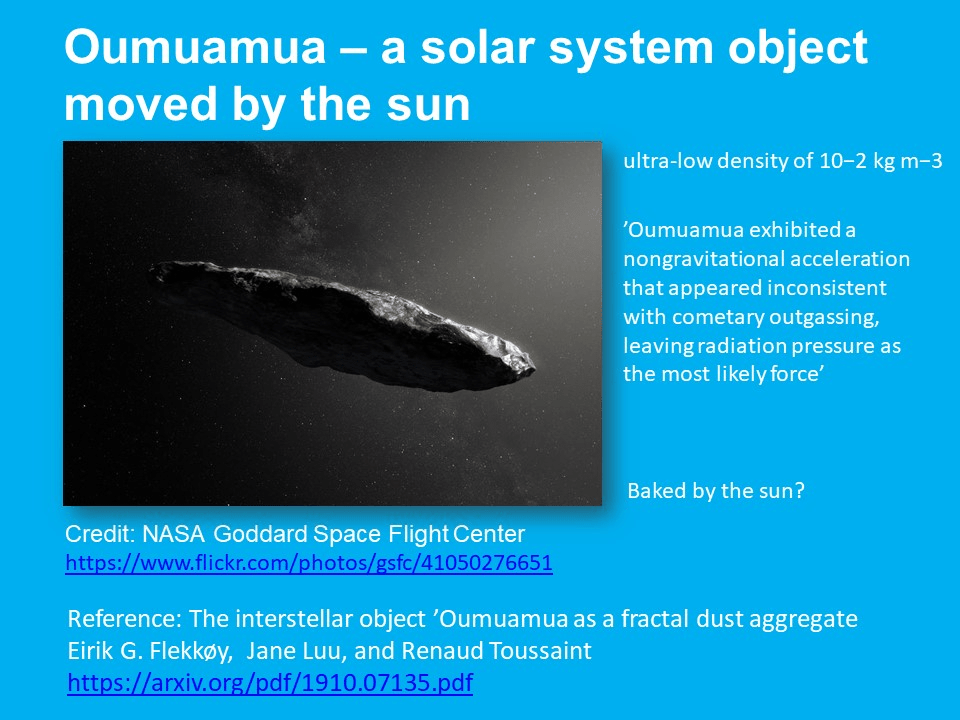
The Interstellar Object ‘Oumuamua as a Fractal Dust Aggregate
Eirik G. Flekkøy1, Jane Luu2,3, and Renaud Toussaint1,4
https://iopscience.iop.org/article/10.3847/2041-8213/ab4f78 or https://arxiv.org/abs/1910.07135
“Oumuamua exhibited a nongravitational acceleration that appeared inconsistent with cometary outgassing, leaving radiation pressure as the most likely force”
“a fractal body with the ultra-low density of 10−2 kg m−3.”
Probably a quasicrystal structure due the fast cooling in space.
Discovery of fossil asteroidal ice in primitive meteorite Acfer 094
- Megumi Matsumoto1,*,†,
- Akira Tsuchiyama2,3,
- Aiko Nakato1,‡,
- Junya Matsuno1,
- Akira Miyake1,
- Akimasa Kataoka4,
- Motoo Ito5,
- Naotaka Tomioka5,
- Yu Kodama6,
- Kentaro Uesugi7,
- Akihisa Takeuchi7,
- Tsukasa Nakano8 and
- Epifanio Vaccaro9
- 1Division of Earth and Planetary Sciences, Kyoto University, Kyoto 606-8502, Japan.
2Research Organization of Science and Technology, Ritsumeikan University, Shiga 525-8577, Japan.
3Guangzhou Institute of Geochemistry, Chinese Academy of Sciences, Guangzhou, GD 510640, China.
4National Astronomical Observatory of Japan, Tokyo 181-8588, Japan.
5Kochi Institute for Core Sample Research, Japan Agency for Marine-Earth Science and Technology (JAMSTEC), Kochi 783-0093, Japan.
6Marine Works Japan Ltd., Kanagawa 237-0063, Japan.
7Japan Synchrotron Radiation Research Institute, Hyogo 679-5198, Japan.
8Geological Survey of Japan, National Institute of Advanced Industrial Science and Technology, Ibaraki 305-8567, Japan.
9Department of Earth Sciences, Natural History Museum, London SW7 5BD, UK.- ↵*Corresponding author. Email: m_matsumto@tohoku.ac.jp
- ↵† Present address (primarily responsible for media coverage): Department of Earth and Planetary Materials Science, Tohoku University, Miyagi 980-8578, Japan.
- ↵‡ Present address: Institute of Space and Astronautical Science, Japan Aerospace Exploration Agency, Kanagawa 252-5210, Japan.
“UPLs ( ultraporous lithology) with abundant pores are fragile. UPLs are porous aggregates of amorphous and crystalline silicates, Fe─Ni sulfides, and organics. Nevertheless, UPLs show no evidence for pore compaction (Fig. 3A), which would be expected to have occurred during accretion.”
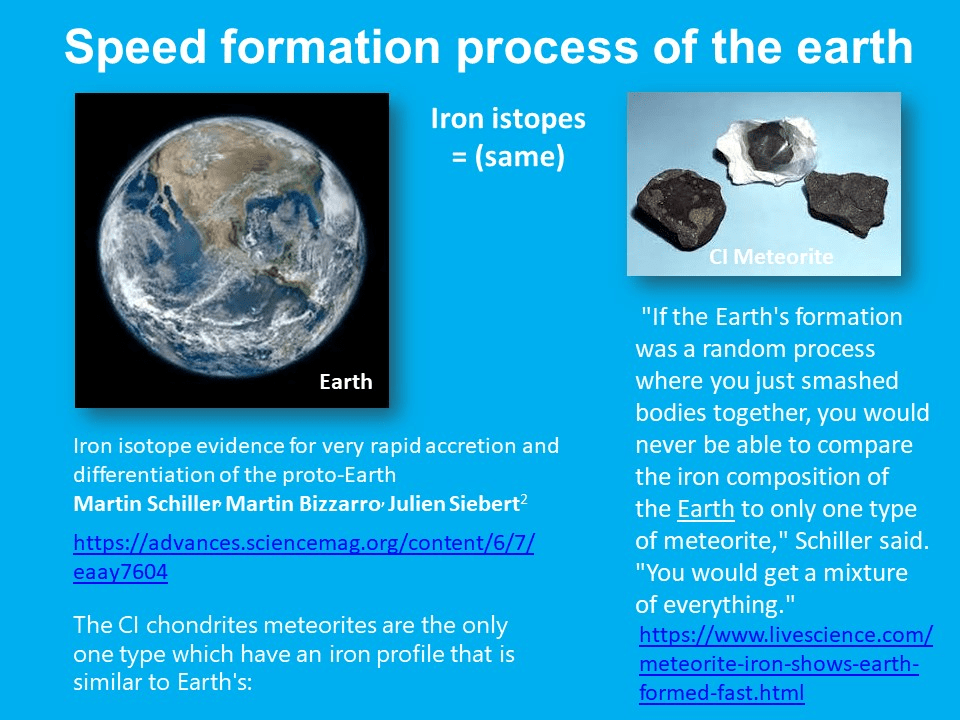
Speed Formation of the Earth
Extraterrestrial ribose and other sugars in primitive meteorites
Yoshihiro Furukawa, Yoshito Chikaraishi, Naohiko Ohkouchi, Nanako O. Ogawa, Daniel P. Glavin, Jason P. Dworkin, Chiaki Abe, and Tomoki Nakamura
PNAS first published November 18, 2019 https://doi.org/10.1073/pnas.1907169116
“The mineralogy and IOM structure of NWA 801 indicate that aqueous alteration of this meteorite was very limited. Thus, sugars in NWA 801 could have been formed before accretion of the CR2 parent body or during an early parent body aqueous alteration stage”
Impact crater data analysis of Ryugu asteroid illuminates complicated geological history
Assistant Professor Naoyuki Hirata of the Department of Planetology at Kobe University’s Graduate School of Science
„Through analyzing the location patterns and characteristics of the craters, they determined that the asteroid’s eastern and western hemispheres were formed at different periods of time.“
„. It is thought that this ridge formed in the distant past during a period when it only took Ryugu 3 hours to rotate. As the eastern hemisphere and western hemisphere were formed at different periods of the asteroid’s history- this suggests that there have been at least two instances where Ryugu’s rotational speed has increased.” – See also Nowadays: Sunlight still makes asteroids spin in strange ways at http://www.spacedaily.com/news/asteroid-03q.html
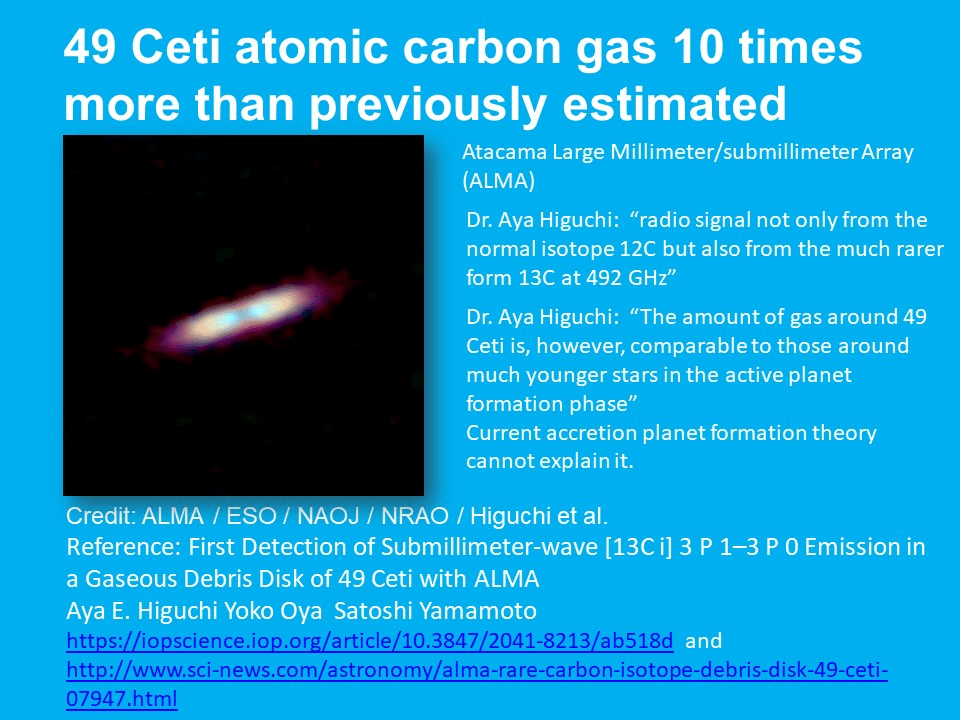
49 Ceti atomic carbon gas 10 times more than previously estimated Dr. Aya Higuchi
Hypothesis: Same Thermo Dynamic Principles apply to all observed Structure Formation in the Universe
Jets of Black Holes, Flares of Stars, the Solar Wind are caused by the same general principles.
The first jets of black holes were observed in 2018: Link and first described in 2001: Link
The pancake structure seems to be the norm in the universe Link1 and Link2. The rotation of structure is also a common charecterictics.
It seems that the distribution of the observable energy follows along a preferred plane with opposing directions within a rotating pancake structure and looks almost like a “flying saucer”. This could be an indication of an underlying energy cycle within these observable systems. But what is the cause?
The “ideal” state in the universe should be a vacuum filled with virtual particles. Yet this state does not seem to be stable enough on a large scale. At a certain scale instability seems to “destroy” this ideal state. In this state virtual particles do not return into the vacuum “field” but instead form observable matter. It seems like a flash of real particle creation is speeding suddenly through this vacuum field and hot gases form along the flash. If such events are happening what would we detected from these high energy matter flash creations on earth first and what do we detect in the aftermath of it.
The new state is bluntly speaking a disturbed state of the ideal. An ongoing formation process is then setting in with the main aim to return back to the ideal state of the vacuum. Yet this transformation process is going through different transformational phases. One of them is the birth of a star.
The mystery of the cosmic rays
„One of the best ways of accelerating particles is a shock front [that occurs] when a medium with a large velocity runs into a slower one, producing a shock— a sudden change in the properties of the medium,” Tjus explains. “In the case of the universe, the changed properties are velocity and density, and even magnetic fields. Luckily for the cosmic rays, the field becomes highly turbulent in that process. And the combination of a shock front with turbulence is a great particle accelerator.” Link
Virtual Particles Conversion
The underlying concpet is the conversion of virtual particles in vacuum into real particles and vice versa. While the observable matter might come from a conversion of virtual particles into more “stable” real particles under which conditions would the opposite coversion from real particles into virtual particles take place?
Neutron Star RX J1856.5-3754 Scientists Catch “Virtual Particles” Hopping In and Out of Existence: Link
Virtual Particles: “Forces—such as the electromagnetic repulsion or attraction between two charges—can be thought of as due to the exchange of virtual photons between the charges”
To examine: Planet Convection Cell Rings have opposing magnetic fields – exchanges of virtual particles?
Observable structures are a disruption of the ideal state (vacuum). The energy cycle sets in to return to the ideal structure (e.g. solar activity), then over the known states of stars to “black” hole.
Continuous Creation of New Galaxies
Similar to technocial shift – seperation of existing galaxies – creating of new galaxies in between
High Energetic Events
Black Holes
https://www.nau.ch/news/forschung/schwarzes-loch-kippwinkel-stellt-thesen-auf-den-kopf-66118577
https://www.digitaltrends.com/cool-tech/comet-water-earth/?amp
http://www.nzz.ch/wissenschaft/astronomie/rasterfahndung-nach-planet-9-1.18714112#register
http://mobile.nzz.ch/wissenschaft/astronomie/die-weltmeere-sind-nicht-aus-kometenwasser-1.18442162
Huang Protoplanetary Disk Gaps https://arxiv.org/pdf/1812.04041.pdf
Further References Collection at:
Density, not radius, separates rocky and water-rich small planets orbiting M dwarf stars
https://www.science.org/doi/10.1126/science.abl7164
“They found that one group is consistent with a purely rocky composition, whereas another group matches a model of 50% rock and 50% water. This split between rocky and water-rich planets could reflect where they formed in their planetary systems” ….
https://widgets.sociablekit.com/twitter-list/widget.js Circular Astronomy