-
The Spectroscopic Frontier: A Comprehensive Review of Exoplanet Atmospheric Characterization in the JWST Era
Abstract This literature review examines the dramatic advancements in exoplanet atmospheric characterization, charting the field’s transition from initial detections to detailed, high-fidelity spectroscopic analyses in the era of the James Webb Space Telescope (JWST). The foundational observational techniques—Transmission Spectroscopy (Charbonneau et al. ) and Secondary Eclipse/Emission Spectroscopy (Deming et al. )—have been augmented by the…
-
High-Redshift Cosmology in the JWST Era: ΛCDM Tension, Early Massive Galaxies, and the 21 cm Frontier
Abstract: Tracing the Universe’s Origins High-redshift cosmology (z≳6), spanning the Cosmic Dawn and the Epoch of Reionization (EoR), currently stands as the central frontier of astrophysics. This review synthesizes recent findings, particularly those enabled by the James Webb Space Telescope (JWST), against the backdrop of the standard ΛCDM cosmological model. JWST has fundamentally altered the…
-
A Step-by-Step Guide to Establishing Space-Based Computing Infrastructure

Setting up a data center in space, a process often referred to as Orbital Cloud Computing (OCC) or Satellite Edge Computing (OEC), is an intensely complex engineering, financial, and policy endeavor. The following guide synthesizes the critical strategic drivers, technological requirements, and necessary policy considerations identified in the analysis of this emerging field. This step-by-step…
-
The Reusable Rocket Revolution: A Comprehensive Guide to the Technology, Economics, and Future of Spaceflight
For decades, the concept of a fully reusable rocket capable of airline-like operations has been the ultimate goal in spaceflight, promising to dramatically lower the cost of accessing orbit, AND with the advent of systems like the Space Shuttle and the modern success of SpaceX’s Falcon 9, the world has proven that recovering and reflying…
-
A Decade of Discovery: A Literature Review on the IBEX Ribbon and its Implications for the Heliosphere
Over a decade ago, a small NASA satellite, the Interstellar Boundary Explorer (IBEX), made a revolutionary discovery that fundamentally changed our understanding of the heliosphere, the protective bubble of solar wind that envelops our solar system. Rather than the smooth, predictable boundary scientists had modeled for years, IBEX’s first all-sky map revealed a startling and…
-
A Comprehensive Literature Review of the NASA Interstellar Mapping and Acceleration Probe (IMAP) Mission
Objectives, Instrumentation, and Contributions to Heliophysics The heliosphere, the colossal magnetic bubble created by the Sun’s constant solar wind, acts as our solar system’s first and most critical line of defense, deflecting the majority of harmful galactic cosmic radiation. Despite decades of exploration, from the pioneering, single-point measurements of the Voyager missions to the groundbreaking…
-
Solar Activity Affects Earth’s Spin and Length of Day
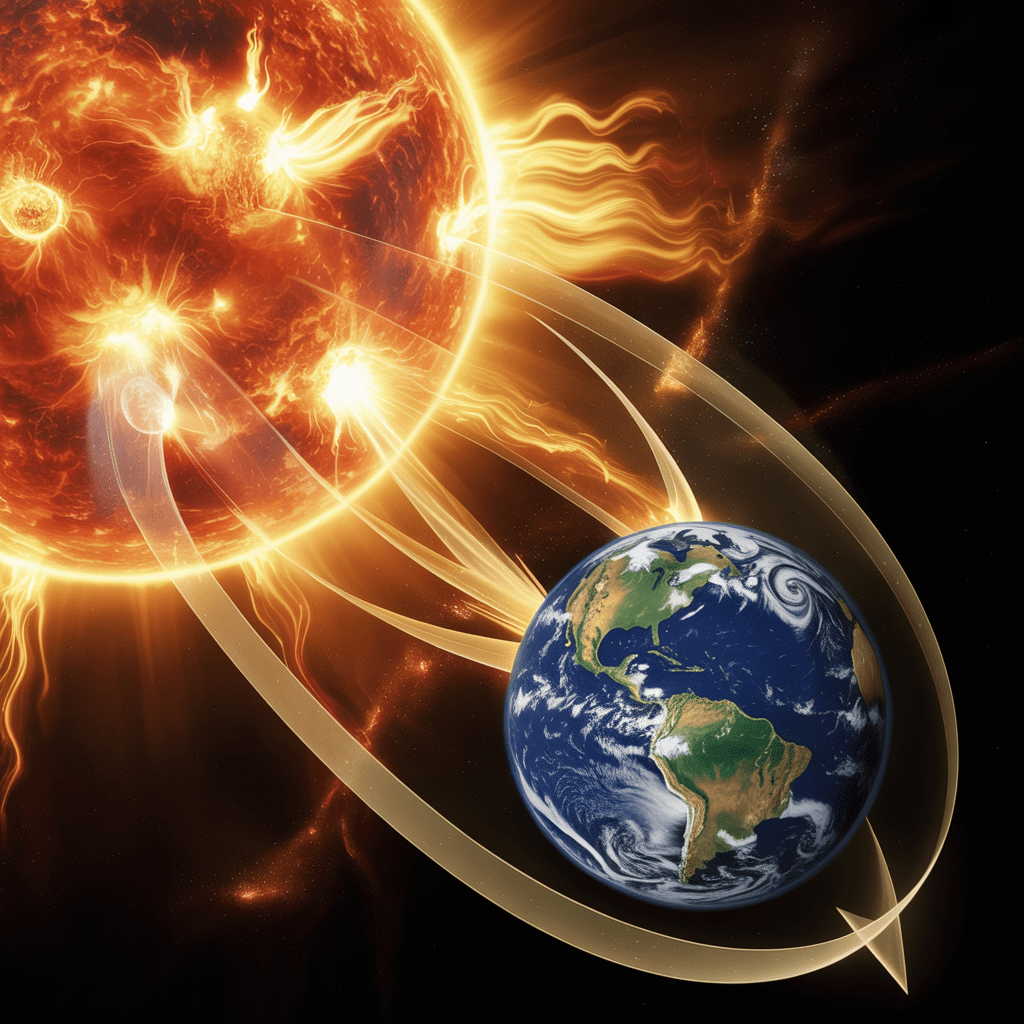
As always, post is in beta mode (work in progress) The solar wind impacts the shape and behavior of the objects in our solar system. See Reference: Sunlight puts asteroids in a spin and Sunlight makes asteroids spin in strange ways Does it also impact Earth’s spin? Created with the assitance of: https://storm.genie.stanford.edu/article/earth-spin-length-of-day-and-sun-activity-since-1995-1318710 Further reading:…
-
What are the Key Components of the Interstellar Mapping and Acceleration Probe (IMAP)
Livestream of the IMAP Assembly https://imap.princeton.edu/clean-room-video-feed The Interstellar Mapping and Acceleration Probe (IMAP) is a NASA mission designed to study the heliosphere and its interaction with the interstellar medium. The spacecraft comprises several key components: 1. Scientific Instruments: IMAP is equipped with ten specialized instruments to achieve its scientific objectives: Charged Particle-Sensing Instrument Installed on…
-
Subscribe
Subscribed
Already have a WordPress.com account? Log in now.
 Circular Astronomy