Are We Inside a Cosmic Whirlpool? Recent JWST Advanced Deep Extragalactic Survey (JADES) observations of mysterious cosmological anomalies in the rotational patterns of galaxies challenge our understanding of the universe and reveal surprising connections to natural growth patterns.
The rotation of 263 galaxies has been studied by Lior Shamir of Kansas State University, with 158 rotating clockwise and 105 rotating counterclockwise. The number of galaxies rotating in the opposite direction relative to the Milky Way is approximately 1.5 times higher than those rotating in the same direction.
New Cosmological anomalies that challenge our cosmological models and would have angered Einstein.
This observation challenges the expectation of a random distribution of galaxy rotation directions in the universe based on the isotropy assumption of the Cosmological Principle.

This is certainly not something Einstein would have liked to hear during his lifetime, but it would have excited Johannes Kepler.
What does this mean for our cosmological models, and why would it make Johannes Kepler happy?
The 1.5 ratio in galaxy rotation bias is intriguingly close to the Golden Ratio of 1.618. The Golden Ratio was one of Johannes Kepler’s two favorites. The astronomer Johannes Kepler (1571–1630) referred to the Golden Ratio as one of the “two great treasures of geometry” (the other being the Pythagorean theorem). He noted its connection to the Fibonacci sequence and its frequent appearance in nature.

What is the Fibonacci sequence?
The Italian mathematician Leonardo of Pisa, better known as Fibonacci, introduced the world to a fascinating sequence in his 1202 book Liber Abaci (The Book of Calculation). This sequence, now famously known as the Fibonacci sequence, was presented through a hypothetical problem involving the growth of a rabbit population.

The growth of a rabbit population and why it matters?
Fibonacci posed the following question: Suppose a pair of rabbits can reproduce every month starting from their second month of life. If each pair produces one new pair every month, how many pairs of rabbits will there be after a year?

The solution unfolds as follows:
- In the first month, there is 1 pair of rabbits.
- In the second month, there is still 1 pair (not yet reproducing).
- In the third month, the original pair reproduces, resulting in 2 pairs.
- In the fourth month, the original pair reproduces again, and the first offspring matures and reproduces, resulting in 3 pairs.

Image Source: https://commons.wikimedia.org/wiki/File:FibonacciRabbit.svg
This pattern continues, with each new generation adding to the total, where each term is the sum of the two preceding terms.
The Fibonacci sequence generated is: 1, 1, 2, 3, 5, 8, 13, 21, 34, 55, …
While this idealized model of a rabbit population assumes perfect conditions—no sickness, death, or other factors limiting reproduction—it reveals a growth pattern that approaches the Golden Ratio as the sequence progresses. The ratio is determined by dividing the current population by the previous population. For example, if the current population is 55 and the previous population is 34, based on the Fibonacci sequence above, the ratio of 55/34 is approximately 1.618.
However, in reality, the growth rate of a rabbit population would likely fall below this mathematical ideal ratio due to natural constraints.
Yet, this growth (evolutionary) pattern appears quite often in nature, such as in the growth patterns of succulents.

The growth patterns in succulents often follow the Fibonacci sequence, as seen in the arrangement of their leaves, which spiral around the stem in a way that maximizes sunlight exposure. This spiral phyllotaxis reflects Fibonacci numbers, where the number of spirals in each direction typically corresponds to consecutive terms in the sequence.
Spiral galaxies exhibit a similar growth (evolutionary) pattern in their spiral arms.
Spiral galaxies, like the Milky Way, display strikingly similar growth patterns in their spiral arms, where new stars are continuously formed and not in the center of the galaxy.
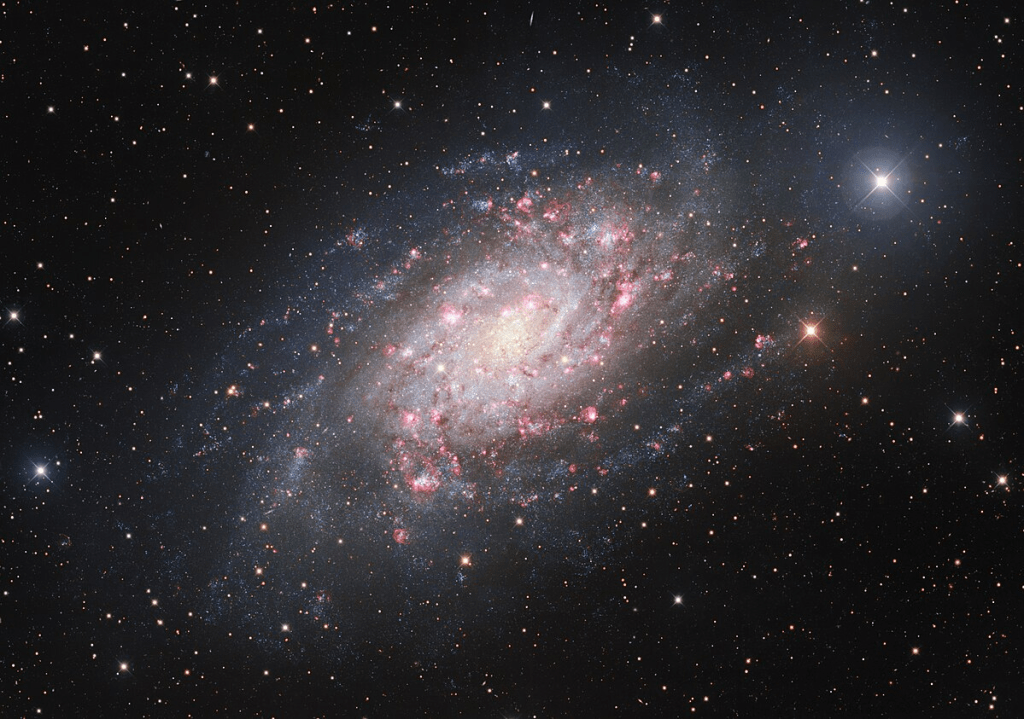
Image Source: https://commons.wikimedia.org/wiki/File:A_Galaxy_of_Birth_and_Death.jpg
Returning to the observations and research conducted by Lior Shamir of Kansas State University using the JWST.
The most galaxies with clockwise rotation are the furthest away from us.
The GOODS-S field is at a part of the sky with a higher number of galaxies rotating clockwise
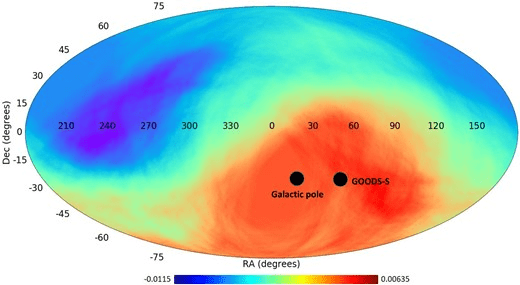
Image Source: Figure 10 https://doi.org/10.1093/mnras/staf292
“If that trend continues into the higher redshift ranges, it can also explain the higher asymmetry in the much higher redshift of the galaxies imaged by JWST. Previous observations using Earth-based telescopes e.g., Sloan Digital Sky Survey, Dark Energy Survey) and space-based telescopes (e.g., HST) also showed that the magnitude of the asymmetry increases as the redshift gets higher (Shamir 2020d).” Source: [1]
“It becomes more significant at higher redshifts, suggesting a possible link to the structure of the early universe or the physics of galaxy rotation.” Source: [1]
Could the universe itself be following the same growth patterns we see in nature and spiral galaxies?
This new observation by Lior Shamir is particularly intriguing because, if we were to shift the perspective of our standard cosmological model—from one based on a singularity (the Big Bang ‘explosion’), which is currently facing a lot of challenges [2], to a growth (evolutionary) model—we would no longer be observing the early universe. Instead, we would be witnessing the formation of new galaxies in the far distance, presenting a perspective that is the complete opposite of our current worldview (paradigm).
NEW: Massive quiescent galaxy at zspec = 7.29 ± 0.01, just ∼700 Myr after the “big bang” found.
RUBIES-UDS-QG-z7 galaxy is near celestial equator.
It is considered to be a “massive quiescent galaxy’ (MQG).
These galaxies are typically characterized by the cessation of their star formation.
https://iopscience.iop.org/article/10.3847/1538-4357/adab7a
The rotation, whether clockwise or counterclockwise, has not yet been observed.
Reference
The distribution of galaxy rotation in JWST Advanced Deep Extragalactic Survey
Lior Shamir
[1 ] https://academic.oup.com/mnras/article/538/1/76/8019798?login=false
The Hubble Tension in Our Own Backyard: DESI and the Nearness of the Coma Cluster
Daniel Scolnic, Adam G. Riess, Yukei S. Murakami, Erik R. Peterson, Dillon Brout, Maria Acevedo, Bastien Carreres, David O. Jones, Khaled Said, Cullan Howlett, and Gagandeep S. Anand
[2] https://iopscience.iop.org/article/10.3847/2041-8213/ada0bd
Reading Recommendation:
The Golden Ratio, Mario Livio, 2002
Mario Livio was an astrophysicist at the Space Telescope Science Institute, which operates the Hubble Space Telescope.
RUBIES Reveals a Massive Quiescent Galaxy at z = 7.3
Andrea Weibel, Anna de Graaff, David J. Setton, Tim B. Miller, Pascal A. Oesch, Gabriel Brammer, Claudia D. P. Lagos, Katherine E. Whitaker, Christina C. Williams, Josephine F.W. Baggen, Rachel Bezanson, Leindert A. Boogaard, Nikko J. Cleri, Jenny E. Greene, Michaela Hirschmann, Raphael E. Hviding, Adarsh Kuruvanthodi, Ivo Labbé, Joel Leja, Michael V. Maseda, Jorryt Matthee, Ian McConachie, Rohan P. Naidu, Guido Roberts-Borsani, Daniel Schaerer, Katherine A. Suess, Francesco Valentino, Pieter van Dokkum, and Bingjie Wang (王冰洁)
https://iopscience.iop.org/article/10.3847/1538-4357/adab7a
Appendix Spiral Galaxies:
Spiral galaxies are known for their stunning and symmetrical spiral arms, and many of them exhibit patterns that approximate logarithmic spirals, which are mathematically related to the Golden Ratio. While not all spiral galaxies perfectly follow the Golden Ratio, some exhibit spiral arm structures that closely resemble this pattern. Here are some notable examples of spiral galaxies with logarithmic spiral patterns:
1. Milky Way Galaxy
- Our own galaxy, the Milky Way, is a barred spiral galaxy with arms that approximate logarithmic spirals. The four primary spiral arms (Perseus, Sagittarius, Scutum-Centaurus, and Norma) follow a logarithmic pattern, though not perfectly aligned with the Golden Ratio.
2. M51 (Whirlpool Galaxy)
- The Whirlpool Galaxy is one of the most famous examples of a spiral galaxy with well-defined logarithmic spiral arms. Its arms are nearly symmetrical and exhibit a pattern that closely resembles the Golden Ratio.
3. M101 (Pinwheel Galaxy)
- The Pinwheel Galaxy is a grand-design spiral galaxy with prominent and well-defined spiral arms. Its structure is often cited as an example of a logarithmic spiral in astronomy.
4. NGC 1300
- NGC 1300 is a barred spiral galaxy with a striking logarithmic spiral pattern in its arms. It is often studied for its near-perfect spiral structure.
5. M74 (Phantom Galaxy)
- The Phantom Galaxy is another grand-design spiral galaxy with arms that follow a logarithmic spiral pattern. Its symmetry and structure make it a textbook example of this phenomenon.
6. NGC 1365
- Known as the Great Barred Spiral Galaxy, NGC 1365 has a prominent bar structure and spiral arms that exhibit a logarithmic pattern.
7. M81 (Bode’s Galaxy)
- Bode’s Galaxy is a spiral galaxy with arms that follow a logarithmic spiral structure. It is one of the brightest galaxies visible from Earth and a popular target for astronomers.
8. NGC 2997
- This galaxy is a grand-design spiral galaxy with arms that closely resemble logarithmic spirals. It is located in the constellation Antlia.
9. NGC 4622
- Known as the “Backward Galaxy,” NGC 4622 has a unique spiral structure with arms that follow a logarithmic pattern, though its rotation direction is unusual.
10. M33 (Triangulum Galaxy)
- The Triangulum Galaxy is a smaller spiral galaxy with arms that exhibit a logarithmic spiral structure. It is part of the Local Group, along with the Milky Way and Andromeda.
 Circular Astronomy

