Circular Astronomy
Twitter List – See all the findings and discussions in one place
-
The Mysterious Discovery of JWST That No One Saw Coming

Are We Inside a Cosmic Whirlpool? Recent JWST Advanced Deep Extragalactic Survey (JADES) observations of mysterious cosmological anomalies in the rotational patterns of galaxies challenge our understanding of the universe and reveal surprising connections to natural growth patterns.
The rotation of 263 galaxies has been studied by Lior Shamir of Kansas State University, with 158 rotating clockwise and 105 rotating counterclockwise. The number of galaxies rotating in the opposite direction relative to the Milky Way is approximately 1.5 times higher than those rotating in the same direction.
New Cosmological anomalies that challenge our cosmological models and would have angered Einstein.
This observation challenges the expectation of a random distribution of galaxy rotation directions in the universe based on the isotropy assumption of the Cosmological Principle.
This is certainly not something Einstein would have liked to hear during his lifetime, but it would have excited Johannes Kepler.
What does this mean for our cosmological models, and why would it make Johannes Kepler happy?
The 1.5 ratio in galaxy rotation bias is intriguingly close to the Golden Ratio of 1.618. The Golden Ratio was one of Johannes Kepler’s two favorites. The astronomer Johannes Kepler (1571–1630) referred to the Golden Ratio as one of the “two great treasures of geometry” (the other being the Pythagorean theorem). He noted its connection to the Fibonacci sequence and its frequent appearance in nature.

What is the Fibonacci sequence?
The Italian mathematician Leonardo of Pisa, better known as Fibonacci, introduced the world to a fascinating sequence in his 1202 book Liber Abaci (The Book of Calculation). This sequence, now famously known as the Fibonacci sequence, was presented through a hypothetical problem involving the growth of a rabbit population.

The growth of a rabbit population and why it matters?
Fibonacci posed the following question: Suppose a pair of rabbits can reproduce every month starting from their second month of life. If each pair produces one new pair every month, how many pairs of rabbits will there be after a year?

The solution unfolds as follows:
- In the first month, there is 1 pair of rabbits.
- In the second month, there is still 1 pair (not yet reproducing).
- In the third month, the original pair reproduces, resulting in 2 pairs.
- In the fourth month, the original pair reproduces again, and the first offspring matures and reproduces, resulting in 3 pairs.
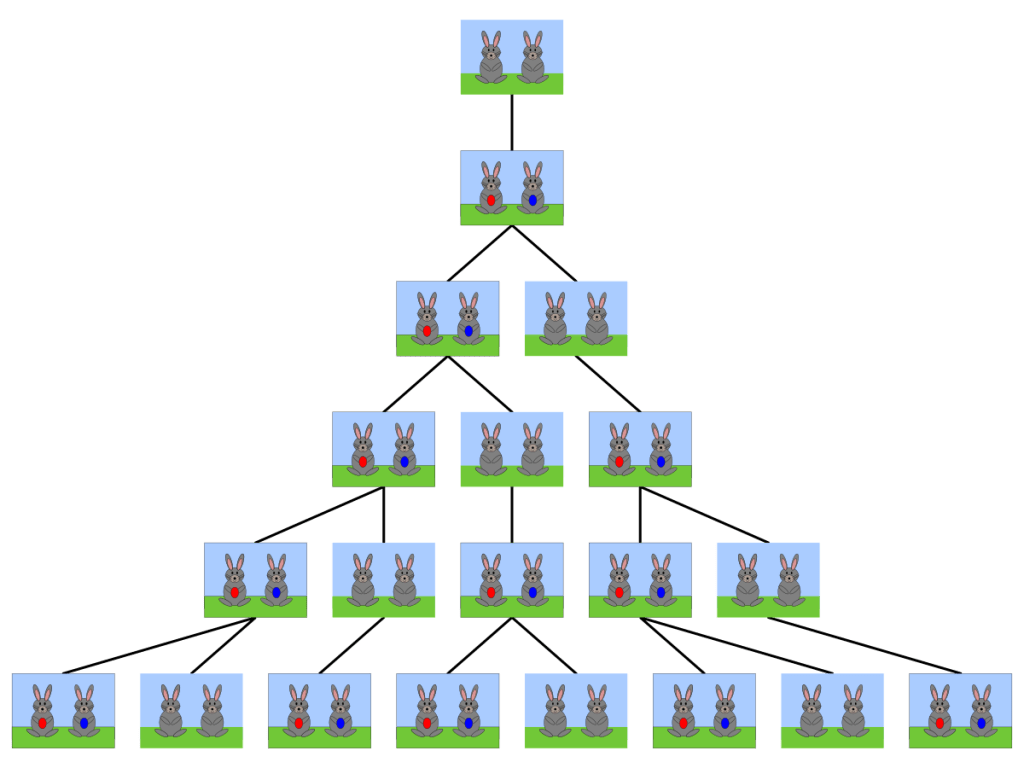
Image Source: https://commons.wikimedia.org/wiki/File:FibonacciRabbit.svg
This pattern continues, with each new generation adding to the total, where each term is the sum of the two preceding terms.
The Fibonacci sequence generated is: 1, 1, 2, 3, 5, 8, 13, 21, 34, 55, …
While this idealized model of a rabbit population assumes perfect conditions—no sickness, death, or other factors limiting reproduction—it reveals a growth pattern that approaches the Golden Ratio as the sequence progresses. The ratio is determined by dividing the current population by the previous population. For example, if the current population is 55 and the previous population is 34, based on the Fibonacci sequence above, the ratio of 55/34 is approximately 1.618.
However, in reality, the growth rate of a rabbit population would likely fall below this mathematical ideal ratio due to natural constraints.Yet, this growth (evolutionary) pattern appears quite often in nature, such as in the growth patterns of succulents.

The growth patterns in succulents often follow the Fibonacci sequence, as seen in the arrangement of their leaves, which spiral around the stem in a way that maximizes sunlight exposure. This spiral phyllotaxis reflects Fibonacci numbers, where the number of spirals in each direction typically corresponds to consecutive terms in the sequence.
Spiral galaxies exhibit a similar growth (evolutionary) pattern in their spiral arms.
Spiral galaxies, like the Milky Way, display strikingly similar growth patterns in their spiral arms, where new stars are continuously formed and not in the center of the galaxy.
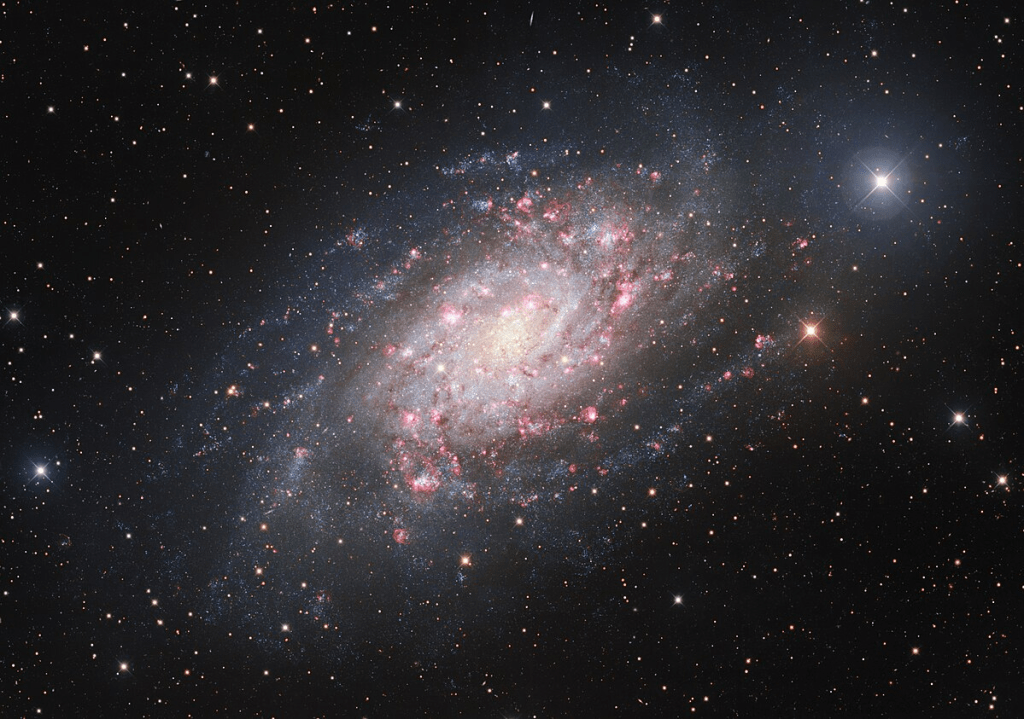
Image Source: https://commons.wikimedia.org/wiki/File:A_Galaxy_of_Birth_and_Death.jpg
Returning to the observations and research conducted by Lior Shamir of Kansas State University using the JWST.
The most galaxies with clockwise rotation are the furthest away from us.
The GOODS-S field is at a part of the sky with a higher number of galaxies rotating clockwise
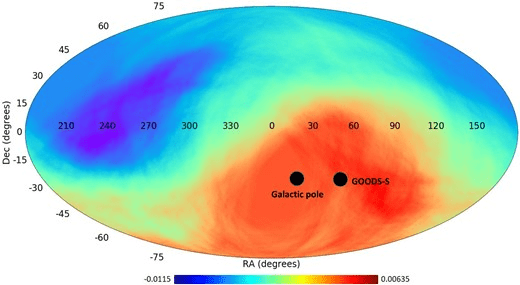
Image Source: Figure 10 https://doi.org/10.1093/mnras/staf292
“If that trend continues into the higher redshift ranges, it can also explain the higher asymmetry in the much higher redshift of the galaxies imaged by JWST. Previous observations using Earth-based telescopes e.g., Sloan Digital Sky Survey, Dark Energy Survey) and space-based telescopes (e.g., HST) also showed that the magnitude of the asymmetry increases as the redshift gets higher (Shamir 2020d).” Source: [1]“It becomes more significant at higher redshifts, suggesting a possible link to the structure of the early universe or the physics of galaxy rotation.” Source: [1]
Could the universe itself be following the same growth patterns we see in nature and spiral galaxies?
This new observation by Lior Shamir is particularly intriguing because, if we were to shift the perspective of our standard cosmological model—from one based on a singularity (the Big Bang ‘explosion’), which is currently facing a lot of challenges [2], to a growth (evolutionary) model—we would no longer be observing the early universe. Instead, we would be witnessing the formation of new galaxies in the far distance, presenting a perspective that is the complete opposite of our current worldview (paradigm).
NEW: Massive quiescent galaxy at zspec = 7.29 ± 0.01, just ∼700 Myr after the “big bang” found.
RUBIES-UDS-QG-z7 galaxy is near celestial equator.
It is considered to be a “massive quiescent galaxy’ (MQG).
These galaxies are typically characterized by the cessation of their star formation.
https://iopscience.iop.org/article/10.3847/1538-4357/adab7a
The rotation, whether clockwise or counterclockwise, has not yet been observed.Reference
The distribution of galaxy rotation in JWST Advanced Deep Extragalactic Survey
Lior Shamir
[1 ] https://academic.oup.com/mnras/article/538/1/76/8019798?login=false
The Hubble Tension in Our Own Backyard: DESI and the Nearness of the Coma Cluster
Daniel Scolnic, Adam G. Riess, Yukei S. Murakami, Erik R. Peterson, Dillon Brout, Maria Acevedo, Bastien Carreres, David O. Jones, Khaled Said, Cullan Howlett, and Gagandeep S. Anand
[2] https://iopscience.iop.org/article/10.3847/2041-8213/ada0bd
Reading Recommendation:
The Golden Ratio, Mario Livio, 2002
Mario Livio was an astrophysicist at the Space Telescope Science Institute, which operates the Hubble Space Telescope.
RUBIES Reveals a Massive Quiescent Galaxy at z = 7.3
Andrea Weibel, Anna de Graaff, David J. Setton, Tim B. Miller, Pascal A. Oesch, Gabriel Brammer, Claudia D. P. Lagos, Katherine E. Whitaker, Christina C. Williams, Josephine F.W. Baggen, Rachel Bezanson, Leindert A. Boogaard, Nikko J. Cleri, Jenny E. Greene, Michaela Hirschmann, Raphael E. Hviding, Adarsh Kuruvanthodi, Ivo Labbé, Joel Leja, Michael V. Maseda, Jorryt Matthee, Ian McConachie, Rohan P. Naidu, Guido Roberts-Borsani, Daniel Schaerer, Katherine A. Suess, Francesco Valentino, Pieter van Dokkum, and Bingjie Wang (王冰洁)
https://iopscience.iop.org/article/10.3847/1538-4357/adab7a
Appendix Spiral Galaxies:
Spiral galaxies are known for their stunning and symmetrical spiral arms, and many of them exhibit patterns that approximate logarithmic spirals, which are mathematically related to the Golden Ratio. While not all spiral galaxies perfectly follow the Golden Ratio, some exhibit spiral arm structures that closely resemble this pattern. Here are some notable examples of spiral galaxies with logarithmic spiral patterns:
1. Milky Way Galaxy
- Our own galaxy, the Milky Way, is a barred spiral galaxy with arms that approximate logarithmic spirals. The four primary spiral arms (Perseus, Sagittarius, Scutum-Centaurus, and Norma) follow a logarithmic pattern, though not perfectly aligned with the Golden Ratio.
2. M51 (Whirlpool Galaxy)
- The Whirlpool Galaxy is one of the most famous examples of a spiral galaxy with well-defined logarithmic spiral arms. Its arms are nearly symmetrical and exhibit a pattern that closely resembles the Golden Ratio.
3. M101 (Pinwheel Galaxy)
- The Pinwheel Galaxy is a grand-design spiral galaxy with prominent and well-defined spiral arms. Its structure is often cited as an example of a logarithmic spiral in astronomy.
4. NGC 1300
- NGC 1300 is a barred spiral galaxy with a striking logarithmic spiral pattern in its arms. It is often studied for its near-perfect spiral structure.
5. M74 (Phantom Galaxy)
- The Phantom Galaxy is another grand-design spiral galaxy with arms that follow a logarithmic spiral pattern. Its symmetry and structure make it a textbook example of this phenomenon.
6. NGC 1365
- Known as the Great Barred Spiral Galaxy, NGC 1365 has a prominent bar structure and spiral arms that exhibit a logarithmic pattern.
7. M81 (Bode’s Galaxy)
- Bode’s Galaxy is a spiral galaxy with arms that follow a logarithmic spiral structure. It is one of the brightest galaxies visible from Earth and a popular target for astronomers.
8. NGC 2997
- This galaxy is a grand-design spiral galaxy with arms that closely resemble logarithmic spirals. It is located in the constellation Antlia.
9. NGC 4622
- Known as the “Backward Galaxy,” NGC 4622 has a unique spiral structure with arms that follow a logarithmic pattern, though its rotation direction is unusual.
10. M33 (Triangulum Galaxy)
- The Triangulum Galaxy is a smaller spiral galaxy with arms that exhibit a logarithmic spiral structure. It is part of the Local Group, along with the Milky Way and Andromeda.
-
How to Download, View, And Edit Images from the James Webb Space Telescope with Jdaviz and Imviz
Like to comfortably view and edit images from the Jamew Webb Space Telescope like an astronomer ?
Then follow this step by step cheatsheet guides if you are using windows on a PC .
Main Software Components
There are three key software components required:
- Microsoft C++ 14
- Jupyter Notebook (Python)
- Jdaviz
Additonal
- MAST Token to be able to download the images with Imviz.
Prerequsites:
Microsoft Visual C++ 14.0 or greater

error: Microsoft Visual C++ 14.0 or greater is required If Microsoft Visual C++ 14.0 or greater is not installed, the installation of Jdaviz will fail. Without Jdaviz the downloaded images from the James Webb Space Telescope cannot be edited.
How to install Microsoft Visual C++
- Navigate to: https://visualstudio.microsoft.com/downloads/
- Download Visual Studio 2022 Community version
- Follow the instructions in this post: Install C and C++ support in Visual Studio | Microsoft Docs
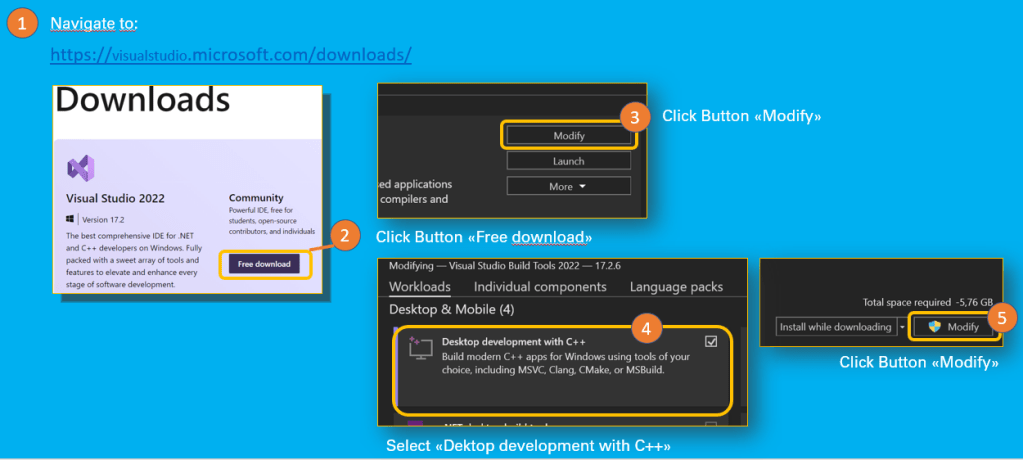
Cheatsheet: Install Visual Studio 2022 MAST Token
- Navigate to https://ssoportal.stsci.edu/token
If you do not have not an account yet, please follow below steps to create your account:
- Click on the Forgotten Password? link
- Enter your email Adress
- Click Send Reset Email Button
- Click Create Account Button
- Click Launch Button
- Enter the Captcha
- Click Submit Button
- Enter your email
- Click Next Button
- Fill in the Name Form
- Click Next Button
- Fill in the Insitution (e.g. Private Citizen or Citizen Scientist)
- Click Accept Institution Button
- Enter Job Title (whatever you are or like to be ;-))
- Click Next Button
- New Account Data for your review is presented, in case of missing contact data, step 17 might be necessary
- Fill in Contact Information Form
- Click Next Button
- Click Create Account Button
- In your email account open the reset password emal
- Click on the link
- Enter Password
- Enter Retype Password
- Click Update Password
- Navigate to https://ssoportal.stsci.edu/token
- Now log on with your email and new account password
- Click Create Token Button
- Fill in a Token Name of your choice
- Click Create Token Button
- Copy the Token Number and save it for later use in Imviz to download the images from the James Webb Space Telescope
Quite a lot of steps for a Token.

Cheatsheet: Create MAST Account 
Cheatsheet: Set Passord for new Account 
Cheatsheet: Create MAST Token for use in Imviz Jupyter Notebook
Jupyter notebook comes with the ananconda distribution.
- Navigate to: https://www.anaconda.com/products/distribution#windows
- Follow the instructions at: https://docs.anaconda.com/anaconda/install/windows/
Install Jdaviz
- Navigate to: Installation — jdaviz v2.7.2.dev6+gd24f8239
- Open the Jupyter Notebook
- Open Terminal from Jupyter Notebook
- Follow the instruction in: Installation — jdaviz v2.7.2.dev6+gd24f8239
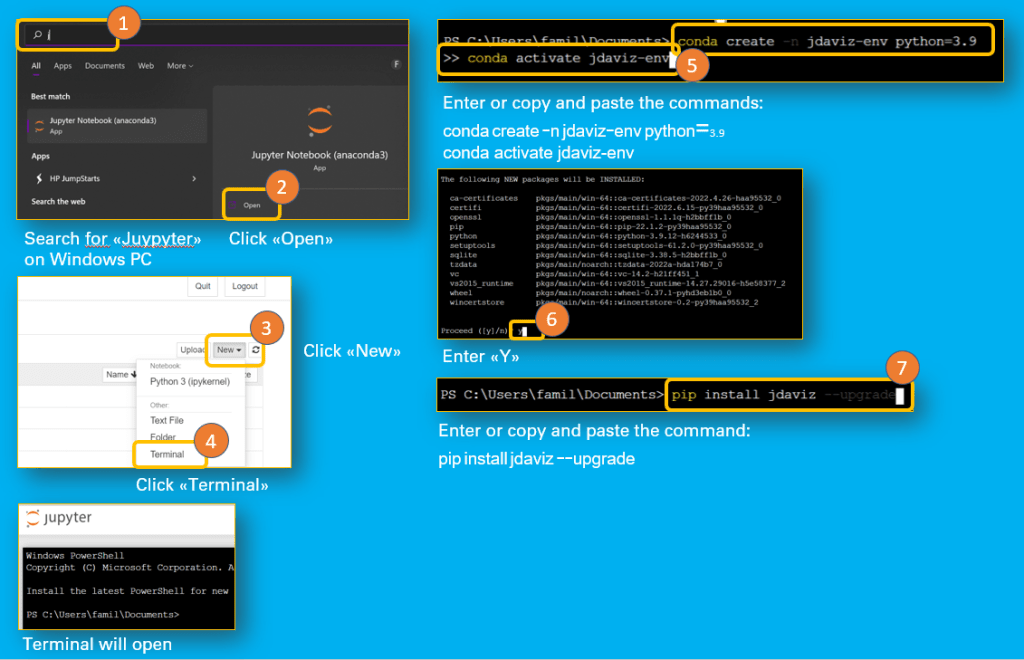
Cheatsheet: Install Jdaviz How to use IMVIZ
Imviz is installed together with Jdaviz.
Following steps to take in order to use Imviz:
- Navigate to: GitHub – orifox/jwst_ero: JWST ERO Analysis Work
- Click Code Button
- Click Download Zip
- If you do not have unzip, then the next steps might work for you:
- In Download Folder (PC) click the jwst_ero master zip file
- Then click on the folder jwst_ero master
- Copy file MIRI_Imviz_demo.jpynb
- Paste the file in the download folder
- Open Jupyter notebook
- Click Upload Button
- Select the file MIRI_Imviz_demo.jpynb
- Click Open Button
- Select the file MIRI_Imviz_demo.jpynb in the Jupyter Notebook file list
- Click View Button
- Click Run Button First Cell
- Paste MAST Token in next cell
- Click Run Button of this Cell
- Click then Run Button of next Cell
- Click Run Button of the following Cell
- Click Run Button of the next Cell to download the images
- Copy the link to the downloaded image file
- Past link into the First Cell in 3. Load and Manipulate Data
- Do the same in the next Cell
- Click Run Button of the Cell to open Imviz
- Click Run Button on the next Cell to load images in Imviz
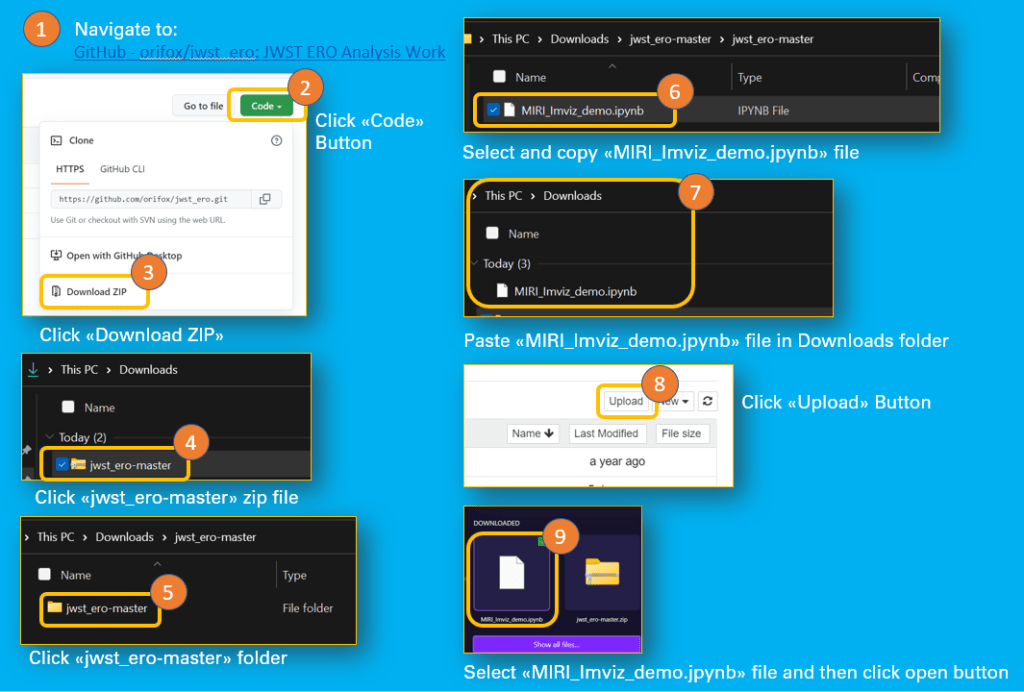
Cheatsheet: Upload MIRI_Imviz_demo.jpynb in Jupyter notebook Now all set to download the images of the JWST observation:
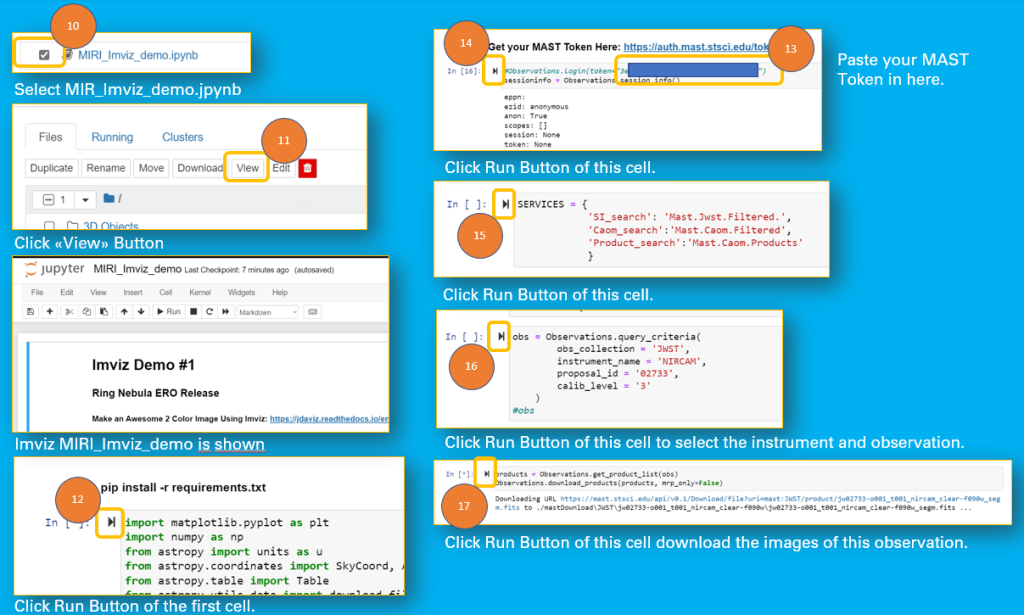
Cheatsheet: Download JWST images with Imviz And now all is set to open and edit the images in Imviz
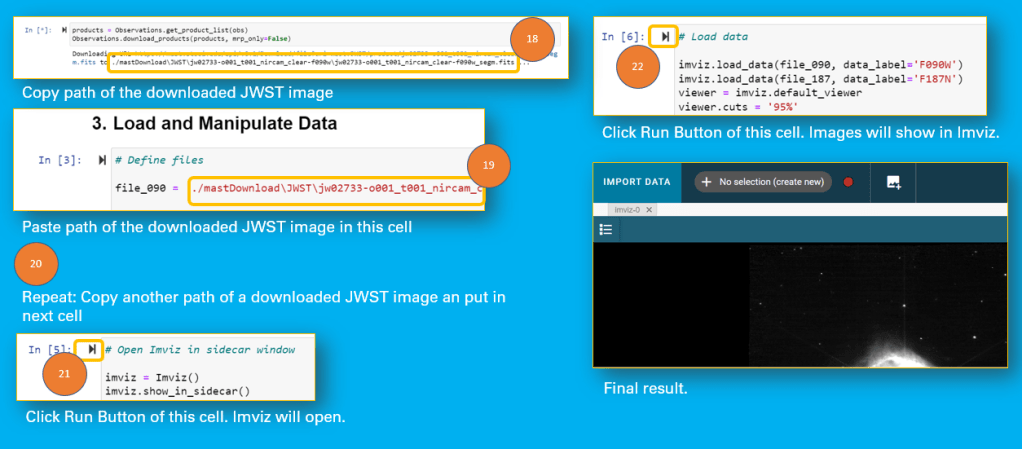
Cheatsheet: Open Images in Imviz And finally you are ready to follow the video tutorials in order to learn how to use Imviz to manipulate the JWST images.
Video Tutorials for Imviz:
And this is the master Ori Fox of the Imviz demo notebook file if you like to follow him on Twitter
-
Time for a new scientific debate – Accretion vs Convection

To what degree is gravity needed to form structures in space? While many believe that celestial bodies (stars, planets, moons, meteoroids) can only form through gravitational attraction in the vacuum of space, I believe that these bodies form through a thermodynamic process similar to the formation of hydrometeors (e.g., hail). This is because our solar system possesses a boundary layer, a discovery made by the Interstellar Boundary Explorer (IBEX) mission in 2013.
In simple terms: Planets, moons, and small bodies are formed within convection cells created by the jet streams of a young sun, under the influence of strong magnetic fields.
Recently, a new paper introduced quantum models in which gravity emerges from the behavior of qubits or oscillators interacting with a heat bath.
More details and link to the research paper: On the Quantum Mechanics of Entropic Forces
https://circularastronomy.com/2025/10/09/entropic-gravity-explained-how-quantum-thermodynamics-could-replace-gravitons/ -
Unraveling the Cosmic Dipole Anomaly: A Comprehensive Literature Review of Challenges to the Cosmological Principle
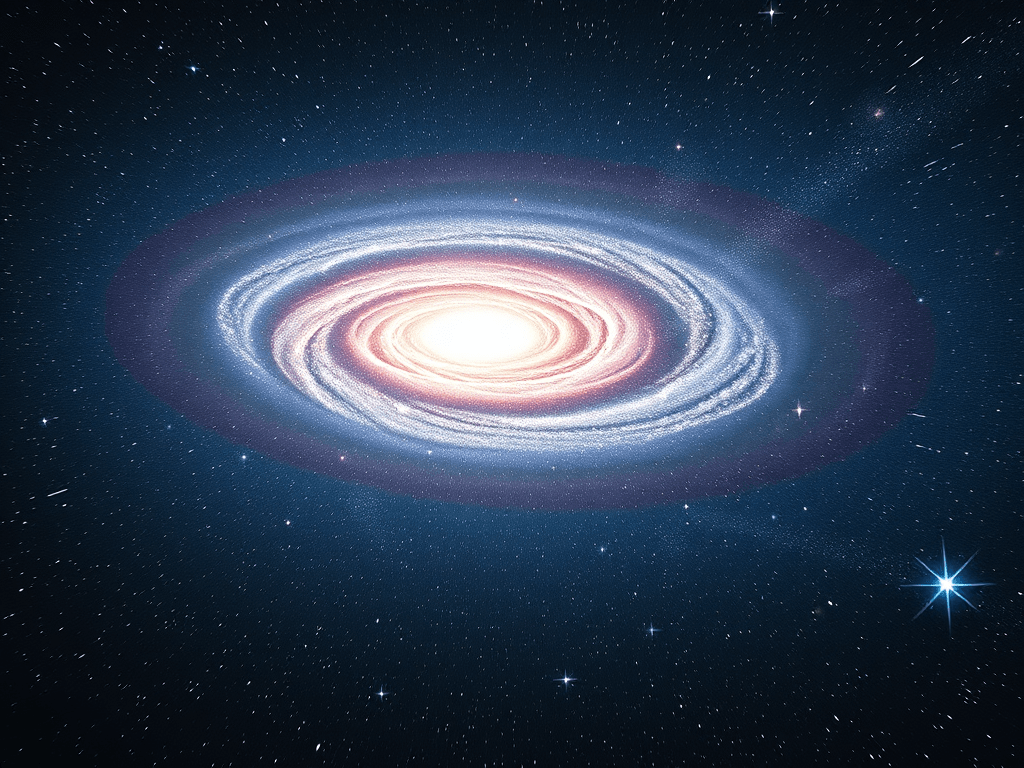
1. Introduction: The Foundational Assumptions of Modern Cosmology
The standard model of cosmology, known as , stands as one of the triumphs of twentieth-century physics. It successfully integrates the expansion of the Universe, the synthesis of light elements, the formation of large-scale structure, and the existence of the Cosmic Microwave Background (CMB) into a coherent narrative. However, this model rests upon a foundational axiom that precedes the field equations of General Relativity themselves: the Cosmological Principle (CP). The CP asserts that, on sufficiently large scales (typically exceeding 100 Mpc), the Universe is statistically homogeneous and isotropic. This implies that there are no privileged positions and no privileged directions in the cosmos.1
The mathematical manifestation of the CP is the Friedmann-Lemaître-Robertson-Walker (FLRW) metric, which reduces the ten independent components of the Einstein field equations to differential equations governing a single time-dependent scale factor, . This metric underpins our definitions of cosmic time, the Hubble parameter , and the interpretation of redshift as a measure of expansion.1 Consequently, the validity of the model—and indeed, our understanding of dark energy, dark matter, and the age of the Universe—is inextricably linked to the validity of the FLRW metric and the CP.
While the CP was initially a philosophical necessity—introduced by Einstein and later formalized by Milne to make the equations of cosmology solvable—it has since been subjected to rigorous observational testing. The discovery of the CMB in 1965 provided strong evidence for isotropy, revealing a Universe that was remarkably uniform in its infancy. The temperature fluctuations in the CMB, , are on the order of , consistent with a Universe that is isotropic to a high degree of precision.3
However, the CMB is not perfectly isotropic. It contains a prominent dipole anisotropy, a variation in temperature of amplitude , which is two orders of magnitude larger than the primordial fluctuations. In the standard paradigm, this dipole is interpreted not as an intrinsic feature of the Universe, but as a kinematic effect arising from the peculiar motion of the Solar System relative to the cosmic rest frame.4 This interpretation predicts that a corresponding dipole must exist in the distribution of distant extragalactic sources. If the Solar System is moving through a sea of photons, it is also moving through the sea of galaxies and quasars that constitute the large-scale structure (LSS) of the Universe.
Over the past two decades, and intensifying in recent years with the release of large-area surveys like CatWISE and RACS, a significant tension has emerged. Measurements of the dipole in the number counts of distant radio galaxies and quasars consistently reveal an amplitude that is significantly larger—by a factor of two to three—than the kinematic prediction derived from the CMB.3 This discrepancy, now reaching statistical significance levels exceeding , has been termed the “Cosmic Dipole Anomaly.” It represents one of the most severe challenges to the CP and the standard model, suggesting that the rest frame of matter and the rest frame of radiation may not coincide, or that the Universe possesses an intrinsic anisotropy that violates the fundamental assumptions of FLRW cosmology.1
This report provides an exhaustive review of the Cosmic Dipole Anomaly. It synthesizes evidence from radio continuum surveys, infrared quasar catalogs, and redshift tomography. It examines the theoretical basis for the kinematic dipole, the statistical methodologies used to measure it, and the potential for systematic errors. Furthermore, it explores theoretical extensions to the standard model—including “tilted” Bianchi cosmologies and modified gravity theories—that seek to explain the anomaly. Finally, it forecasts the potential of next-generation facilities such as the Euclid mission, the Square Kilometre Array (SKA), and the Vera C. Rubin Observatory (LSST) to definitively resolve this cosmic puzzle.
2. The Kinematic Hypothesis and the Cosmic Microwave Background
2.1 The CMB Dipole: Observation and Interpretation
The Cosmic Microwave Background provides the ultimate reference frame for cosmology. Observations by the COBE, WMAP, and Planck satellites have mapped the CMB temperature field with exquisite precision. The dominant feature in these maps, after the monopole temperature $T_0 = 2.7255$ K, is the dipole moment.
The Planck 2018 results constrain the solar system’s peculiar velocity, under the kinematic interpretation, to be:
$$v_{\text{CMB}} = 369.82 \pm 0.11 \text{ km s}^{-1}$$
This velocity vector points towards the Galactic coordinates $(l, b) = (264.021^\circ \pm 0.011^\circ, 48.253^\circ \pm 0.005^\circ)$.3
In the standard model, this velocity is attributed to the gravitational pull of local large-scale structures. The Solar System orbits the Galactic Center; the Milky Way falls towards the Andromeda Galaxy; the Local Group falls towards the Virgo Cluster; and the Local Supercluster is influenced by the Great Attractor and the Shapley Concentration.9 The vector sum of these motions results in the net velocity observed as the CMB dipole.
The temperature distribution of the CMB in the presence of an observer velocity $\vec{v}$ is given by the relativistic Doppler formula:
$$T(\hat{n}) = \frac{T_0}{\gamma (1 – \vec{\beta} \cdot \hat{n})}$$where $\vec{\beta} = \vec{v}/c$, $\gamma = (1 – \beta^2)^{-1/2}$ is the Lorentz factor, and $\hat{n}$ is the direction of observation. To first order in $\beta$, this simplifies to:
$$T(\hat{n}) \approx T_0 (1 + \hat{n} \cdot \vec{\beta})$$
This dipolar modulation is kinematic in nature. It is not an intrinsic variation in the temperature of the last scattering surface, but a frame-dependent effect. Crucially, this interpretation relies on the assumption that the CMB rest frame represents the global rest frame of the Universe. If the CP holds, the distribution of matter on large scales must also be isotropic in this same frame.4
2.2 Relativistic Effects on Matter Distribution
If the CMB dipole is kinematic, an observer moving with velocity $\vec{v}$ relative to the cosmic rest frame should see a specific signature in the distribution of distant sources. This signature arises from two distinct relativistic effects: Doppler boosting and relativistic aberration.1
2.2.1 Doppler Boosting
The flux density $S$ of a source is frame-dependent. For a source with a power-law spectrum $S \propto \nu^{-\alpha}$, the observed flux density $S_{\text{obs}}$ is related to the rest-frame flux density $S_{\text{rest}}$ by:
$$S_{\text{obs}} = S_{\text{rest}} \delta^{1+\alpha}$$
where $\delta = [\gamma (1 – \vec{\beta} \cdot \hat{n})]^{-1}$ is the Doppler factor. Since $\delta > 1$ in the direction of motion, sources appear brighter. In a flux-limited survey (which counts all sources brighter than a threshold $S_{\text{lim}}$), this brightening brings sources that would otherwise be too faint to be detected into the sample. The magnitude of this effect depends on the slope of the number counts, $x$, defined by $N(>S) \propto S^{-x}$.3
2.2.2 Relativistic Aberration
Aberration is the apparent displacement of objects toward the direction of motion. The angle of incidence $\theta$ in the observer’s frame is related to the angle $\theta’$ in the rest frame by:
$$\cos \theta = \frac{\cos \theta’ + \beta}{1 + \beta \cos \theta’}$$
This effect causes the solid angle elements to shrink in the forward direction and expand in the backward direction. Consequently, the number density of sources per unit solid angle increases in the direction of motion, even if the intrinsic spatial distribution is uniform.9
2.3 The Ellis-Baldwin Formulation
In their seminal 1984 paper, George Ellis and John Baldwin derived the combined effect of boosting and aberration on the observed number counts of sources. They showed that for a flux-limited survey of sources with spectral index $\alpha$ and count slope $x$, the observed number density $N(\hat{n})$ is modulated by a dipole of amplitude $\mathcal{D}$:
$$N(\hat{n}) = \bar{N} (1 + \mathcal{D} \cos \theta)$$where the theoretical kinematic dipole amplitude is:$$\mathcal{D}_{\text{kin}} = [2 + x(1 + \alpha)] \beta$$
The term “2” arises from aberration (and geometric dilution), while the term $x(1+\alpha)$ accounts for the Doppler boosting of flux across the survey threshold.3
This formula provides a rigorous consistency test for the standard model. Since $\beta$ is fixed by the CMB measurement ($\beta \approx 1.23 \times 10^{-3}$) and $x$ and $\alpha$ are observable properties of the galaxy population, one can predict $\mathcal{D}_{\text{kin}}$ precisely. For typical radio populations ($x \sim 1$, $\alpha \sim 0.75$), the amplification factor is roughly 4, leading to a predicted matter dipole of $\mathcal{D} \approx 0.5\%$. Any significant deviation from this prediction implies a violation of the underlying assumptions: either the velocity $\beta$ is different (implying matter and radiation frames differ), or the intrinsic universe is not isotropic.4
3. Observational Evidence from Radio Continuum Surveys
Radio galaxies have historically been the tracer of choice for testing the cosmic dipole. They are detectable out to high redshifts ($z \sim 1-2$), are sparse enough to avoid confusion, and are less affected by dust extinction than optical sources.
3.1 The NRAO VLA Sky Survey (NVSS)
The NVSS, conducted at 1.4 GHz with the Very Large Array, covers the entire sky north of declination $-40^\circ$. It contains nearly 2 million sources and has served as the primary dataset for dipole studies for two decades.3
Early studies, such as those by Blake and Wall (2002), detected a dipole in the NVSS number counts that was directionally consistent with the CMB. However, the amplitude was found to be somewhat larger than the kinematic prediction, though the large error bars at the time allowed for consistency. As measurement techniques refined, the tension grew. Singal (2011) performed a comprehensive analysis, applying stricter flux cuts to ensure completeness and removing local sources. This study found a dipole amplitude approximately four times larger than the CMB prediction, with a significance exceeding $3\sigma$.5
Subsequent re-analyses have largely confirmed this excess. Rubart and Schwarz (2013) and Tiwari et al. (2015) employed different estimators and masking strategies, consistently finding amplitudes in the range of $\mathcal{D} \sim 1.5 – 2.5 \times 10^{-2}$, compared to the expected $\sim 0.5 \times 10^{-2}$. The direction of the NVSS dipole generally aligns with the CMB dipole (within $\sim 20^\circ-30^\circ$), which is crucial; a random systematic error would not be expected to align with the Solar motion vector so well.5
3.2 The TIFR GMRT Sky Survey (TGSS)
The TGSS ADR1, operating at 150 MHz, offers a low-frequency counterpart to NVSS. Investigating the dipole at different frequencies is essential for checking frequency-dependent systematics. Analyses of TGSS data have reported even more extreme anomalies, with some studies finding dipole amplitudes up to ten times the kinematic expectation.5 However, TGSS is known to have more complex calibration issues and significant ionospheric effects compared to NVSS, leading some researchers to treat these extreme values with caution. Nevertheless, when conservative cuts are applied, TGSS still exhibits a statistically significant excess over the $\Lambda$CDM prediction.
3.3 The Rapid ASKAP Continuum Survey (RACS)
The arrival of the Rapid ASKAP Continuum Survey (RACS) has provided a vital new dataset in the Southern Hemisphere, complementing the Northern coverage of NVSS. RACS-low, centered at 887.5 MHz, covers the sky south of $\delta = +30^\circ$.
Recent studies combining NVSS and RACS provide a near-all-sky view of the radio continuum universe. Wagenveld et al. (2025) and Oayda et al. (2025) performed Bayesian analyses of the combined NVSS and RACS datasets. They found that while there are internal tensions between the catalogs (likely due to different flux scales and calibration strategies), the combined data strongly reject the purely kinematic CMB hypothesis. Specifically, RACS data alone indicates a “strong tension” with the Planck expectation, yielding a dipole amplitude consistent with the NVSS excess.3
3.4 Summary of Radio Dipole Findings
The consensus from radio surveys is clear: while the direction of the matter dipole is broadly consistent with the CMB dipole, the amplitude is persistently high. The inferred velocity of the Solar System relative to the radio galaxy frame is $v_{\text{radio}} \sim 1000 – 1500$ km s$^{-1}$, drastically higher than the $v_{\text{CMB}} \approx 370$ km s$^{-1}$. This “Radio Dipole Anomaly” suggests that radio galaxies are not at rest in the CMB frame, or that there is a surplus of sources in the direction of motion that cannot be explained by kinematics alone.9
4. The Quasar Dipole and the “Orthogonality” Argument
While radio surveys provided the first hints of the anomaly, they are susceptible to specific systematics, such as calibration drifts in interferometers and the complex morphology of radio lobes (which can be resolved into multiple sources, biasing counts). Quasars (Active Galactic Nuclei) observed in the infrared provide an independent and physically distinct tracer.
4.1 The Wide-field Infrared Survey Explorer (WISE) and CatWISE
The WISE mission mapped the entire sky in four infrared bands. The CatWISE2020 catalog, derived from WISE data, contains roughly 1.35 million quasars selected via their red mid-infrared colors ($W1 – W2 \ge 0.8$). This selection effectively isolates AGNs at redshifts $0.5 < z < 2.0$ (mean $z \sim 1.2$) from stars and normal galaxies.2
Secrest et al. (2021) performed a landmark analysis of the CatWISE quasar distribution. After masking the Galactic plane and correcting for extinction, they measured a dipole with an amplitude of $\mathcal{D}_{\text{obs}} = 0.01554 \pm 0.00079$. The kinematic expectation, derived from the specific $x$ and $\alpha$ of the quasar population, was $\mathcal{D}_{\text{kin}} \approx 0.007$.
- Significance: The observed dipole is more than double the expected value. The statistical significance of the discrepancy is $4.9\sigma$ (one-sided normal distribution), meaning the probability of this result occurring by chance in a $\Lambda$CDM universe is less than one in a million.7
- Direction: The CatWISE dipole points towards $(l, b) \approx (238^\circ, 29^\circ)$. While this is offset from the CMB dipole by about $27^\circ$, it is statistically consistent with alignment given the uncertainties and the potential influence of the “Clustering Dipole” (discussed in Section 6).
4.2 The Argument for Orthogonality
The confirmation of the dipole anomaly with quasars is a pivotal moment in this field because of the orthogonality of the datasets:
- Physical Mechanism: Radio galaxies are detected via synchrotron radiation from relativistic jets and lobes. CatWISE quasars are detected via thermal emission from hot dust in the accretion torus. These are distinct physical processes involving different particle populations.
- Instrumental Systematics: Radio surveys use ground-based interferometers (VLA, ASKAP) subject to atmospheric and ionospheric noise, RFI, and UV-coverage limitations. CatWISE uses a space-based photometer (WISE) subject to scan-pattern artifacts and zodiacal light. The systematics are uncorrelated.
- Sample Overlap: There is very little overlap between the NVSS and CatWISE catalogs (less than 10% of sources are common to both). They essentially probe two independent populations of the Universe.15
The fact that two completely independent surveys, using different wavelengths and instruments, both find a dipole that is aligned with the CMB but has an amplitude excess of factor $\sim 2-3$ makes it extremely difficult to attribute the anomaly to a specific instrument error. It points strongly towards a genuine cosmological signal.2
5. Statistical Methodologies and Tension Quantification
The measurement of the cosmic dipole is a subtle statistical problem. The signal ($\sim 1\%$) is small, and the noise (Poissonian and systematic) can be significant.
5.1 Estimators: Linear vs. Quadratic
Early studies often used linear estimators, summing the direction vectors of all sources. While intuitive, linear estimators are biased by non-uniform sky coverage (masks). Modern analyses, such as those by Secrest et al. and Wagenveld et al., employ quadratic or maximum likelihood estimators (MLE). These methods fit a model of the number density field (monopole + dipole + quadrupole) to the data, properly accounting for the mask and the covariance between multipoles.16
5.2 Bayesian Frameworks
Recent work has moved towards Bayesian analysis to rigorously quantify the tension. Oayda et al. (2025) presented a Bayesian hierarchical model that jointly analyzes Planck, NVSS, RACS, and CatWISE.
- Evidence Ratios: They computed the Bayesian evidence for models where the dipole is fixed to the CMB kinematics versus models where the dipole parameters are free.
- Results: The “free dipole” model is strongly favored by the data. The analysis indicates “severe tension” ($>5\sigma$) between the Planck kinematic prior and the CatWISE likelihood.
- Concordance: Crucially, the Bayesian analysis reveals a “strong concordance” between CatWISE and NVSS. Their posteriors for the dipole amplitude and direction overlap, suggesting they are observing the same underlying phenomenon, even though it disagrees with the CMB.3
5.3 The Look-Elsewhere Effect
Critics might argue that searching for anomalies in multiple catalogs incurs a “look-elsewhere” penalty. However, the dipole test is a specific, a priori prediction of the standard model. The direction is fixed by the CMB, and the amplitude is fixed by the source counts. There are no free parameters to tune. Therefore, the high significance levels reported are robust against look-elsewhere criticisms.17
6. Systematic Effects and Counter-Arguments
Before accepting the conclusion that the Universe violates the CP, one must exhaustively explore all possible systematic errors.
6.1 Masking and Mode Coupling
The Galaxy obscures a significant portion of the sky (roughly 20-40% depending on the wavelength). This missing data destroys the orthogonality of spherical harmonics, causing “mode coupling.” Power from the monopole and quadrupole can leak into the dipole.
- Critique: Abghari et al. (2024) suggested that when the mode coupling matrix is properly accounted for, the uncertainty on the dipole increases significantly, potentially reducing the tension to $<3\sigma$. They argued that the intrinsic quadrupole of the quasar distribution is unknown and degenerate with the dipole.7
- Rebuttal: Secrest et al. (2025) and Bashir et al. (2025) countered this with extensive forward modeling using FLASK simulations. They generated mock catalogs with standard $\Lambda$CDM clustering and applied the exact survey masks. Their results show that while mode coupling does increase variance, it does not induce a systematic bias in the amplitude. The observed signal in CatWISE is far outside the distribution of mock dipoles, even with severe masking. They conclude that mode coupling cannot explain the factor of $\sim 2$ excess.7
6.2 The Clustering Dipole
The measured dipole is the vector sum of the kinematic dipole (our motion) and the clustering dipole (actual large-scale structure).
$$\vec{D}_{\text{obs}} = \vec{D}_{\text{kin}} + \vec{D}_{\text{clus}}$$
In a homogeneous universe, $\vec{D}_{\text{clus}}$ should converge to zero as the survey volume increases. However, for finite surveys, “cosmic variance” persists.
- Local Structure: Structures like the Shapley Concentration could mimic a dipole. However, quasars and radio galaxies are at high redshift ($z \sim 1$). The contribution of local ($z < 0.1$) structure to the projected dipole of such distant sources is negligible.3
- Random Alignment: For the clustering dipole to explain the anomaly, it would have to be (a) large (comparable to the kinematic term) and (b) aligned with the kinematic dipole. The probability of a random LSS vector aligning with the solar motion vector to within $\sim 20^\circ$ is roughly $1\%$. The fact that this alignment is seen in multiple independent surveys makes the “random clustering” hypothesis highly unlikely.5
6.3 Star-Galaxy Separation
In infrared surveys, stars can mimic quasars. Stars have a dipole due to solar motion and galactic rotation, but this dipole is distinct from the cosmic one.
- Directionality: The stellar dipole is dominated by the gradient of the Milky Way, pointing towards the Galactic Center $(0^\circ, 0^\circ)$.
- Effect: If the CatWISE sample were contaminated by stars, the measured dipole vector would be pulled towards the Galactic Center. The observed CatWISE dipole points to $(238^\circ, 29^\circ)$, which is nearly orthogonal to the Galactic Center. Therefore, stellar contamination would likely dilute the anomaly rather than create it. Removing stars more aggressively would likely increase the tension.15
6.4 Redshift Evolution and Tomography
One subtle theoretical systematic involves the evolution of source populations. The standard Ellis-Baldwin formula assumes a static population.
- The Dalang-Bonvin Correction: Dalang and Bonvin (2022) showed that if the number density or luminosity function of sources evolves with redshift, additional terms enter the dipole equation. These terms arise because the Doppler shift changes the observed redshift, and if the selection function depends on redshift, this creates a secondary dipole.20
- Impact: While theoretically important, applying these corrections to current datasets has not resolved the tension. In some cases, the evolution terms can actually increase the predicted kinematic dipole, making the observed excess slightly smaller but still significant.
- Tomography Results: Preliminary tomographic analyses (splitting sources into redshift bins) suggest that the dipole amplitude may be redshift-dependent. If the derived velocity $v(z)$ increases with redshift, this would effectively rule out a simple kinematic origin (which requires a constant $v$) and point towards bulk flows or intrinsic anisotropy.20
7. Theoretical Interpretations: Beyond $\Lambda$CDM
If systematics cannot explain the $5\sigma$ tension, we are forced to consider physical mechanisms that violate the standard FLRW assumptions.
7.1 Large-Scale Bulk Flows and “Dark Flow”
The most direct physical interpretation of the excess dipole is that the matter rest frame is moving relative to the CMB frame. This is known as a “bulk flow.”
- Scale: The standard model predicts bulk flows should decay on scales $> 100$ Mpc. The dipole anomaly implies a coherent flow extending to $z \sim 1$ (billions of light years).
- Kashlinsky’s Dark Flow: In 2008, Kashlinsky et al. claimed to detect a bulk flow of $\sim 600-1000$ km s$^{-1}$ using the kinetic Sunyaev-Zel’dovich (kSZ) effect in galaxy clusters. While controversial and challenged by Planck kSZ results, the magnitude of the “Dark Flow” is remarkably similar to the velocity implied by the radio/quasar dipole anomaly.22
- Implication: A flow on this scale suggests the influence of super-horizon fluctuations—gravitational gradients originating from beyond the observable Universe. This could imply that our Hubble patch is sliding towards a massive inhomogeneity outside our horizon.24
7.2 Dipole Cosmology and Tilted Bianchi Models
The FLRW metric assumes zero shear and zero tilt. However, the Einstein equations allow for homogeneous but anisotropic solutions, known as Bianchi models.
- The “Tilt”: In a “tilted” Bianchi universe (specifically Type V or VII$_h$), the cosmic fluid has a global velocity field relative to the geometric expansion.
- Krishnan et al. (2023): Proposed a “Dipole Cosmology” framework. They showed that in these models, the relative velocity between the matter fluid and the radiation fluid can grow over cosmic time. This would naturally explain why the CMB dipole (radiation frame) and the quasar dipole (matter frame) differ in amplitude. They share a direction (the axis of the tilt) but decouple dynamically.25
- Observables: These models predict specific signatures in the Hubble diagram (a dipole in $H_0$) and parity-violating modes in the CMB polarization, which are currently being searched for.
7.3 Modified Gravity and Dark Energy
The cosmic dipole tension may also signal a breakdown of General Relativity on large scales.
- Horndeski Theories: Certain classes of scalar-tensor theories (like Horndeski gravity) allow for effective gravitational couplings that vary with scale or direction. If dark energy is not a cosmological constant but a dynamic field (quintessence) with a gradient, it could induce an anisotropic expansion.27
- Early Dark Energy (EDE): Models of EDE, proposed to solve the Hubble Tension, might also leave imprints on large-scale anisotropy. If the scalar field associated with EDE had spatial fluctuations, it could generate a large-scale mode that resembles a dipole.28
7.4 Connections to Other Anomalies
The Dipole Anomaly is likely connected to other tensions in cosmology:
- The Hubble Tension: A large local bulk flow would bias local measurements of $H_0$. If we are in a bulk flow of $\sim 1000$ km s$^{-1}$, this could account for a significant fraction of the difference between Supernova ($H_0 \sim 73$) and CMB ($H_0 \sim 67$) measurements.3
- Hemispherical Asymmetry: The CMB exhibits a power asymmetry (one hemisphere is “smoother” than the other). The axis of this asymmetry aligns closely with the dipole. A single physical mechanism—such as a modulation of the primordial power spectrum by a super-horizon mode—could generate both the power asymmetry and the enhanced kinematic dipole.30
8. Future Prospects: Resolving the Anomaly
The next decade will see a definitive resolution to the Cosmic Dipole Anomaly, driven by three flagship observatories.
8.1 The Euclid Mission (ESA)
Launched in 2023, Euclid will survey 15,000 square degrees of the sky in the visible and near-infrared.
- Cosmic Infrared Background (CIB): Euclid will measure the dipole of the CIB by integrating the light of all resolved galaxies. This method is independent of the number-count thresholding used in CatWISE. Forecasts suggest Euclid will measure the CIB dipole direction to sub-degree accuracy and the amplitude with extremely high signal-to-noise ($>50\sigma$).32
- Tomography: Euclid‘s spectroscopic redshifts will allow for precise measurement of the dipole as a function of redshift ($0.9 < z < 1.8$). Observing a variation in $\mathcal{D}(z)$ would be the “smoking gun” for non-kinematic physics.33
8.2 The Square Kilometre Array (SKA)
The SKA will be the ultimate radio survey machine.
- Source Counts: SKA will detect hundreds of millions of radio sources (compared to NVSS’s 2 million). This will reduce Poisson noise to negligible levels.
- Precision: Forecasts indicate that SKA will constrain the dipole direction to within $\sim 4^\circ$ and the amplitude to within $10\%$. This precision is sufficient to distinguish between the kinematic prediction ($\mathcal{D} \sim 0.005$) and the anomalous value ($\mathcal{D} \sim 0.015$) at $>10\sigma$.34
- HI Intensity Mapping: SKA will also measure the dipole using 21cm intensity mapping, a completely different tracer than continuum counts, providing an internal cross-check.36
8.3 The Vera C. Rubin Observatory (LSST)
The LSST will conduct the Legacy Survey of Space and Time, mapping the Southern sky every few nights.
- Systematics Control: LSST’s unique “dithering” strategy and rapid revisit rate allow for exquisite control over calibration systematics, which are the main counter-argument against the current dipole results.
- Third Orthogonal Probe: LSST will provide a deep optical galaxy sample. Comparing the optical dipole (LSST) with the radio (SKA) and IR (Euclid) dipoles will provide a rigorous “triangulation” of the anomaly. If all three agree on an excess, the case for new physics will be irrefutable.37
9. Conclusion
The Cosmic Dipole Anomaly has graduated from a statistical curiosity to a central crisis in modern cosmology. The convergence of evidence from radio galaxies and infrared quasars points to a persistent, high-significance ($>5\sigma$) discrepancy between the Universe’s matter frame and its radiation frame.
The standard kinematic interpretation—that the CMB dipole is due solely to our motion of 370 km s$^{-1}$—is increasingly untenable in the face of matter dipoles that imply velocities of $\sim 1000$ km s$^{-1}$. The “orthogonality” of the radio and quasar datasets makes instrumental systematics an unlikely explanation. While theoretical refinements like redshift evolution and LSS clustering must be accounted for, they have so far failed to close the gap.
We are left with two profound possibilities. Either we have identified a subtle, pervasive systematic error that affects all flux-limited surveys across the electromagnetic spectrum, or the Cosmological Principle is violated. If the latter is true, we may inhabit a “tilted” Universe, flowing through the cosmos relative to the light of the Big Bang, or a Universe influenced by the gravitational ghosts of pre-inflationary structure.
The resolution is imminent. With Euclid taking data and SKA and Rubin on the horizon, the next few years will determine whether the Cosmic Dipole Anomaly is the final crack that shatters the FLRW metric, or a subtle lesson in the complexities of observing the cosmos. Until then, the “lopsided universe” remains one of the most compelling clues that our standard model of cosmology is incomplete.
Comparison of Cosmic Dipole Measurements
Dataset Type Frequency/Band Source Count Dipole Amplitude (×10−2) Kinematic Exp. (×10−2) Tension Reference CMB (Planck) Radiation Microwave N/A $0.123$ (velocity) N/A N/A 3 NVSS Radio Galaxies 1.4 GHz $1.8 \times 10^6$ $1.5 – 2.5$ $\sim 0.5$ $>2\sigma$ 3 TGSS Radio Galaxies 150 MHz $0.6 \times 10^6$ $2.0 – 6.0$ $\sim 0.5$ $>3\sigma$ 5 RACS Radio Galaxies 887 MHz $2.1 \times 10^6$ $\sim 1.5 – 2.0$ $\sim 0.5$ Strong 6 CatWISE Quasars Mid-IR (W1/W2) $1.35 \times 10^6$ $1.55 \pm 0.16$ $0.70$ $4.9\sigma$ 2 Combined Multi-tracer All $>4 \times 10^6$ $1.5 – 2.0$ $\sim 0.6$ $>5\sigma$ 8 Table 1: Summary of major dipole measurements compared to the kinematic expectation.
Works cited
- Colloquium: The Cosmic Dipole Anomaly – arXiv, accessed on January 9, 2026, https://arxiv.org/html/2505.23526v1
- (PDF) Colloquium: The Cosmic Dipole Anomaly – ResearchGate, accessed on January 9, 2026, https://www.researchgate.net/publication/392204608_Colloquium_The_Cosmic_Dipole_Anomaly
- Cosmic dipole tensions: confronting the cosmic microwave background with infrared and radio populations of cosmological sources – Oxford Academic, accessed on January 9, 2026, https://academic.oup.com/mnras/article/543/4/3229/8266509
- The kinematic contribution to the cosmic number count dipole – arXiv, accessed on January 9, 2026, https://arxiv.org/html/2503.02470v1
- Resolution of the incongruency of dipole asymmetries within various large radio surveys – implications for the Cosmological Principle – Oxford Academic, accessed on January 9, 2026, https://academic.oup.com/mnras/article/528/4/5679/7604001
- Overdispersed radio source counts and excess radio dipole detection – arXiv, accessed on January 9, 2026, https://arxiv.org/html/2509.16732v1
- The CatWISE2020 Quasar dipole: A Reassessment of the Cosmic Dipole Anomaly – arXiv, accessed on January 9, 2026, https://arxiv.org/html/2511.00822v1
- [2505.23526] Colloquium: The Cosmic Dipole Anomaly – arXiv, accessed on January 9, 2026, https://arxiv.org/abs/2505.23526
- Are radio surveys showing us that the Cosmological Principle doesn’t hold up? – Astrobites, accessed on January 9, 2026, https://astrobites.org/2024/02/14/ur-template-post-title-2/
- The Rotating Universe: Radio Galaxies and the Cosmic Dipole Anomaly, accessed on January 9, 2026, https://spacefed.com/astronomy/the-rotating-universe-radio-galaxies-and-the-cosmic-dipole-anomaly/
- Kinematically Induced Dipole Anisotropy in Line-Emitting Galaxy Number Counts and Line Intensity Maps – arXiv, accessed on January 9, 2026, https://arxiv.org/pdf/2501.09800
- Resolution of the incongruency of dipole asymmetries within various large radio surveys – implications for the Cosmological Principle – ResearchGate, accessed on January 9, 2026, https://www.researchgate.net/publication/378315283_Resolution_of_the_incongruency_of_dipole_asymmetries_within_various_large_radio_surveys_-_implications_for_the_Cosmological_Principle
- Cosmic dipole tensions: confronting the Cosmic Microwave Background with infrared and radio populations of cosmological sources – arXiv, accessed on January 9, 2026, https://arxiv.org/html/2509.18689v1
- [2511.00822] The CatWISE2020 Quasar dipole: A Reassessment of the Cosmic Dipole Anomaly – arXiv, accessed on January 9, 2026, https://arxiv.org/abs/2511.00822
- The Dipole Problem in Cosmology – Indico Global, accessed on January 9, 2026, https://indico.global/event/1728/contributions/30544/attachments/15592/24877/The%20Dipole%20Problem%20in%20Cosmology.pdf
- Cosmic Multipoles in Galaxy Surveys II: Comparing Different Methods in Assessing the Cosmic Dipole | Published in The Open Journal of Astrophysics, accessed on January 9, 2026, https://astro.theoj.org/article/144907-cosmic-multipoles-in-galaxy-surveys-ii-comparing-different-methods-in-assessing-the-cosmic-dipole
- Reassessment of the dipole in the distribution of quasars on the sky – arXiv, accessed on January 9, 2026, https://arxiv.org/html/2405.09762v2
- The CatWISE2020 Quasar dipole: A Reassessment of the Cosmic Dipole Anomaly, accessed on January 9, 2026, https://www.researchgate.net/publication/397232239_The_CatWISE2020_Quasar_dipole_A_Reassessment_of_the_Cosmic_Dipole_Anomaly
- Clustering properties of the CatWISE2020 quasar catalogue and their impact on the cosmic dipole anomaly – ResearchGate, accessed on January 9, 2026, https://www.researchgate.net/publication/397006102_Clustering_properties_of_the_CatWISE2020_quasar_catalogue_and_their_impact_on_the_cosmic_dipole_anomaly
- Redshift tomography of the kinematic matter dipole – University of Portsmouth, accessed on January 9, 2026, https://pure.port.ac.uk/ws/portalfiles/portal/106493259/Redshift_tomography_of_the_kinematic_matter_dipole.pdf
- On the kinematic cosmic dipole tension | Request PDF – ResearchGate, accessed on January 9, 2026, https://www.researchgate.net/publication/359307883_On_the_kinematic_cosmic_dipole_tension
- [1411.4180] Probing the Dark Flow signal in WMAP 9 yr and PLANCK cosmic microwave background maps – arXiv, accessed on January 9, 2026, https://arxiv.org/abs/1411.4180
- Scientists Detect Cosmic ‘Dark Flow’ Across Billions of Light Years – NASA, accessed on January 9, 2026, https://www.nasa.gov/news-release/nasa-scientists-detect-cosmic-dark-flow-across-billions-of-light-years/
- Dark flow – Wikipedia, accessed on January 9, 2026, https://en.wikipedia.org/wiki/Dark_flow
- Dipole cosmology: the Copernican paradigm beyond FLRW | Request PDF – ResearchGate, accessed on January 9, 2026, https://www.researchgate.net/publication/372211883_Dipole_cosmology_the_Copernican_paradigm_beyond_FLRW
- Towards a realistic dipole cosmology: the dipole ΛCDM model – ResearchGate, accessed on January 9, 2026, https://www.researchgate.net/publication/381707155_Towards_a_realistic_dipole_cosmology_the_dipole_LCDM_model
- Observations by DESI Open the Door to Modified Gravity Models – Universe Today, accessed on January 9, 2026, https://www.universetoday.com/articles/observations-by-desi-open-the-door-to-modified-gravity-models
- The “Hubble tension”: A growing crisis in cosmology – Math Scholar, accessed on January 9, 2026, https://mathscholar.org/2024/10/the-hubble-tension-a-growing-crisis-in-cosmology/
- Cosmic dipoles from large-scale structure surveys – ResearchGate, accessed on January 9, 2026, https://www.researchgate.net/publication/398345183_Cosmic_dipoles_from_large-scale_structure_surveys
- CMB-S4 and the hemispherical variance anomaly – Oxford Academic, accessed on January 9, 2026, https://academic.oup.com/mnras/article/470/1/372/3828090
- (PDF) Resolution to the CMB Hemispherical Asymmetry, Cold Spot, Quadrupole-Octupole, and Missing Large-Angle Correlations: Cosmological Coda III of the Principia Cybernetica – ResearchGate, accessed on January 9, 2026, https://www.researchgate.net/publication/399488032_Resolution_to_the_CMB_Hemispherical_Asymmetry_Cold_Spot_Quadrupole-Octupole_and_Missing_Large-Angle_Correlations_Cosmological_Coda_III_of_the_Principia_Cybernetica
- Euclid preparation XLVI. The near-infrared background dipole experiment with Euclid, accessed on January 9, 2026, https://aaltodoc.aalto.fi/items/e1aa01b4-bed9-4847-9bdf-ac24ca24ac33
- Euclid: Cosmological forecasts from the void size function – the University of Groningen research portal, accessed on January 9, 2026, https://research.rug.nl/files/603418851/aa44095_22.pdf
- PoS(AASKA14)032, accessed on January 9, 2026, https://pos.sissa.it/215/032/pdf
- Testing the standard model of cosmology with the SKA: the cosmic radio dipole | Request PDF – ResearchGate, accessed on January 9, 2026, https://www.researchgate.net/publication/345465646_Testing_the_standard_model_of_cosmology_with_the_SKA_the_cosmic_radio_dipole
- Testing the standard model of cosmology with the SKA: the cosmic radio dipole – CORE, accessed on January 9, 2026, https://core.ac.uk/download/pdf/195277694.pdf
- Examples of LSST Science Projects | Rubin Observatory, accessed on January 9, 2026, https://www.lsst.org/science/science_portfolio
- The Rubin Observatory Legacy Survey of Space and Time (LSST), accessed on January 9, 2026, https://lsstdesc.org/pages/rubin.html
astronomy, Bulk Flow, CatWISE Quasars, CMB Dipole, Cosmic Anisotropy, Cosmic Dipole Anomaly, Cosmic Rest Frame, Cosmological Principle, Dark Flow, Dipole Anisotropy, Doppler Boosting, Ellis-Baldwin Test, Euclid Mission, FLRW Metric, Hubble Tension, Isotropy Violation, Kinematic Dipole, Lambda-CDM Model, Large-Scale Structure, LSST, Modern Cosmology Crisis, NVSS Radio Survey, philosophy, physics, Quasar Dipole, RACS Survey, Radio Galaxy Dipole, Relativistic Aberration, science, Solar Peculiar Motion, Square Kilometre Array, Tilted Universe Models, universe, Universe Homogeneity, Vera Rubin Observatory -
Ternary Computing: A Systematic Review of Optimal Logic, Balanced Architectures, and Emerging Frontiers in AI Networks and Qutrit Technology

Abstract: Ternary Computing: Structured Literature Review
This structured literature review provides a comprehensive analysis of Ternary Computing, spanning its foundational theory, architectural implementations, and emerging applications. Originating from the theoretical advantages of optimal radix economy and early prototypes like the Setun computer (1958), the field offers substantial benefits in information density and interconnect reduction over conventional binary systems. Key research themes reviewed include the evolution from discrete transistor-based logic to modern implementations using CMOS, CNTFETs, and Memristors, alongside the powerful computational symmetry of balanced ternary arithmetic.
The review highlights important studies establishing the superior efficiency of ternary logic in areas like Ternary Neural Networks (TNNs) and cybersecurity protocols. Persistent debates center on the trade-off between the complexity of fabricating reliable three-state devices (maintaining sufficient noise margin) versus the gains in system-level integration. Significant gaps remain in developing a viable, manufacturable, high-yield Ternary ALU and standardizing a cohesive Ternary Memory architecture. Future research should prioritize breakthroughs in tunneling-based solid-state devices and the practical implementation of Quantum Ternary Logic (Qutrits) to fully unlock non-binary computing’s promise.
Benefit of Ternary Computing for Analog Computing
Ternary logic benefits analog computing by enabling Multi-Valued Logic (MVL) implementations that increase the information density per wire and can reduce overall component count. This is often achieved via current-mode CMOS circuits, which inherently manage the multiple current levels of ternary logic, simplifying the design of high-dynamic-range converters like Ternary Digital-to-Analog Converters (DACs).
Advanced computer systems, Balanced ternary, CNTFET, Computer science literature, Digital system design, Future of computing, Logic gate design, Memristor logic, Multi-valued computing, Multi-valued logic, Multi-valued logic review, MVL, Non-binary computing, Quantum ternary logic, Qutrits, Setun computer, Ternary ALU, Ternary computer architecture, Ternary computing, TERNARY LOGIC, Ternary memory, Ternary neural networks, Ternary processors, Three-valued logic -
Unraveling Turbulent Heat Transport: Boundary Layers, Scalar Scaling, and the Ultimate Convection Debate

Abstract: Scalar Turbulence and Heat Transport Scaling in High-Rayleigh Number Convection
This structured literature review synthesizes the theoretical and experimental foundations concerning scalar turbulence and heat transport scaling in high-Rayleigh number (Ra) Rayleigh–Bénard convection (RBC), focusing on the critical role of thermal boundary layers (TBLs). The primary objective is to critically assess the evolution, central tenets, and ongoing debates surrounding the dominant heat flux scaling laws, particularly the predicted $\text{Nu} \propto \text{Ra}^{2/7}$ relationship.
The review traces the evolution of understanding from the classical $\text{Nu} \propto \text{Ra}^{1/3}$ prediction to the foundational Shraiman and Siggia (SS) $\text{Ra}^{2/7}$ scaling, which hinges on a passive scalar approximation for temperature advection within the turbulent bulk and distinct boundary layer turbulence dynamics. Key themes explored include the interplay between bulk turbulence (often described by Kolmogorov scaling) and the unique characteristics of the TBLs, the mechanism of plume dynamics (the primary mode of heat transport), and the theoretical structure proposed by Grossmann and Lohse (GL), which attempts a unified description of the Nusselt ($\text{Nu}$) and Reynolds ($\text{Re}$) numbers across various Ra and Prandtl ($\text{Pr}$) regimes.
A central finding is the persistent, yet increasingly constrained, debate between the $\text{Ra}^{2/7}$ and $\text{Ra}^{1/3}$ exponents, with modern high-Ra experiments and Direct Numerical Simulations (DNS) often yielding exponents that cluster near $0.28$ ($\approx 2/7$), especially in the proposed ‘soft’ or ‘intermediate’ turbulent regime. The primary conflicting viewpoint remains the validity of the passive scalar assumption in the bulk of this active, buoyancy-driven flow, which directly influences the predicted boundary layer velocity and temperature profiles.
Significant gaps remain in fully characterizing the flow structure in the proposed ‘ultimate’ regime ($\text{Ra} > 10^{14}$), particularly regarding the detailed scaling of the TBL velocity and the definitive role of the Large Scale Circulation (LSC). Future research should focus on high-fidelity, high-Ra DNS with sufficient resolution to resolve TBL microstructure, novel experimental techniques to directly measure logarithmic velocity profiles within the TBL, and advanced theoretical modeling that incorporates the full non-passive nature of the temperature field to reconcile observed scaling with theoretical predictions across all relevant Ra numbers.
The core findings and theoretical frameworks within the literature review on Scalar Turbulence and Heat Transport Scaling in High-Rayleigh Number Convection offer significant conceptual and structural insights that could be useful for addressing the Navier-Stokes Millennium Problem (specifically, the question of existence and smoothness of solutions for the 3D incompressible Navier-Stokes equations).
The utility stems from the literature’s focus on:
Scaling Laws and Singularities (The Core Problem)
The Millennium Problem is fundamentally about understanding whether the Navier-Stokes equations can lead to a singularity (infinite energy dissipation or velocity) in finite time.
- Turbulence Scaling ($\text{Nu} \propto \text{Ra}^{2/7}$): The literature review details how the $\text{Nu} \propto \text{Ra}^{2/7}$ and similar scaling laws are derived from assumptions about the structure of turbulence (like Kolmogorov $\text{K41}$ scaling) and the balance of energy/fluxes in the governing equations. These scaling relations are empirical and theoretical efforts to characterize the behavior of solutions at extreme parameters ($\text{Ra} \to \infty$).
- Analogy to Singularities: The theoretical debate between $\text{Nu} \propto \text{Ra}^{2/7}$ and the classical $\text{Ra}^{1/3}$ is essentially a debate over how energy dissipates as the system becomes more turbulent. A singularity in the Navier-Stokes equations would represent a point of infinite energy/vorticity dissipation. The scaling laws, while not proving or disproving singularities, provide a quantitative framework for how solutions should behave in the limit of infinite driving force ($\text{Ra}$), forcing theorists to identify the critical physical mechanism (e.g., the thermal boundary layer dynamics in the Shraiman & Siggia theory) that controls the flow.
Boundary Layers and Energy Dissipation
The literature emphasizes the crucial distinction between bulk turbulence and thermal boundary layers (TBLs).
- Dissipation Localization: In high-$\text{Ra}$ convection, a significant portion of the total energy (both kinetic and thermal) dissipation is confined to the thin TBLs. The Grossmann-Lohse (GL) theory explicitly formalizes this by partitioning the total dissipation into contributions from the bulk and the boundary layers.
- Relevance to Navier-Stokes: The Millennium Problem requires understanding if localized regions of extreme energy concentration can form. The $\text{RBC}$ studies show a physical mechanism for concentrating dissipation (the TBLs). Mathematical analysis of the Navier-Stokes equations could draw on this by investigating if the boundary layer structure provides a natural “regularizing” mechanism or, conversely, a prime location for the growth of potentially singular gradients.
Passive vs. Active Scalar Turbulence
The conflicting viewpoints section is highly relevant.
- Passive Scalar Approximation: The $\text{Nu} \propto \text{Ra}^{2/7}$ scaling relies on the assumption of passive scalar turbulence in the bulk (where temperature acts as a passive tracer). This is a simplification that allows for cleaner mathematical analysis.
- Mathematical Simplification: For the Navier-Stokes Problem, a common approach is to study simplified, related equations (like the Euler equations or 2D Navier-Stokes) that do have global smooth solutions. The $\text{RBC}$ literature demonstrates how the results change fundamentally when the active nature of the temperature field (buoyancy, the driving force) is correctly accounted for, moving beyond the passive scalar simplification. This provides a test case: any proposed proof for 3D Navier-Stokes must hold for the full, non-simplified equations where buoyancy is active.
In summary, the $\text{RBC}$ literature provides a mathematically tractable, physically realized system of equations closely related to Navier-Stokes ($\text{RBC}$ is $\text{Navier-Stokes} + \text{Temperature Field} + \text{Boussinesq}$ approximation). The efforts to derive and validate scaling exponents force a deep confrontation with the structure of solutions at high Reynolds numbers, which is the exact regime where the existence and smoothness of the pure Navier-Stokes solutions are questioned.
$\text{Nu} \propto \text{Ra}^{2/7}$, Buoyancy-Driven Flow, Convection boundary layer, fluid dynamics, Fluid mechanics research, Grossmann-Lohse theory, Heat transfer scaling, High Rayleigh number, Nusselt number scaling, Passive scalar, Plume dynamics, Rayleigh-Bénard Convection, Scalar turbulence, Scaling Laws, Shraiman and Siggia theory, Thermal boundary layers, Turbulence theory, Turbulent Convection, Ultimate regime convection -
Best Practices for Accessing, Viewing, and Editing James Webb Space Telescope Imagery: A Comprehensive Review
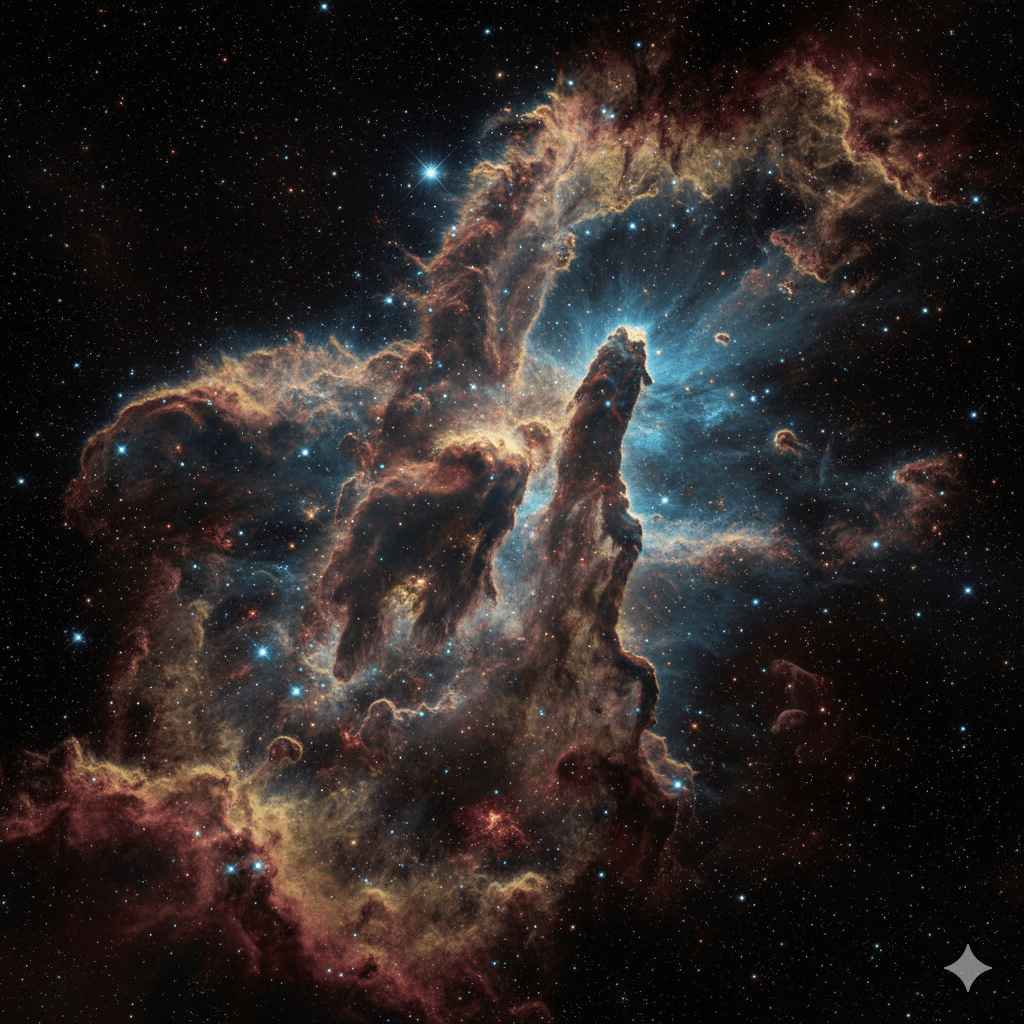
Abstract:
This literature review comprehensively synthesizes the evolving best practices for the full lifecycle of James Webb Space Telescope (JWST) imagery, from initial data retrieval to final public-facing aesthetic processing. The primary research themes cover Data Access and Archival, Scientific Calibration and Processing, and Aesthetic Visualization and Presentation.
The review establishes that the cornerstone of access lies with the NASA MAST archive, where data is primarily distributed in the complex, multi-extension FITS image format. Key studies emphasize the necessity of programmatic access using Python/Astropy and the JWST Pipeline for rigorous image calibration and correction of artifacts. The evolution of processing shows a shift from general-purpose tools to specialized pipelines like Astropy and community-developed solutions like Eureka!, underscoring the increasing complexity of mid-infrared data handling.
Best practices for visualization fall into two domains: quick-look scientific inspection via tools like SAOImage DS9 and advanced false-color compositing for public outreach. The latter involves a critical, non-trivial step of mapping shorter infrared wavelengths (e.g., NIRCam) to blue/cyan and longer wavelengths (e.g., MIRI) to red/gold, which requires specialized non-linear stretching. This review provides a structured workflow analysis and tool comparison, offering essential guidance for astronomers, data scientists, and astrophotographers seeking to move beyond raw data to scientifically accurate and compelling imagery.
Step-by-Step Guide for Working with JWST Imagery
Phase 1: Accessing and Downloading the Raw Data (The Archive)
This guide translates the specialized information from the literature review into a simple, three-stage workflow for accessing, viewing, and aesthetically editing JWST imagery. The process moves from the highly technical FITS data to a beautiful, public-ready image.
The most important source for all JWST data is the Mikulski Archive for Space Telescopes (MAST).
Step Action Best Practice / Finding from Review 1.1. Navigate to MAST Go to the official MAST Portal (mast.stsci.edu). This is the primary access point recommended for all first-time users. All publicly released JWST data is stored here. Programmatic access (APIs) is possible, but the web portal is best for beginners. 1.2. Search for Data Use the “Advanced Search” to filter by Mission: JWST and the Target Name (e.g., Carina Nebula or its catalogue ID, NGC3324). Searching by Target Name or a specific Program ID is the most effective way to locate a set of images for one object. 1.3. Select Files Identify the multiple files for your chosen target. You must download files from different filters (e.g., F090W, F150W, F444W) to create a color image. You need at least three filters to map to Red, Green, and Blue channels. For each filter, look for the highly processed file, typically ending in _i2d.fits(Level 3 or final calibrated data).1.4. Download Select your chosen files and use the Download Manager. Be aware that these files, in the FITS format, can be several gigabytes each. FITS is the universally used scientific format. You will need to disable pop-up blockers, as the download process often uses a pop-up window. 1.5. Extract the Science Data After unzipping, navigate through the folders. The actual image data you want is within the FITS file, specifically in the extension with the SCIheader.The FITS format is Multi-Extension (MEF). The first or primary extension is usually header information; the science data resides in a subsequent extension labeled SCI.Phase 2: Viewing and Basic Scientific Inspection (The Quick Look)
Since FITS files cannot be opened like a standard JPEG, you need specialized software.
Step Action Best Practice / Finding from Review 2.1. Install a FITS Viewer Download and install a dedicated FITS viewer like SAOImage DS9 (free and cross-platform). DS9 is the standard, most-cited tool for astronomers for quick viewing and inspection of FITS files. 2.2. Open the FITS Files Open each filter’s FITS file in DS9. If it opens in a solid black or white screen, you must adjust the stretch and scale. The data is in 32-bit floating-point format and must be contrast-stretched to become visible on an 8-bit screen. Use the scale options (e.g., Log, Sqrt, or ZScale) to reveal the detail. 2.3. Inspect Data Quality Use the view options to switch between the extensions within the file. Specifically, look at the ERR(error) andDQ(Data Quality) extensions.Best practice for scientific review is to check the Data Quality. The DQarray flags bad pixels, cosmic ray hits, and other artifacts that need to be masked or ignored during processing.2.4. Align the Images Since the multiple filter images may not be perfectly aligned, use DS9’s features to match them up, often using the World Coordinate System (WCS) option. Alignment is a critical prerequisite for creating a composite color image; the pixels of each filter must correspond exactly to the same location in space. Phase 3: Aesthetic Editing and False-Color Compositing (The Magazine Image)
This phase turns the multiple gray-scale FITS images into a single, vibrant, and informative color image.
Step Action Best Practice / Finding from Review 3.1. Convert to RGB Layers Export each of your contrast-stretched FITS images (e.g., three filters) into an easily editable 16-bit or 32-bit image format, such as TIFF. Recommended FITS Liberator 4 for stretching and creation of TIFF files. Standard image editors like GIMP or Photoshop (cited in the review) require TIFF or similar layered formats; they cannot natively handle FITS data. 3.2. Apply False Color Mapping In your image editor, assign your three TIFF files to the Red (R), Green (G), and Blue (B) color channels of a new RGB composite image. This is the most crucial step: Shorter Wavelength Blue/Cyan and Longer Wavelength Red/Gold is the widely accepted, scientifically-driven best practice. 3.3. Non-linear Stretching Apply aggressive, non-linear stretching (such as logarithmic or hyperbolic stretching) to the individual color channels to pull faint detail out of the background noise. This maximizes the Dynamic Range (HDR), making the image pop. It is what separates raw JWST data from the finished, magazine-quality public images. 3.4. Final Touches Fine-tune the color balance, remove noise/artifacts flagged in the DQimage, and sharpen the final composite.Aesthetic editing is an “art as much as a science.” The goal is a visually compelling image that remains true to the scientific assignment of color. The key to creating professional-grade JWST imagery is to embrace the programmatic access and advanced tools, as demonstrated in this video tutorial: Easiest Way to Download JWST Data.
artificial intelligence, Astrophotography editing guide, Astropy Python JWST, digital-marketing, FITS image editing for astrophotography, GIMP Photoshop astronomy, James Webb Space Telescope data guide, JWST false color mapping, JWST FITS file access, JWST image calibration workflow, JWST image processing tutorial, JWST image viewing DS9, marketing, NASA MAST archive download, open-source astronomy tools, photography, SAOImage DS9 tutorial, Space telescope data processing, Webb telescope data analysis -
The Spectroscopic Frontier: A Comprehensive Review of Exoplanet Atmospheric Characterization in the JWST Era
Abstract
This literature review examines the dramatic advancements in exoplanet atmospheric characterization, charting the field’s transition from initial detections to detailed, high-fidelity spectroscopic analyses in the era of the James Webb Space Telescope (JWST).
The foundational observational techniques—Transmission Spectroscopy (Charbonneau et al. ) and Secondary Eclipse/Emission Spectroscopy (Deming et al. )—have been augmented by the deployment of High-Resolution Spectroscopy (HRS) for dynamic studies and the integration of high-contrast integral field spectroscopy on next-generation instruments like the Extremely Large Telescope’s (ELT) HARMONI for molecule mapping.
The advent of JWST has driven immediate breakthroughs, providing the first definitive evidence of complex photochemistry (SO2 and CO2 on WASP-39b ), enabling the characterization of the notoriously opaque sub-Neptune GJ 1214b below its thick haze layer , and identifying the intriguing Hycean candidate K2-18b through the detection of carbon-bearing molecules.
This influx of high-precision data has exposed critical methodological and physical hurdles. Computationally, the complexity and volume of JWST spectra have rendered traditional Bayesian retrieval methods prohibitively expensive. This challenge is being addressed by a paradigm shift toward amortized inference using neural networks (e.g., FASTER), which performs practically instantaneous Bayesian analysis and model comparison. Physically, persistent debates center on the cloud/haze degeneracy problem and the revelation that imperfect stellar models introduce significant systematic errors in emission spectroscopy, even for high-precision JWST data.
For future research, the review highlights critical gaps, particularly the severe data scarcity for temperate rocky exoplanets and the theoretical disconnect between retrieved atmospheric compositions and protoplanetary disk evolution. The search for biosignatures must adhere to the principle of life as the “hypothesis of last resort” , requiring comprehensive contextual observations to rigorously rule out abiotic false positives. Future success hinges on the coordinated synergy between the statistical census capabilities of missions like ARIEL and the dynamical mapping capabilities of ELT-class ground-based facilities , prioritizing large-scale, multi-transit campaigns to characterize habitable-zone worlds.
Advances in Exoplanet Atmospheric Characterization: Techniques, Discoveries, and Future Prospects
I. Introduction and Historical Context
I.A. Defining the Scientific Imperative and Scope of Characterization
Exoplanet atmospheric characterization represents the critical pivot in exoplanetary science, moving research beyond the statistical detection of new worlds toward the detailed investigation of their physical and chemical states. This undertaking is paramount, as the atmosphere serves as the observable link connecting a planet’s formation mechanisms, its long-term evolution, and its ultimate potential for supporting life. The scope of characterization has expanded dramatically, evolving from the initial measurement of bulk planetary properties (mass, radius) to an exhaustive spectroscopic census that seeks to determine atmospheric composition, thermal structure, and dynamic processes, including global circulation patterns and atmospheric loss.1 These comprehensive investigations are essential for interpreting the conditions that prevail on extrasolar planets.
I.B. The Foundational Era: From Detection to First Light
The current capability for atmospheric characterization is entirely dependent upon the foundational techniques of radial velocity and transit photometry, which established the prerequisite bulk parameters—mass, radius, and orbital configuration—necessary to select viable targets.
The characterization era was inaugurated by landmark spectroscopic achievements utilizing the Hubble Space Telescope (HST). The first robust detection of an exoplanet atmosphere was reported by Charbonneau et al. in 2002.2 Using the HST’s STIS spectrograph, the team measured absorption from atomic Sodium (Na D lines) in the optical transmission spectrum of the hot Jupiter HD209458b, detecting a signal at a level of percent.2 This successful detection established transmission spectroscopy as the primary early tool for probing exoplanetary envelopes. It is important to note that the difficulty encountered in confirming this Na detection from ground-based telescopes at the time, due to pervasive systematic effects and contamination, directly foreshadowed the subsequent necessary development of High-Resolution Spectroscopy (HRS).1 The limitations imposed by telluric (Earth’s atmospheric) and stellar contamination became the driving force necessitating the technological shift toward instruments capable of high spectral resolving power for effective isolation of the planetary signal.1
Following the success of transmission spectroscopy, the field rapidly progressed to measure thermal emission. Deming et al. (2005) pioneered occultation spectroscopy, or secondary eclipse spectroscopy, demonstrating the ability to measure the planet’s emitted light when it passes behind its host star.3 This technique provided the first constraints on dayside temperature profiles. The success of occultation spectroscopy served as a critical foundational justification for the design requirements and wavelength coverage specifications of future large, cryogenic space observatories, recognizing the inherent need for high-sensitivity infrared capabilities realized today by JWST.3
Concurrently, a separate branch of atmospheric characterization emerged with the first robust direct images of exoplanets published by Kalas et al. (2008) and Marois et al. (2008). These images captured young, self-luminous gas giants (e.g., Fomalhaut b and the HR 8799 system).4 This area of research highlighted the extreme technical challenges involved, specifically the necessity of suppressing the host star’s light (which can be up to times brighter than the planet) to overcome diffraction and scattering limitations imposed by physics and engineering.4 These early efforts utilized techniques such as coronagraphy and angular differential imaging (ADI) to confirm planetary identity and obtain initial low-resolution spectral data.4
The historical trajectory shows a clear scientific mandate: the progression from easily studied, massive, highly irradiated planets (Hot Jupiters) toward the daunting challenge of characterizing faint, low-mass, temperate, rocky worlds, necessitating an exponential increase in observational precision and modeling sophistication.5
Table I: Seminal Studies Driving Exoplanet Atmospheric Characterization
Study (Author, Year) Technique Target Class Core Finding Charbonneau et al. (2002) 2 Transmission Spectroscopy (HST) Hot Jupiter (HD209458b) First robust detection of an exoplanet atmosphere (Sodium). Deming et al. (2005) 3 Secondary Eclipse Spectroscopy Hot Jupiters Demonstrated thermal emission measurement (occultation spectroscopy). Marois et al. (2008); Kalas et al. (2008) 4 Direct Imaging Young Gas Giants (HR 8799, Fomalhaut b) First images and low-res spectra, confirming planet identity and structure. JWST/NASA (2022-present) 5 Transmission/Emission Spectroscopy Gas Giants, Sub-Neptunes First detections of , , and complex photochemistry (WASP-39b); identification of Hycean candidates (K2-18b). II. Observational Techniques for Atmospheric Probing
II.A. Transit and Eclipse Spectroscopy: Principles and Limitations
Transmission Spectroscopy yields information on the atmospheric absorption profile at the planet’s terminator as it passes in front of the star. The signal is proportional to the atmospheric scale height, making it highly effective for gas-rich envelopes. However, stellar contamination, driven by phenomena such as starspots and active regions, remains a persistent systematic barrier, particularly for the small signal sizes expected from Earth-sized planets orbiting active M-dwarf stars.7 This effect can severely obscure or mimic atmospheric features, complicating robust retrieval.
Secondary Eclipse Spectroscopy (Emission Spectroscopy) measures the thermal radiation emitted by the planet’s dayside. This technique provides critical insights into the planetary thermal structure, energy redistribution, and circulation patterns. While often assumed to be less susceptible to stellar surface inhomogeneity than transmission spectroscopy, recent research has indicated a critical dependence on the accuracy of stellar models. The use of imperfect knowledge regarding stellar spectra introduces systematic uncertainty in emission spectroscopy that substantially limits the ability to constrain parameters like planetary albedo and distinguish between different types of bare rocky surfaces.7 Specifically, discrepancies between current stellar models (e.g., SPHINX vs. PHOENIX) can lead to differences of up to 60 ppm in eclipse depth estimations for M8 stars, creating degeneracies that weaken constraints on the presence of an atmosphere.7 This finding necessitates a strategic shift, requiring that future high-precision emission observations, particularly with JWST, systematically include dedicated stellar mid-infrared spectroscopy to mitigate these uncertainties and ensure the fidelity of the retrieved planetary parameters.7
II.B. High-Resolution Spectroscopy (HRS) and Kinematics
High-Resolution Spectroscopy (HRS), generally executed by instruments on large ground-based telescopes, has matured into a mainstream characterization technique.1 The chief advantage of HRS lies in its exceptional spectral resolving power (), which allows for the efficient separation of the planetary signal from terrestrial (telluric) and stellar contaminants using the planet’s significant Doppler velocity shift.1
HRS is indispensable for moving beyond static chemical inventories to dynamic atmospheric science. It facilitates detailed studies of global winds, atmospheric circulation patterns, and atmospheric loss mechanisms.1 Key findings utilizing HRS include the detection of a rich spectrum of atomic and ionic species in the highest irradiated planets. Furthermore, the observation of enormous leading and/or trailing tails of light gases, such as helium, escaping these highly irradiated worlds provides unique and direct insights into planetary evolution and atmospheric escape processes.1 The ability of HRS to provide precise measurements of kinematics makes it the ideal complementary tool to the high-precision flux measurements delivered by space-based platforms like JWST.
II.C. Direct Imaging (DI) and High-Contrast Spectroscopy
Direct imaging, though limited to wide-separation, typically young, and self-luminous planets, offers the advantage of isolating the planetary light source. Historically, the technique has been constrained by the immense contrast ratio between the planet and its star, along with the necessity of overcoming complex optical barriers like diffraction and speckle noise.4 Modern approaches utilize highly optimized coronagraphy, sophisticated adaptive optics (AO), and angular/spectral differential imaging.4
The future trajectory of DI involves the merger of high-contrast capabilities with integral field spectroscopy. The ELT instrument HARMONI, for example, will combine high-contrast AO with medium-resolution spectroscopy (up to ).9 This synergy enables “molecule mapping,” a technique that uses the molecular signatures within the spectrum to disentangle the faint planetary signal from residual stellar and telluric background noise, significantly boosting the signal-to-noise ratio.9 Simulations indicate that this combined approach allows for the detection of companions up to 2.5 magnitudes fainter than achievable with classical high-contrast imaging methods, reaching contrasts of 16 magnitudes at close separations (down to 75 mas).9 This demonstrates a definitive evolution of direct imaging into a powerful tool for routine atmospheric characterization, rather than just detection.
III. The Role of Current and Future Instrumentation
III.A. The JWST Revolution: High-Precision Infrared Spectroscopy
JWST, leveraging its cryogenic operating environment and high-precision infrared instruments, has delivered the breakthrough data anticipated since the earliest thermal emission studies.3 Its broad-band, high-fidelity spectroscopy (NIRSpec, MIRI) facilitates both precise molecular detection and detailed mapping of thermal structures.
JWST’s observations have provided critical proof-of-concept for complex atmospheric processes. For instance, the first definitive detection of carbon dioxide () and sulfur dioxide () in the atmosphere of the hot Saturn WASP-39b was achieved using JWST.5 The detection is particularly telling, as it serves as unambiguous evidence of active photochemistry—chemical reactions driven by energetic stellar radiation—indicating the capability to probe atmospheric processes beyond simple chemical equilibrium models.5 JWST is also pushing into the terrestrial regime, exemplified by the first thermal emission measurement on an Earth-sized planet, TRAPPIST-1b, which suggested the absence of a significant atmosphere.5
III.B. Future Space Missions: ARIEL’s Comprehensive Survey Strategy
While JWST focuses on highly detailed case studies, the ESA ARIEL mission (launch 2029) is designed to address the need for statistical characterization by surveying the atmospheres of hundreds of exoplanets.11 ARIEL’s instrumentation includes spectrometers and photometers providing continuous spectral coverage from 0.5 to 7.8 .12
The strategic goal of ARIEL is to define population trends, allowing robust testing of planet formation theories (e.g., correlations with stellar metallicity 13) and establishing definitive atmospheric classifications for diverse planetary types. A key component is the NASA CASE instrument, dedicated to characterizing and observing clouds and hazes.11 This directly tackles the cloud/haze degeneracy problem 14, ensuring that the retrieved chemical compositions across the statistical sample are reliable and quantified.11 The statistical power afforded by ARIEL is necessary to calibrate the prevalence of the complex phenomena (e.g., photochemistry, inversions) initially discovered by JWST.
III.C. Ground-Based Giant Telescopes (ELT) and High-Contrast Characterization
The future generation of Extremely Large Telescopes (ELT) will provide unprecedented light-gathering power for high-resolution and high-contrast atmospheric characterization. Instruments like HARMONI on the ELT will combine sophisticated adaptive optics with integral field spectroscopy.9
The synergy between the statistical precision of JWST/ARIEL and the dynamical capabilities of the ELT is critical. The massive increase in light collecting area and the superior HRS capabilities on ELTs are projected to increase detection speed for HRS by up to three orders of magnitude.1 This dramatic improvement is the key factor that finally makes the characterization of temperate, rocky exoplanets tractable for ground-based facilities. This necessity confirms that the study of small, faint worlds requires a joint space-ground roadmap, coordinating campaigns (such as prioritizing multi-transit windows on JWST 8) with the kinematic mapping capabilities of ELT HRS.1
IV. Advanced Atmospheric Modeling and Retrieval
IV.A. Radiative Transfer, Clouds, and the Degeneracy Problem
The sophisticated forward modeling of exoplanet atmospheres requires solving the radiative transfer equation coupled with complex thermal and chemical models. A persistent physical hurdle remains the ubiquitous presence of clouds and hazes, which efficiently scatter and absorb light, muting diagnostic spectral features.14 This effect introduces a critical degeneracy in retrieval analyses, meaning multiple atmospheric models can equally fit the observational data, leading to ambiguous constraints on chemical composition or temperature structure. Comprehensive cloud modeling is therefore recognized as potentially the limiting factor in the ability to fully interpret future high-fidelity observations.14
However, the degeneracy is proving to be wavelength-dependent. The success of JWST in probing the heavy-element-rich atmosphere of GJ 1214b 15, a planet traditionally opaque due to a thick haze layer 16, demonstrates that observation in the mid-infrared can penetrate below the obscuring layers. This reinforces the need for broad-wavelength coverage (e.g., ARIEL’s to range 12) to maximize pressure level penetration and provide simultaneous constraints on high-altitude opacity (haze) and deeper chemical composition.
IV.B. Atmospheric Retrieval: Computational Bottlenecks and the Paradigm Shift
Historically, atmospheric properties have been inferred from spectra using Bayesian retrieval methods, typically implemented via Markov Chain Monte Carlo (MCMC) or Nested Sampling. These techniques are computationally demanding because they must explore a complex parameter space defined by thermal profiles, chemical compositions, and cloud models to identify the best fit.17
The massive influx of high-quality spectra from JWST, requiring analysis over thousands of targets and demanding exploration of large ensembles of complex models 18, has rendered traditional Bayesian inference methods prohibitively expensive.17 This computational pressure necessitates a fundamental algorithmic paradigm shift.
The development of neural-network based techniques, such as FASTER (Fast Amortized Simulation-based Transiting Exoplanet Retrieval) 17, offers the necessary solution through amortized inference. This framework performs practically instantaneous Bayesian inference and model comparison after an initial training phase, matching the posterior distribution results of classical techniques (e.g., for WASP-39b).17 The critical advantage of amortized inference is its ability to perform analyses over large ensembles of spectra—real or simulated—at minimal additional computational cost.18 This constitutes a requisite technological leap, allowing researchers to quickly gain valuable insight into complex model distinctions (such as cloudy vs. cloud-free models), which would be computationally intractable using classical methods.18
IV.C. Global Circulation Models (GCMs) and Photochemistry
Interpreting the thermal profiles and energy budgets of exoplanets, particularly tidally locked worlds, requires moving beyond simple one-dimensional models to use three-dimensional Global Circulation Models (GCMs). GCMs simulate heat redistribution, global winds, and circulation patterns (e.g., the potential for anti-Hadley circulation hypothesized for planets like GJ 1214b 19).
The modern evolution of GCMs involves coupling them with sophisticated photochemical kinetics schemes.20 This coupling is vital for understanding how the external environment, such as intense stellar flares, chemically alters the atmosphere. For M-dwarf orbiting terrestrial planets, stellar flares can induce significant changes in atmospheric composition via high-energy UV irradiation, fundamentally impacting the long-term viability of the atmosphere and its potential habitability.20 This integrative modeling confirms that atmospheric modeling now functions as a crucial diagnostic tool for interpreting time-dependent physical and chemical processes, rather than simply providing a static compositional fit.
V. Characterization Discoveries by Planet Class
V.A. Hot Jupiters and Gas Giants
Retrieval analyses focusing on Hot Jupiters have provided key constraints on planet formation theory. These massive, highly irradiated worlds display rich chemical spectra, often featuring atomic and ionic species.1 Analysis of their compositions frequently points toward solar metallicities and chemistry, which generally supports the Core Accretion model for giant planet formation.1 Furthermore, recent advancements have enabled the detection of minor isotopes of carbon and oxygen in these gas giants, offering high-fidelity data points that may illuminate precise formation pathways.1
Observational data also highlight a clear division among hot Jupiters based on their thermal structure: a dichotomy exists between planets with and without atmospheric temperature inversions, which correlates strongly with their equilibrium temperature.1 These inversions are believed to be caused by high-altitude absorbers that effectively trap stellar light. Finally, the detection of vast tails of escaping helium gas in these highly irradiated systems provides observational evidence of ongoing atmospheric loss, placing direct constraints on models of planetary evolution.1
V.B. Mini-Neptunes and Super-Earths: Compositional Diversity
Super-Earths (planets up to ) and Mini-Neptunes (often defined by radii between and ) are planetary classes common in the galaxy but absent from our solar system.21 The fundamental question surrounding these worlds is their bulk composition: whether they are primarily rocky, contain large fractions of water ice, or possess substantial hydrogen/helium envelopes.21
GJ 1214b: This nearby sub-Neptune remained spectroscopically opaque for over a decade due to a thick, high-altitude haze.15 JWST successfully used mid-infrared emission spectroscopy to measure its thermal profile, achieving the first direct detection of light emitted by a planet in this mass class.15 The results suggest the atmosphere contains water vapor and is rich in elements heavier than hydrogen.15 This finding supports the notion that low-mass planet formation often involves the accretion of significant solid materials (rock or ice), resulting in a divergence from the solar system’s gas giant composition.
K2-18b and Hycean Worlds: The JWST investigation of K2-18b (), orbiting in its star’s habitable zone, revealed the presence of carbon-bearing molecules, specifically methane () and carbon dioxide ().6 These findings support the intriguing possibility that K2-18b is a Hycean exoplanet—a world characterized by a hydrogen-rich atmosphere enveloping a deep, potentially habitable water ocean.6 This discovery is crucial because it expands the traditional scope of habitability, requiring consideration of diverse environments beyond the classical Earth analog.6
V.C. Atmospheric Escape and Evolution
Atmospheric escape is a primary physical process that filters the outcomes of planetary evolution. While stellar radiation (particularly high-energy X-ray and UV flux) is the main driver, other stellar environmental factors, including stellar winds, stellar flares, coronal mass ejections, and magnetic fields, exert significant control over the escape mechanisms.23 The observed detection of extended, escaping gaseous tails around highly irradiated planets provides direct constraints on how long low-mass planets can retain their volatile envelopes, fundamentally influencing the boundary of the long-term habitable zone.1
VI. Conflicting Viewpoints and Ongoing Debates
VI.A. Planet Formation: Metallicity Correlation and the C/O Ratio
The exact nature of the relationship between host-star metallicity and giant planet occurrence is a subject of active research. While the link is generally accepted, questions persist regarding the precise functional form of this relationship and its applicability to terrestrial planets.13 Recent comprehensive analyses have identified systematic differences in formation outcomes tied to metallicity: sub-Jupiter mass planets () orbit hosts that are systematically less metallic than the hosts of Jupiter-mass planets.13 This observation suggests that planet formation channels are not monolithic, but may be complexly linked to disc lifetime and the availability of planet-building materials in high-metallicity environments.13 Importantly, these findings challenge the existence of a sharp mass breakpoint above which formation channels fundamentally differ; instead, the resulting mass may be strongly influenced by environmental conditions, such as stellar or disc mass.13
VI.B. The Limit of Precision: Stellar Contamination and Degeneracy
Stellar activity has long constituted a major systematic error source in transmission spectroscopy.7 A pressing debate has emerged concerning the robustness of emission spectroscopy against these same stellar uncertainties. Analysis reveals that even high-precision JWST secondary eclipse observations suffer from significant systematic error when stellar models are inaccurate. For instance, current stellar model discrepancies can introduce a difference in eclipse depth for M8 stars.7 This error margin is sufficient to limit the ability to confidently constrain planetary albedo and prevent reliable distinction between different bare surface types (e.g., basalt versus granitoid).7 The proposed resolution is a systematic observational requirement: future JWST campaigns focusing on secondary eclipses must integrate concurrent stellar mid-infrared spectroscopy to anchor the stellar parameters and effectively remove this source of systematic uncertainty.7
VI.C. Biosignatures and the “Hypothesis of Last Resort”
The search for biosignatures, particularly molecular oxygen (), is complicated by the existence of numerous abiotic processes—or false positives—that can generate significant atmospheric without the presence of life.24 Mechanisms such as runaway water loss on M-dwarf planets can flood the atmosphere with after hydrogen has escaped.25
This reality has shifted the scientific focus from mere detection to robust validation. The consensus in astrobiology is that life must be treated as the “hypothesis of last resort”.26 Robust interpretation of a potential biosignature requires comprehensive contextual observations, including constraining the planet’s UV environment, cloud coverage, total pressure, and the abundances of companion molecules (, , ).24 The objective is to observationally rule out every potential abiotic mechanism, thereby increasing confidence in a biogenic interpretation. This mandates a holistic approach to characterization, where stellar properties (e.g., flare activity 20) are essential components in assessing planetary habitability.
VII. Gaps in the Current Literature and Future Research Suggestions
VII.A. Gaps in the Current Literature
The most substantial scientific gaps involve the characterization of intrinsically difficult targets and limitations in connecting atmospheric observations to planet formation theory.
- Temperate Rocky Exoplanets: While JWST has initiated characterization (e.g., TRAPPIST-1b 5), this population remains severely data-starved. The small atmospheric signal, coupled with the high systematic noise from active M-dwarf host stars, makes robust characterization extremely challenging.8 Furthermore, long-period exoplanets, which are often less irradiated and potentially dynamically analogous to outer solar system bodies, are heavily under-represented in the current spectroscopic catalog due to the selection bias inherent in transit surveys.
- Formation Theory Disconnect: A fundamental theoretical gap persists in linking retrieved atmospheric composition (e.g., heterogeneous abundances 27) directly to the structural and chemical evolution of the protoplanetary disk. Models must better integrate the effects of disk inhomogeneities, the distribution of solid particles, and the simultaneous thermal and chemical processes that occur during planet formation.27
- Modeling Resolution Limitations: The persistent use of 1D atmospheric models for many retrieval analyses limits the understanding of key processes like atmospheric dynamics and heat transport. There is a need for the routine, systematic implementation of high-fidelity, 3D Global Circulation Models coupled with sophisticated photochemical schemes to accurately interpret the thermal structure and mixing processes in rapidly rotating or tidally locked worlds.19
VII.B. Strategic Future Research Roadmap
Addressing the literature gaps and ongoing debates requires a coordinated, multi-institutional, and computationally advanced roadmap.
- Prioritize Integrated Campaigns for Terrestrial Worlds: The systemic challenges inherent in characterizing temperate rocky planets mandate that future research prioritize large-scale, joint space- and ground-based initiatives.8 To mitigate stellar activity and maximize data efficiency, observational planners must strategically prioritize multi-transit windows.8
- Advance Computational and Measurement Infrastructure: The computational crisis must be addressed by the widespread adoption of amortized inference frameworks like FASTER 17 to manage the enormous data volumes from current and future missions. Furthermore, the systematic uncertainty introduced by stellar model inaccuracies dictates that all high-precision emission campaigns must mandate dedicated concurrent stellar mid-infrared spectroscopy.7
- Exploit ELT for Dynamic Science: Future ground-based research must capitalize on the dramatic speed increase and resolution provided by ELTs (e.g., ELT/HARMONI).1 This capability must be systematically employed to map atmospheric dynamics—global circulation, wind speeds, and atmospheric escape rates 23—across diverse planetary classes, transitioning the field into a mature discipline of planetary atmospheric dynamics.
- Define and Characterize Hycean Worlds: Continued, comprehensive follow-up characterization of Hycean candidates like K2-18b 6 is required. The focus must be on constraining the internal structures and testing the stability of these hydrogen-rich atmospheres, which offer a promising, non-Earth-like avenue in the search for extraterrestrial habitability.
VIII. Conclusions and Recommendations
Exoplanet atmospheric characterization has entered an era defined by high-fidelity space-based measurements and unprecedented computational demands. The field has moved successfully from the detection of elemental absorption in highly inflated Hot Jupiters to the chemical inventory of sub-Neptunes and the search for biosignatures on temperate worlds.
The core conclusions drawn from the current literature are threefold:
- Synergy is Essential: No single observational technique can provide the full picture. The deepest scientific understanding requires the integration of JWST’s broad, high-precision molecular census, ARIEL’s statistical population overview, and the ELT’s high-resolution kinematic mapping capability.
- The Star is a Systemic Error Source: For highly precise characterization, particularly of small planets around M-dwarfs, the host star cannot be treated as a stable blackbody. Stellar model uncertainties introduce significant systematic errors in both transmission and emission spectroscopy.7 Mitigating these errors requires dedicated, concurrent stellar observations and specialized retrieval methodologies.
- Validation Over Detection: The scientific confidence necessary to identify biosignatures requires a shift in research strategy, focusing on ruling out all plausible abiotic false positive mechanisms through contextual observations (e.g., planetary context, stellar UV environment) before life can be considered the hypothesis of last resort.26
Based on these conclusions, the following strategic recommendations are highly relevant: The astronomical community must prioritize the development and institutionalization of computationally efficient retrieval pipelines (e.g., amortized inference) to process the impending data volumes. Furthermore, future mission planning must be explicitly structured as coordinated, large-scale, joint space-ground campaigns, particularly for the ambitious goal of characterizing temperate, low-mass, potentially habitable worlds.
Works cited
- Exoplanet Atmospheres at High Spectral Resolution | Annual Reviews, accessed on October 13, 2025, https://www.annualreviews.org/content/journals/10.1146/annurev-astro-052622-031342
- [0805.0789] Ground-based detection of sodium in the transmission spectrum of exoplanet HD209458b – arXiv, accessed on October 13, 2025, https://arxiv.org/abs/0805.0789
- Finding and Characterizing SuperEarth Exoplanets Using Transits and Eclipses, accessed on October 13, 2025, https://www8.nationalacademies.org/astro2010/DetailFileDisplay.aspx?id=236
- Direct Imaging of Exoplanets – American Museum of Natural History, accessed on October 13, 2025, https://www.amnh.org/content/download/53052/796511/file/direct-imaging-of-exoplanets.pdf
- Webb’s Impact on Exoplanet Research – NASA Science, accessed on October 13, 2025, https://science.nasa.gov/mission/webb/science-overview/science-explainers/webbs-impact-on-exoplanet-research/
- Webb Discovers Methane, Carbon Dioxide in Atmosphere of K2-18 b – NASA Science, accessed on October 13, 2025, https://science.nasa.gov/missions/webb/webb-discovers-methane-carbon-dioxide-in-atmosphere-of-k2-18-b/
- [2502.19585] Stellar Models Also Limit Exoplanet Atmosphere Studies in Emission – arXiv, accessed on October 13, 2025, https://arxiv.org/abs/2502.19585
- De Wit et al. 2024: A roadmap for the atmospheric characterization of terrestrial exoplanets with JWST – NASA GISS, accessed on October 13, 2025, https://www.giss.nasa.gov/pubs/abs/de08900u.html
- [2104.11251] Direct imaging and spectroscopy of exoplanets with the ELT/HARMONI high-contrast module – arXiv, accessed on October 13, 2025, https://arxiv.org/abs/2104.11251
- HARMONI – ELT | ESO, accessed on October 13, 2025, https://elt.eso.org/instrument/HARMONI/
- Atmospheric Remote-sensing Infrared Exoplanet Large-survey – NASA Science, accessed on October 13, 2025, https://science.nasa.gov/mission/ariel/
- Ariel Space Mission – European Space Agency M4 Mission, accessed on October 13, 2025, https://arielmission.space/
- Heavy Metal Rules. I. Exoplanet Incidence and Metallicity – MDPI, accessed on October 13, 2025, https://www.mdpi.com/2076-3263/9/3/105
- Clouds and Hazes in Exoplanet Atmospheres – ResearchGate, accessed on October 13, 2025, https://www.researchgate.net/publication/234813572_Clouds_and_Hazes_in_Exoplanet_Atmospheres
- Researchers get first up-close look at mysterious planet’s atmosphere – UChicago News, accessed on October 13, 2025, https://news.uchicago.edu/story/researchers-get-first-close-look-mysterious-planets-atmosphere
- New Type of Alien Planet Is a Steamy ‘Waterworld’ | Space, accessed on October 13, 2025, https://www.space.com/14634-alien-planet-steamy-waterworld-gj1214b.html
- Near-instantaneous Atmospheric Retrievals and Model Comparison with FASTER – arXiv, accessed on October 13, 2025, https://arxiv.org/html/2502.18045v1
- [2502.18045] Near-instantaneous Atmospheric Retrievals and Model Comparison with FASTER – arXiv, accessed on October 13, 2025, https://arxiv.org/abs/2502.18045
- Disentangling atmospheric compositions of K2-18 b with next generation facilities – PMC, accessed on October 13, 2025, https://pmc.ncbi.nlm.nih.gov/articles/PMC9166872/
- 3D modelling of the impact of stellar activity on tidally locked terrestrial exoplanets: atmospheric composition and habitability | Monthly Notices of the Royal Astronomical Society | Oxford Academic, accessed on October 13, 2025, https://academic.oup.com/mnras/article/518/2/2472/6779704
- What Is a Super-Earth? – NASA Science, accessed on October 13, 2025, https://science.nasa.gov/exoplanets/super-earth/
- Super-Earth – Wikipedia, accessed on October 13, 2025, https://en.wikipedia.org/wiki/Super-Earth
- accessed on October 13, 2025, https://arxiv.org/abs/2502.18124#:~:text=Stellar%20radiation%20is%20one%20of,of%20exoplanet%2C%20as%20the%20planetary
- Biosignature False Positives – NASA Technical Reports Server, accessed on October 13, 2025, https://ntrs.nasa.gov/api/citations/20180004768/downloads/20180004768.pdf
- Exoplanet Biosignatures: Understanding Oxygen as a Biosignature in the Context of Its Environment – PMC – PubMed Central, accessed on October 13, 2025, https://pmc.ncbi.nlm.nih.gov/articles/PMC6014580/
- Life on the edge: using planetary context to enhance biosignatures and avoid false positives – Oxford Academic, accessed on October 13, 2025, https://academic.oup.com/mnras/advance-article-pdf/doi/10.1093/mnras/staf1204/63851599/staf1204.pdf
- Exoplanetary Atmospheres: Key Insights, Challenges and Prospects – NExScI, accessed on October 13, 2025, https://nexsci.caltech.edu/workshop/2019/madhusudhan_2019_exoplanets_review.pdf
ARIEL mission, astronomy, Atmospheric escape, Atmospheric photochemistry, Atmospheric retrieval, Bayesian retrieval, ELT, Emission spectroscopy, Exoplanet atmospheric characterization, Exoplanet biosignatures, exoplanets, FASTER, GJ 1214b, Global Circulation Models (GCMs), High-resolution spectroscopy, Hycean exoplanets, JWST exoplanet spectroscopy, Mini-Neptunes, nasa, science, space, Stellar contamination, Super-Earth atmospheres, Transmission spectroscopy, wasp-39b -
High-Redshift Cosmology in the JWST Era: ΛCDM Tension, Early Massive Galaxies, and the 21 cm Frontier
Abstract: Tracing the Universe’s Origins
High-redshift cosmology (
z≳6), spanning the Cosmic Dawn and the Epoch of Reionization (EoR), currently stands as the central frontier of astrophysics. This review synthesizes recent findings, particularly those enabled by the James Webb Space Telescope (JWST), against the backdrop of the standard
ΛCDM cosmological model.
JWST has fundamentally altered the census of the early universe, revealing an unexpected population of massive, evolved galaxies at ultra-high redshifts (
z≳10).1 These structures, appearing mature just ∼300
million years after the Big Bang, introduce a strong tension with
CDM’s hierarchical growth predictions, suggesting that either star formation efficiency was radically higher or that fundamental cosmological parameters must be modified (e.g., Early Dark Energy or Constant Creation Cosmology).3 Further conflict exists in 21 cm cosmology, where the highly absorbed signal reported by EDGES at
z≈17 points toward an unexpectedly cold baryonic gas, potentially requiring exotic physics such as Scattering Dark Matter (SDM).6
Key research themes covered include the confirmed dominance of star-forming galaxies in driving the EoR (6≲z≲10
) 8, the search for direct and indirect evidence of zero-metallicity Population III stars 9, and the growth of Supermassive Black Holes traced by
z>6 quasars.10
We identify critical literature gaps and future imperatives:
- Observational Gaps: The Cosmic Dark Ages (
z≳20) remain unprobed, requiring dedicated radio observatories on the lunar farside.11 Robust spectroscopic confirmation of
z≳10 galaxies and accurate constraints on the faint-end slope of the UV luminosity function are crucial for resolving the ionizing photon budget.13
- Theoretical Imperatives: Resolving the Λ
CDM tension hinges on meticulously accounting for Cosmic Variance, which dominates the error budget for rare objects at
z≳12.14 Numerical models must transition from approximating the Cosmic Dawn and EoR as separate phases to fully coupled N-body/Radiative Transfer simulations.15
The path forward demands a strategic, multi-wavelength approach, leveraging the synergistic constraints from JWST, ALMA (for metallicity), the Nancy Grace Roman Space Telescope (for large-scale BAO measurements), and the Square Kilometre Array (SKA) for 21 cm cosmology.17 The next decade of high-redshift research promises to shift from merely charting cosmic history to definitively testing the fundamental physics governing the universe’s origins.
Tracing the Universe’s Origins: An Exhaustive Review of High-Redshift Cosmology () in the JWST Era
I. Introduction to the High-Redshift Universe: Epochs and Milestones
High-redshift cosmology, conventionally defined as the study of the universe at (less than a billion years after the Big Bang), represents the frontier of astrophysical investigation. This era is characterized by fundamental phase transitions that set the stage for all subsequent cosmic evolution. Recent observational breakthroughs, particularly from the James Webb Space Telescope (JWST), have necessitated a rigorous re-evaluation of established theoretical models and necessitated a new wave of computational and statistical techniques.
Tracing the Universes Origins An Exhaustive Review of High-Redshift Cosmology z gtrsim 6 in the JWST EraDownloadWorks cited
- Chronology of the universe – Wikipedia, accessed on October 13, 2025, https://en.wikipedia.org/wiki/Chronology_of_the_universe
- Early star-forming galaxies and the reionization of the Universe – The Royal Observatory, Edinburgh, accessed on October 13, 2025, https://www.roe.ac.uk/~jsd/recent_papers/Robertson.pdf
- Reionization – Wikipedia, accessed on October 13, 2025, https://en.wikipedia.org/wiki/Reionization
- Observing the Dark Ages of the Universe from the Far Side of the Moon, accessed on October 13, 2025, https://www.universetoday.com/articles/observing-the-dark-ages-of-the-universe-from-the-far-side-of-the-moon
- Testing common approximations to predict the 21-cm signal at the epoch of reionization and cosmic dawn | Phys. Rev. D, accessed on October 13, 2025, https://link.aps.org/doi/10.1103/PhysRevD.110.023543
- The impact of the first galaxies on cosmic dawn and reionization – Oxford Academic, accessed on October 13, 2025, https://academic.oup.com/mnras/article/511/3/3657/6521455
- Can You Explain These Long, Dark Gaps in Your Cosmological Resume? – AAS Nova, accessed on October 13, 2025, https://aasnova.org/2022/07/27/can-you-explain-these-long-dark-gaps-in-your-cosmological-resume/
- [2211.02129] High Redshift $Λ$CDM Cosmology: To Bin or not to Bin? – arXiv, accessed on October 13, 2025, https://arxiv.org/abs/2211.02129
- [1109.6012] 21-cm cosmology – arXiv, accessed on October 13, 2025, https://arxiv.org/abs/1109.6012
- New tool for 21-cm cosmology. I. Probing and beyond | Phys. Rev. D, accessed on October 13, 2025, https://link.aps.org/doi/10.1103/PhysRevD.109.043512
- Experiment to Detect the Global EoR Signature (EDGES) – LoCo Lab, accessed on October 13, 2025, https://loco.lab.asu.edu/edges/
- AARTFAAC Cosmic Explorer: observations of the 21-cm power spectrum in the EDGES absorption trough | Monthly Notices of the Royal Astronomical Society | Oxford Academic, accessed on October 13, 2025, https://academic.oup.com/mnras/article/499/3/4158/5920221
- Cosmic mysteries and the hydrogen 21-cm line: bridging the gap with lunar observations, accessed on October 13, 2025, https://pmc.ncbi.nlm.nih.gov/articles/PMC10961189/
- [1502.02024] Cosmic Reionization and Early Star-Forming Galaxies: A Joint Analysis of New Constraints from Planck and Hubble Space Telescope – arXiv, accessed on October 13, 2025, https://arxiv.org/abs/1502.02024
- Cosmic Reionization and Early Star-Forming Galaxies: A Joint Analysis of New Constraints from Planck and Hubble Space Telescope – ResearchGate, accessed on October 13, 2025, https://www.researchgate.net/publication/272027404_Cosmic_Reionization_and_Early_Star-Forming_Galaxies_A_Joint_Analysis_of_New_Constraints_from_Planck_and_Hubble_Space_Telescope
- [2012.11645] Observations of Ly$α$ Emitters at High Redshift – arXiv, accessed on October 13, 2025, https://arxiv.org/abs/2012.11645
- The Chronology of the Very Early Universe According to JWST: The First Billion Years – Breakthrough Workshop | 11-15 March 2024, accessed on October 13, 2025, https://workshops.issibern.ch/first-billion-years/
- Observational Evidence for the First Generation of Stars – Astrobites, accessed on October 13, 2025, https://astrobites.org/2015/12/25/observational-evidence-for-the-first-generation-of-stars/
- first fireworks: A roadmap to Population III stars during the epoch of reionization through pair-instability supernovae | Monthly Notices of the Royal Astronomical Society | Oxford Academic, accessed on October 13, 2025, https://academic.oup.com/mnras/article/527/3/5102/7424186
- Evolution of high-redshift quasars – University of Arizona, accessed on October 13, 2025, https://experts.arizona.edu/en/publications/evolution-of-high-redshift-quasars
- Astro2020 Science White Paper The First Luminous Quasars and Their Host Galaxies – Roman Space Telescope, accessed on October 13, 2025, https://roman.gsfc.nasa.gov/science/Astro2020/FanXiaohui.pdf?version=1&modificationDate=1628623861929&api=v2
- [1109.6241] The First High Redshift Quasar from Pan-STARRS – arXiv, accessed on October 13, 2025, https://arxiv.org/abs/1109.6241
- Growth of high-redshift supermassive black holes from heavy seeds in the BRAHMA cosmological simulations – Oxford Academic, accessed on October 13, 2025, https://academic.oup.com/mnras/article/533/2/1907/7722027
- JWST Illuminates the Universe’s First Billion Years: New Community …, accessed on October 13, 2025, https://www.issibern.ch/press-release-jwst-illuminates-the-universes-first-billion-years/
- Exploring the nature of UV-bright z ≳ 10 galaxies detected by JWST: star formation, black hole accretion, or a non-universal IMF? – Oxford Academic, accessed on October 13, 2025, https://academic.oup.com/mnras/article/529/4/3563/7623041
- [2309.13100] JWST early Universe observations and ΛCDM cosmology – arXiv, accessed on October 13, 2025, https://arxiv.org/abs/2309.13100
- JWST Sees More Galaxies than Expected – Physical Review Link Manager, accessed on October 13, 2025, https://link.aps.org/doi/10.1103/Physics.17.23
- Discovery of Unexpected Ultra-Massive Galaxies May Not Rewrite Cosmology, But Still Leaves Questions | McDonald Observatory, accessed on October 13, 2025, https://mcdonaldobservatory.org/news/releases/20240209
- High-redshift Galaxy Candidates at z = 9–10 as Revealed by JWST Observations of WHL0137-08 – ResearchGate, accessed on October 13, 2025, https://www.researchgate.net/publication/373891901_High-redshift_Galaxy_Candidates_at_z_9-10_as_Revealed_by_JWST_Observations_of_WHL0137-08
- Are the ultra-high-redshift galaxies at z > 10 surprising in the context of standard galaxy formation models? – Oxford Academic, accessed on October 13, 2025, https://academic.oup.com/mnras/article/527/3/5929/7419856
- [1403.2783] The Evolution of Galaxy Structure over Cosmic Time – arXiv, accessed on October 13, 2025, https://arxiv.org/abs/1403.2783
- The Evolution of Galaxy Structure Over Cosmic Time | Annual Reviews, accessed on October 13, 2025, https://www.annualreviews.org/content/journals/10.1146/annurev-astro-081913-040037
- A Robust Study of High-Redshift Galaxies: Unsupervised Machine Learning for Characterising morphology with JWST up to z – arXiv, accessed on October 13, 2025, https://arxiv.org/html/2306.17225v2
- [2403.00050] On the Significance of Rare Objects at High Redshift: The Impact of Cosmic Variance – arXiv, accessed on October 13, 2025, https://arxiv.org/abs/2403.00050
- Early galaxies and early dark energy: a unified solution to the hubble tension and puzzles of massive bright galaxies revealed by JWST | Monthly Notices of the Royal Astronomical Society | Oxford Academic, accessed on October 13, 2025, https://academic.oup.com/mnras/article/533/4/3923/7750120
- Cosmic Inconsistencies: JWST Anomalies and HST Perspectives – Astrobites, accessed on October 13, 2025, https://astrobites.org/2024/02/17/cosmic-inconsistencies/
- JWST early Universe observations and ΛCDM cosmology | Monthly Notices of the Royal Astronomical Society | Oxford Academic, accessed on October 13, 2025, https://academic.oup.com/mnras/article/524/3/3385/7221343
- Cosmological radiative transfer codes comparison project – I. The static density field tests | Monthly Notices of the Royal Astronomical Society | Oxford Academic, accessed on October 13, 2025, https://academic.oup.com/mnras/article/371/3/1057/1006713
- MEGATRON: Reproducing the Diversity of High-Redshift Galaxy Spectra with Cosmological Radiation Hydrodynamics Simulations – arXiv, accessed on October 13, 2025, https://arxiv.org/html/2510.05201v1
- THe High Redshift Universe: Galaxies and the Intergalactic Medium, accessed on October 13, 2025, https://edoc.ub.uni-muenchen.de/19752/1/Kakiichi_Koki.pdf
- Semi-Analytical Models – Yale University, accessed on October 13, 2025, http://www.astro.yale.edu/vdbosch/jerusalem_lecture4.pdf
- Semi-analytic forecasts for the Universe – Simons Foundation, accessed on October 13, 2025, https://www.simonsfoundation.org/semi-analytic-forecasts/
- Applications of Bayesian model selection to cosmological parameters | Monthly Notices of the Royal Astronomical Society | Oxford Academic, accessed on October 13, 2025, https://academic.oup.com/mnras/article/378/1/72/1152651
- Limitations of Bayesian Evidence applied to cosmology | Monthly Notices of the Royal Astronomical Society | Oxford Academic, accessed on October 13, 2025, https://academic.oup.com/mnras/article/388/3/1314/956454
- Bayesian framework to infer the Hubble constant from the cross-correlation of individual gravitational wave events with galaxies | Phys. Rev. D – Physical Review Link Manager, accessed on October 13, 2025, https://link.aps.org/doi/10.1103/PhysRevD.111.063513
- Enhancing Cosmological Model Selection with Interpretable Machine Learning | Phys. Rev. Lett., accessed on October 13, 2025, https://link.aps.org/doi/10.1103/PhysRevLett.134.041002
- Astro2020 Science White Paper The Future Landscape of High-Redshift Galaxy Cluster Science – Roman Space Telescope, accessed on October 13, 2025, https://roman.gsfc.nasa.gov/science/Astro2020/MantzAdamB.pdf?version=1&modificationDate=1628623866440&api=v2
- Exploring the High-Redshift Universe with ALMA – arXiv, accessed on October 13, 2025, https://arxiv.org/pdf/2112.07452
- Galaxies by the Millions – Roman Space Telescope, accessed on October 13, 2025, https://roman.gsfc.nasa.gov/science/docs/roman-capabilities-galaxies.pdf
- Cosmological constraints from baryonic acoustic oscillation measurements – Scholarpedia, accessed on October 13, 2025, http://www.scholarpedia.org/article/Cosmological_constraints_from_baryonic_acoustic_oscillation_measurements
accessed on October 13, 2025, https://link.aps.org/doi/10.1103/PhysRevD.102.123515#:~:text=Baryon%20acoustic%20oscillations%20(BAO)%20provide,the%20Universe%20at%20low%20redshift
21 cm Cosmology, ALMA, astronomy, Bayesian Inference, Cosmic Dawn, Cosmic Variance, Cosmology, Dark Ages, Early Universe, Epoch of Reionization, Galaxy Formation, High-Redshift Cosmology, ΛCDM Tension, JWST, Machine Learning Cosmology, Massive Early Galaxies, N-body Simulations, Population III Stars, Quasars z>6, Radiative Transfer, Roman Space Telescope, science, space, Spectroscopic Surveys, Structure Formation, Supermassive Black Holes, universe, z>10 galaxies - Observational Gaps: The Cosmic Dark Ages (
-
Rotational Dynamics and Vorticity Across Scales: A Unified Literature Review of Fluid Helicity, Cosmic Structures, and Optical Angular Momentum (OAM)
Abstract
This structured literature review synthesizes the concepts of rotational dynamics and vortical structures across three traditionally distinct physical domains: classical fluid mechanics, relativistic cosmology, and quantum optics. The review establishes a unifying Gradient Principle, whereby the core dynamic effects in all systems—from fluid flow to structured light—are governed by the spatial gradients of their fundamental fields.
Key findings show that in fluid dynamics, the topological invariant, helicity (H), is remarkably conserved even during topology-changing vortex reconnection events, demonstrating an efficient mechanism for the transfer of rotational energy across scales. In the gravitational realm, the Lense–Thirring effect (frame dragging) manifests in wave optics by intricately altering gravitational lensing caustics, transforming lensing into a high-precision tool capable of directly measuring the spin (angular momentum content) of compact cosmic objects. For structured light, the conserved Orbital Angular Momentum (OAM), derived from SO(3) spacetime symmetry, requires engaging unconventional electric-quadrupole (E2) moments—dependent on the electric field gradient—to achieve discriminatory chiroptical interactions characterized by a signature spin-OAM (
σℓ) coupling.
The review highlights two major critical gaps driving ongoing debates: the lack of stringent observational constraints on late-time, large-scale cosmic vorticity, which challenges the strict homogeneity implied by the Cosmological Principle (CP) and
CDM model; and the deficiency of a comprehensive non-equilibrium thermodynamic framework to rigorously explain the physical trigger for rotational spontaneous symmetry breaking across scales. Future high-value research trajectories include implementing Vorticity-Constrained Cosmology (VCC) techniques and developing E2-driven spectroscopic systems to exploit these gradient-based rotational sensitivities.
Rotational Dynamics and Vortical Structures in Interconnected Systems: A Structured Review from Fundamental Fluidity to Cosmic and Quantum Scales
I. Foundational Principles and Classical Vorticity Dynamics
The systematic study of rotational motion in physical systems requires a rigorous approach rooted in continuum mechanics, even when analyzing highly complex phenomena ranging from atmospheric storms to astrophysical magnetic fields. The conceptual foundation for this analysis rests on vorticity (), a field quantity that quantifies the local spin of a fluid element.
Rotational Dynamics and Vortical Structures in Interconnected Systems A Structured Review from Fundamental Fluidity to Cosmic and Quantum ScalesDownloadWorks cited
- On the Origins of Vorticity in a Simulated Tornado-Like Vortex in – AMS Journals, accessed on October 12, 2025, https://journals.ametsoc.org/view/journals/atsc/80/5/JAS-D-22-0145.1.xml
- Helicity and singular structures in fluid dynamics | PNAS, accessed on October 12, 2025, https://www.pnas.org/doi/abs/10.1073/pnas.1400277111
- Helicity conservation by flow across scales in reconnecting vortex …, accessed on October 12, 2025, https://pmc.ncbi.nlm.nih.gov/articles/PMC4217404/
- (PDF) Topological transition and helicity conversion of vortex knots and links – ResearchGate, accessed on October 12, 2025, https://www.researchgate.net/publication/361550739_Topological_transition_and_helicity_conversion_of_vortex_knots_and_links
- JOURNAL OF MARINE RESEARCH – EliScholar, accessed on October 12, 2025, https://elischolar.library.yale.edu/cgi/viewcontent.cgi?article=1659&context=journal_of_marine_research
- River Meandering – ResearchGate, accessed on October 12, 2025, https://www.researchgate.net/publication/234150823_River_Meandering
- River Meander Modeling and Confronting Uncertainty – OSTI.GOV, accessed on October 12, 2025, https://www.osti.gov/servlets/purl/1018448
- Wave optics for rotating stars | Phys. Rev. D, accessed on October 12, 2025, https://link.aps.org/doi/10.1103/PhysRevD.111.063061
- Orbital angular momentum and dynamics of off-axis vortex light – arXiv, accessed on October 12, 2025, https://arxiv.org/html/2505.02119v1
- Spin-orbit interactions and chiroptical effects engaging orbital …, accessed on October 12, 2025, https://link.aps.org/doi/10.1103/PhysRevA.99.023837
- Relation between the isotropy of the CMB and the geometry of the universe | Phys. Rev. D, accessed on October 12, 2025, https://link.aps.org/doi/10.1103/PhysRevD.79.123522
- Constraining cosmological vorticity modes with CMB secondary anisotropies | Phys. Rev. D, accessed on October 12, 2025, https://link.aps.org/doi/10.1103/PhysRevD.108.123528
- Swirling around filaments: are large-scale structure vortices spinning up dark haloes? | Monthly Notices of the Royal Astronomical Society | Oxford Academic, accessed on October 12, 2025, https://academic.oup.com/mnras/article/446/3/2744/2892872
- Large Scale Cosmological Anomalies and Inhomogeneous Dark Energy – MDPI, accessed on October 12, 2025, https://www.mdpi.com/2075-4434/2/1/22
- (PDF) Is the observable Universe consistent with the cosmological principle?, accessed on October 12, 2025, https://www.researchgate.net/publication/368796161_Is_the_Observable_Universe_Consistent_with_the_Cosmological_Principle
- Optical vortices 30 years on: OAM manipulation from topological charge to multiple singularities – PubMed Central, accessed on October 12, 2025, https://pmc.ncbi.nlm.nih.gov/articles/PMC6804826/
- Generation, Topological Charge, and Orbital Angular Momentum of Off-Axis Double Vortex Beams – MDPI, accessed on October 12, 2025, https://www.mdpi.com/2304-6732/10/4/368
- Light propagation in anisotropic media | Request PDF – ResearchGate, accessed on October 12, 2025, https://www.researchgate.net/publication/337193614_Light_propagation_in_anisotropic_media
- Thermodynamic Insights into Symmetry Breaking: Exploring Energy Dissipation across Diverse Scales – PubMed Central, accessed on October 12, 2025, https://pmc.ncbi.nlm.nih.gov/articles/PMC10969087/
- Spontaneous symmetry breaking – Wikipedia, accessed on October 12, 2025, https://en.wikipedia.org/wiki/Spontaneous_symmetry_breaking
- Winter Conferences – Aspen Center for Physics, accessed on October 12, 2025, https://aspenphys.org/winter-conferences/
- Finding the time: Exploring a new perspective on students’ perceptions of cosmological time and efforts to improve temporal frameworks in astronomy | Phys. Rev. Phys. Educ. Res. – Physical Review Link Manager, accessed on October 12, 2025, https://link.aps.org/doi/10.1103/PhysRevPhysEducRes.14.010138
Chiral Spectroscopy, Cosmic Anomalies, Cosmic Vorticity, E2 Moments, Fluid Helicity, Gravitational Lensing, Helicity Conservation, ΛCDM Consistency Test, Lense–Thirring Effect, Navier–Stokes, Optical Angular Momentum (OAM), Quantum Simulation, Rotational Dynamics, Spin-Orbit Interaction (SOI), Spontaneous Symmetry Breaking (SSB), Topological Defects, Turbulence, Vorticity -
Emergent Gravity and Decoherence: A Comparative Review of the Entropic Force Paradigm and Quantum Noise Signatures

Abstract
This literature review explores the radical paradigm of emergent gravity, which posits that gravitational interaction is not a fundamental force, but a statistical phenomenon arising from quantum information and the thermodynamics of spacetime. We establish that this approach interprets general relativity as a macroscopic, effective theory—analogous to classical thermodynamics—derived from the coarse-grained behavior of microscopic informational constituents.
The central theoretical divergence lies in the predicted dynamics of quantum objects: while standard perturbative quantum gravity predicts coherent, unitary evolution mediated by hypothetical gravitons, entropic models describe the interaction as an open quantum system featuring intrinsic Lindbladian noise terms. This non-unitary evolution is the defining mechanistic signature of emergent gravity.
We analyze the profound implications of this framework, including the natural incorporation of the holographic principle, which links spacetime geometry directly to quantum entanglement entropy, and the theoretical capacity to account for Modified Newtonian Dynamics (MOND) as an entropic scaling effect in the weak-field regime.
The highest-value contribution for researchers is the delineation of experimentally falsifiable predictions. These include the necessity of detecting a characteristic gravitational force noise spectrum, the search for decoherence and dissipative effects within high-precision tabletop experiments like atom interferometry, and the critical test of whether the gravitational interaction can coherently generate quantum entanglement. These signatures provide the definitive means to distinguish between a fundamental, coherent quantum gravity and a thermodynamic, emergent gravitational reality.
-
Giant Impacts, Planetary Instability, and Debris: Exoplanetary Evolution Analogues
Abstract
The architecture and bulk properties of exoplanetary systems confirm that giant impact (GI) events and subsequent dynamical instability, previously inferred from Solar System remnants, are universal mechanisms of planetary evolution. This review establishes observational analogues across distant systems that validate the outcomes predicted by high-resolution Smoothed Particle Hydrodynamics (SPH) simulations: merging, hit-and-run, erosion, and catastrophic disruption.1
Key Observational Analogues and Data Points:
- Erosive Impacts (Mercury Analogue): The Kepler-107 system provides unambiguous evidence for GI-induced mantle stripping. Kepler-107c, the outer of two nearly equal-sized planets (1.5–1.6
), exhibits an extreme density (
) that is more than double the density of its inner neighbor (Kepler-107b,
).2 This disparity, which cannot be explained by stellar photoevaporation, is consistent only with a catastrophic GI that stripped Kepler-107c’s silicate mantle, leaving a core-dominated body.2
- Transient Collisions (Real-Time Cataclysm): The event ASASSN-21qj, observed around a young star, provides direct confirmation of a recent catastrophic impact between two exoplanets, potentially ice giants.5 The collision resulted in a prolonged mid-infrared spike followed years later by an optical dimming, caused by the expanding debris cloud intercepting the line of sight.5 Dynamic modeling suggests this massive debris field may ultimately condense into a new satellite system, universalizing the GI mechanism for moon formation.6
- Late-Stage Instability and Collisional Cascades (LHB Analogue): Evolved stellar systems confirm long-term collisional evolution. Polluted white dwarfs (WDs) accrete heavy elements (Mg, Fe, Si, O) from tidally disrupted planetesimals, providing chemical evidence that rocky exoplanets undergo core/mantle differentiation.8 Furthermore, debris disks like the one around WD 0145+234 exhibit stochastic brightening events and flux decay characteristic of an ongoing collisional cascade.10 Dynamically, the existence of highly eccentric (
), retrograde giant exoplanets (e.g., TIC 241249530) provides a “snapshot” of planet-planet scattering and gravitational chaos, validating the large-scale dynamical instability hypothesized by the Nice Model.11
These findings confirm that the final properties of terrestrial and giant exoplanets—including their core fraction, rotational dynamics, volatile inventory, and final orbital configuration—are stochastically determined by a violent past. Future research must leverage high-resolution simulations and continued forensic analysis of WD debris to constrain the frequency and specific conditions of GI outcomes that dictate planetary habitability.12
Collisional Shaping of Exoplanetary Systems: Analogues to Solar System Giant Impacts and Instability
Section 1: The Giant Impact Paradigm in Planetary Formation: Establishing the Solar System Baseline
Planetary collisions, particularly those classified as giant impacts (GIs), represent energetic, global events that fundamentally determine a planet’s final mass, composition, thermal history, and orbital architecture.1 Our understanding of these processes is rooted in the architecture of the Solar System, where GIs are invoked to explain major anomalies, setting a crucial baseline for searching for similar phenomena in exoplanetary systems.
1.1. Theoretical Foundations of Giant Impacts and Diverse Outcomes
The most intensively studied giant impact is the collision hypothesized to have formed Earth’s Moon, known as the Giant Impact Hypothesis (GIH).4 This canonical scenario posits that the proto-Earth was struck by a Mars-sized protoplanet, often labeled Theia, approximately 4.5 billion years ago.4 The traditional iteration of the hypothesis suggested that the debris from this collision formed a silicate-rich circumplanetary disk which coalesced into the Moon over months or years, beyond Earth’s Roche limit.5
However, newer, high-resolution Smoothed Particle Hydrodynamics (SPH) simulations have introduced the “immediate formation” hypothesis, suggesting the Moon may have formed instantaneously, within a matter of hours, and was placed directly into a wide, stable orbit.6 This rapid, single-stage formation model is significant because it directly addresses the long-standing puzzle of the Moon’s near-identical isotopic composition to Earth’s.7 Unlike older models where the Moon was expected to be predominantly composed of Theia material, the high-resolution simulations reveal that the resulting satellite’s outer layers—the part most accessible for sampling—are composed of up to 60% proto-Earth material.6 This compositional homogenization occurs rapidly and globally during the highly energetic collision, demonstrating that GIs can immediately reset the chemical signature of the resulting satellite, validating the search for chemical evidence of collisions, not just dynamical remnants, in distant systems.
Numerical models delineate a spectrum of GI outcomes depending on impact velocity, angle, and the relative size of the colliding bodies.3 These outcomes dictate the resulting planetary properties, including mass, density, and orbit.3 For the interpretation of exoplanet data, four primary outcomes are critical:
- Merging (Accretion): The bodies combine to form a single, larger planet.3
- Hit-and-Run: The impactor survives relatively intact after the collision, but its trajectory and composition are altered.3
- Erosion: A fraction of the mantle, or even the entire atmosphere, is stripped off the target planet.3
- Catastrophic Disruption: Both bodies are shattered, leaving only a massive debris field.3
1.2. Giant Impact Signatures Across the Inner Solar System
The physical anomalies present across the Solar System confirm that GIs are the dominant stochastic mechanism of planetary evolution.
1.2.1. Density Modification and Mantle Stripping
Mercury’s anomalously high mean density, which suggests a disproportionately large iron core, is widely attributed to a GI event.8 The hypothesis suggests that a massive, erosive impact blasted off a significant portion of the proto-Mercury’s initial silicate mantle, leaving behind a refractory, core-dominated body.8 This mechanism provides a clear template: any high-density, core-rich terrestrial exoplanet strongly suggests a history involving mantle-stripping GIs.
1.2.2. Spin, Tilt, and Orbital Configuration
GIs are also the most plausible explanation for the rotational and axial anomalies of several planets. Uranus, for instance, possesses an extreme axial tilt of nearly 98 degrees.10 Simulations suggest this unique orientation resulted from a single, massive oblique collision with a proto-planetary body early in its history.11 Similarly, Venus’s slow, retrograde rotation is consistent with a GI that reversed its spin, potentially without generating sufficient orbital debris to form a moon, thereby explaining its current lack of a satellite. The specific combination of retrograde rotation and the absence of a moon serves as a key dynamical prediction of the GI model for Venus.
1.2.3. Crustal Structure and Mega-Basins
The Solar System features impact structures so large they altered planetary global structure. Mars exhibits a dramatic crustal dichotomy between the northern plains and the southern highlands.12 This feature is hypothesized to be the Borealis Basin, a mega-impact structure potentially spanning 8500 km, the largest known basin in the Solar System.14 This single impact may have melted and thinned the northern crust, while causing recrystallization and thickening in the southern crust.12 These examples underscore that GIs are not merely satellite formation events but are pervasive drivers shaping planetary density, rotation, axial tilt, crustal structure, and even internal dynamics across all planetary types.
Section 2: Direct Observation of Acute Collisions: Transient Exoplanetary Events
While the Solar System evidence is retrospective, relying on geologic and compositional remnants, advances in astronomical detection have enabled the observation of acute, catastrophic collisions in real time, confirming that the GI process is ongoing in other systems.
2.1. The Observational Challenge and the Utility of Transient Signatures
Since most GIs occurred billions of years ago during the stellar system’s early accretion phase, direct imaging is generally infeasible due to extreme distance and resolution limits.15 Consequently, research focuses on transient, high-energy events that produce detectable photometric or spectroscopic signatures.16 These ephemeral observations offer a unique, if fleeting, opportunity to witness active planetary evolution.
2.2. Case Study: ASASSN-21qj – The Collision of Ice Giants
A compelling example of a recent, large-scale collision is the ASASSN-21qj event observed around the young, solar-like star 2MASS J08152329-3859234, located about 1850 light-years away.16 The event presented a two-part photometric signature: a sudden, prolonged spike in mid-infrared brightness that lasted for over a thousand days, followed three years later by a distinct dimming of the star’s light at visible wavelengths.16
Scientists analyzing the data concluded that the only consistent explanation was the catastrophic collision between two ice giant exoplanets, potentially similar in size to Uranus or Neptune and estimated to possess masses ranging from several to tens of Earth masses.17 The immense energy released by the impact would have liquefied the two planets, creating a single molten core enveloped by a massive, hot cloud of gaseous debris, dust, and hot rock.18 This expanding, glowing material was the source of the prolonged infrared excess.16 The delayed optical dimming observed three years later confirms the mechanism: it was caused by the expanding debris cloud intercepting the line of sight and eclipsing the central star.16 This sequence establishes quantifiable constraints on the timeline and size scale of post-impact debris expansion, validating the physical processes modeled for GIs in our own system.
Furthermore, dynamic modeling suggests that the large quantity of circulating material orbiting the collision remnant may eventually condense to form a new generation of moons.17 This observation confirms that the GI mechanism for generating satellite-forming debris disks is a universal phenomenon, applicable even to large ice giants, extending the GIH beyond the well-known rocky planet systems like Earth-Moon and the Kuiper Belt object Pluto-Charon.4
Section 3: Inferring Impact History from Planetary Compositional Anomalies
When a planet survives a giant impact, the event often leaves an indelible structural record. The most durable signature of an erosive collision is a change in the planet’s bulk composition, particularly an elevated core-to-mantle ratio resulting in an anomalously high density.
3.1. The Signature of Mantle Stripping: Extreme Density Anomalies
The Kepler-107 system offers the clearest known example of an erosive GI signature. This system hosts two neighboring super-Earths, Kepler-107b and Kepler-107c, which present a major paradox.20 They possess nearly identical radii (Kepler-107b: ; Kepler-107c: ).21 However, the outer planet, 107c, is dramatically denser than its inner neighbor, 107b.20 The inner planet has an Earth-like density of , while the outer planet exhibits an extreme density of .21 This density disparity implies that Kepler-107c must contain a significantly larger iron core fraction relative to its bulk size than Kepler-107b.22
Crucially, standard planetary evolution theories struggle to explain this disparity. The leading alternative mechanism, photoevaporative mass loss induced by stellar X-ray and extreme ultraviolet (XUV) flux, would preferentially affect the less massive, more irradiated inner planet, Kepler-107b, making it the denser body.21 Since the outer planet is the dense one, XUV stripping is rigorously excluded as the primary cause.
Instead, the only hypothesis consistent with the observed data is that Kepler-107c was subjected to a massive giant impact.21 Simulations suggest the collision was sufficiently energetic to strip off a large portion of Kepler-107c’s lower-density silicate mantle, leaving behind an exceptionally core-dominated body.20 This observation provides the first robust evidence that erosive giant impacts occur frequently enough to significantly alter the bulk internal structure of exoplanets, serving as a direct, observational validation of the theoretical mechanism proposed for the extreme density of Mercury in our own Solar System.8
The comparison is visually striking:
Table 1: Compositional Anomalies in the Kepler-107 System
Planet Radius () Mass () Bulk Density () Core Interpretation Solar System Analogue Kepler-107b Earth-like Silicate/Iron Ratio Earth/Proto-Earth Kepler-107c Giant-Impact Stripped Core (High Iron Fraction) Mercury (due to high density) 3.2. Volatile Depletion and Delivery
The early history of rocky planets in the inner Solar System confirms that they were initially depleted in essential volatile elements (such as carbon and nitrogen) because the Sun’s intense heat prevented their condensation into planetary building blocks.25 A critical function of late-stage giant impacts in the Solar System was the delivery of these essential volatiles, likely by the final massive impactor, making Earth conducive to life.25 Since GIs regulate the volatile inventory of forming planets, future atmospheric characterization of rocky exoplanets (e.g., using next-generation observatories on targets like TRAPPIST-1b 27) will allow researchers to constrain the history of late-stage impacts and determine if they acted as deliverers or strippers of crucial materials.
Section 4: Collisional Graveyards: White Dwarf Debris Systems
Evolved stars, specifically white dwarfs (WDs), offer a unique approach to studying the collisional history and resulting bulk chemistry of exoplanets. WDs serve as astrophysical forensic tools, allowing scientists to analyze the remnants of planetesimals long after their systems’ main sequences have ended.
4.1. White Dwarfs as Forensics Tools and Proof of Differentiation
White dwarfs possess shallow convection zones where heavy elements sink rapidly due to extremely high gravity.28 Consequently, any detected heavy element “pollution” in the stellar atmosphere (e.g., magnesium, iron, silicon, and oxygen) must result from the recent accretion of orbiting material that was tidally disrupted and deposited onto the WD surface.29
The elemental abundance ratios observed in polluted WD atmospheres are generally dominated by Mg, Fe, Si, and O, matching the expected composition of rocky bodies in our Solar System.28 Furthermore, the detection of fragments with disproportionately high abundances of siderophilic (iron-loving) or lithophilic (rock-loving) elements strongly indicates that the accreting material originated from differentiated bodies—that is, fragments of fully segregated cores or mantles.28 This analysis provides chemical proof that exoplanetary bodies universally undergo the process of internal heating, melting, and core/mantle segregation (differentiation) during their formation, which is a necessary precondition for the energetic GIs seen in the Solar System.
4.2. Analogues to the Proto-Earth/Theia Debris Disk
Beyond compositional analysis, the debris fields associated with giant impacts have been observed directly around young stars. Warm dust belts detected around stars such as HD 23514 and BD+20°307 are chemically and spatially analogous to the type of debris disk predicted to have formed shortly after the Earth-Theia collision.4 These belts exhibit high fractional luminosity, indicating that they result from the recent catastrophic collision of large, planet-sized objects, confirming that the debris fields generated by GIs are physically observable in other young stellar systems.
4.3. Collisional Cascades and Long-Term Bombardment
Polluted white dwarfs also provide evidence for the long-term, ongoing collisional evolution of debris fields. Observations of WD debris disks, such as the material orbiting WD 0145+234, reveal stochastic brightening events superimposed on the general decay of infrared flux.33 This behavior is interpreted as a collisional cascade, where remnants of disrupted planetary bodies continue to smash into one another, grinding down the largest fragments into smaller dust.33
This process serves as the exoplanetary analogue for the long-lived phase of collisional evolution and grinding that affected our own system’s minor bodies, notably the hypothesized tail of the Late Heavy Bombardment (LHB).34 In the Solar System, the LHB is associated with an episode of elevated impact flux between and Ga 36, potentially driven by giant planet migration (the Nice Model).37 Terrestrial evidence suggests a residual tail of impactors lasted until Ga.35 WDs effectively monitor the “Late Stage Bombardment” of their own planetary debris, confirming that the dynamic, fragmenting nature of late-stage bombardment is globally prevalent.
Table 2: Exoplanetary Geology Inferred from White Dwarf Pollution
System Type Observational Signature Inferred Parent Body History Solar System Equivalent Polluted WD Atmospheres Mg, Fe, Si, O pollution; specific elemental ratios Differentiation into core/mantle; fragmentation via tidal/collisional disruption Terrestrial Planet or Large Differentiated Asteroid Fragments WD Debris Disks (e.g., WD 0145+234) Stochastic infrared brightening events Ongoing collisional grinding/cascades within the debris disk Asteroid Belt evolution / Late Heavy Bombardment Tail Young Star Dust Belts (e.g., HD 23514) Warm dust belt, high fractional luminosity Recent catastrophic collision of planet-sized objects Proto-Earth/Theia Debris Disk Section 5: Dynamical Signatures of Instability and Planet-Planet Scattering
Beyond direct collision signatures, the extreme orbital configurations observed in many exoplanetary systems provide strong evidence that planet-planet scattering and chaotic gravitational interactions—mechanisms analogous to those that caused the Solar System’s Late Heavy Bombardment—are universal dynamical shapers.
5.1. The Universality of Dynamical Instability (Nice Model Analogues)
The Late Heavy Bombardment in our Solar System is attributed to a period of dynamical instability that involved the migration of Jupiter, Saturn, Uranus, and Neptune.36 This instability scattered large populations of planetesimals into the inner Solar System.34
In exoplanetary systems, particularly the dense, multi-planet configurations discovered by missions like Kepler, orbital instability is common. Numerical modeling of these systems shows that architectures defined by closely spaced planets and overlapping Mean Motion Resonances (MMRs) are highly prone to secular chaos.38 These instabilities frequently lead to strong planet-planet scattering, resulting in either a collision or the ejection of one or more bodies.39 This validation confirms that the mechanisms underlying the Solar System’s LHB are universal archetypes for the late-stage gravitational rearrangement of giant planets.
5.2. Orbital Signatures of Gravitational Perturbation and Scattering
Planetary scattering leaves a lasting mark on orbital geometry, particularly through eccentricity. While the terrestrial planets in our Solar System have low-eccentricity, nearly circular orbits, many exoplanets exhibit highly eccentric, elliptical paths.40 High orbital eccentricity is a primary indicator of intense past gravitational interactions, often signifying an event where a planet was scattered by a massive neighbor, potentially ejecting a third body from the system.41
The gas giant TIC 241249530 provides an extreme example. This massive transiting exoplanet possesses an orbital eccentricity of , the most extreme known for a transiting planet, and exhibits a retrograde orbit (moving opposite to the star’s spin).42 Such an eccentric and misaligned orbit is characteristic of a body that has undergone an acute gravitational event, such as strong planet-planet scattering or high-eccentricity tidal migration driven by angular momentum exchange with a stellar companion (the von Zeipel–Lidov–Kozai mechanism).42
This extreme case is interpreted as a direct “snapshot” of a massive planet caught in the process of evolving inward toward the tight, circular orbit characteristic of a “hot Jupiter”.42 The presence of such systems affirms that high-energy gravitational chaos and scattering fundamentally govern the final orbital location and rotational alignment of massive exoplanets, establishing a universal dynamic pathway previously inferred only from theoretical models of our own giant planets.
Section 6: Synthesis and Future Observational Imperatives
6.1. The Confirmed Universality of Cataclysmic Planet Formation
The comprehensive evidence collected from exoplanetary systems confirms that the violent, stochastic phase of giant impacts and planetary instability—previously understood primarily through the retrospective study of the Solar System—is a confirmed universal process in planet formation across diverse stellar environments.
The evidence confirms the ubiquity of these processes across multiple detection modalities:
- Transient Events (ASASSN-21qj): Proving that catastrophic collisions occur in real-time, even long after the initial protoplanetary disk dissipation.18
- Compositional Anomalies (Kepler-107c): Providing unambiguous proof that erosive impacts act as a mechanism for mantle stripping, radically resetting planetary density and internal structure, analogous to the hypothesized history of Mercury.24
- Remnant Forensics (Polluted WDs): Demonstrating chemically that exoplanetary bodies universally undergo differentiation and subsequent fragmentation, with collisional grinding persisting over gigayear timescales, similar to the LHB tail.28
- Dynamical Signatures (TIC 241249530): Confirming that gravitational scattering is a potent mechanism capable of generating extreme eccentricities and retrograde orbits, governing the final placement of giant planets throughout the galaxy.42
Table 3: Collisional Analogues: Solar System vs. Exosystem Synthesis
Solar System Phenomenon Universal Process Exoplanet Observational Signature Key Scientific Implication Moon Formation (Theia) Giant Impact Satellite Formation/Stripping High-Density Super-Earths (Kepler-107c) Core fraction and density are determined by erosive collisions.24 Uranus/Venus Axial Tilt/Spin High-Energy Oblique Impact/Scattering Retrograde/High-Eccentricity Hot Jupiters (TIC 241249530) Orbital and spin misalignment arise from chaotic dynamical interactions.42 Late Heavy Bombardment (LHB) Dynamical Instability/Collisional Cascade Polluted White Dwarf Debris Disks with Stochastic Brightening Collisional grinding of remnant planetesimals is an ongoing late-stage process.33 Mercury Density Anomaly Mantle Stripping Exoplanet Compositional Fingerprints in WD Spectra Exoplanetary geology, including differentiation, is directly measurable post-mortem.31 6.2. Future Constraints and Open Questions
While the universality of giant impacts is confirmed, key quantitative questions remain regarding the specific parameters that govern outcomes. The reliance on indirect observation necessitates continual refinement of computational models.
Future observational efforts must focus on:
- Refining Impact Conditions: Analyzing the thermal and compositional properties of post-collision debris clouds (e.g., the aftermath of ASASSN-21qj) using next-generation observatories will provide temperature and compositional data necessary to precisely calibrate SPH models for impactor velocity, angle, and size ratio.2
- Mapping Exoplanetary Geology: Continued high-resolution spectroscopy of polluted white dwarfs is critical to achieving the precision required to differentiate between the accretion of core, mantle, or crustal material.30 This will allow researchers to map the geological structure and differentiation pathways of destroyed exoplanets across the galaxy.
- The Habitable Zone Constraint: The question of the rarity of Earth-like planets is intrinsically linked to the specific, chaotic history of giant impacts.43 The successful formation of a habitable world requires a delicate balance of violent events: sufficient impacts for volatile delivery 26 and core formation, but not so catastrophic as to strip the mantle completely or eject the planet entirely. Understanding the universality and statistical probability of specific GI outcomes—such as grazing vs. head-on collisions—is paramount to predicting which exoplanets may possess the necessary ingredients and structure to host life.
Works cited
- The Role of Giant Impacts in Planet Formation | Request PDF – ResearchGate, accessed on October 11, 2025, https://www.researchgate.net/publication/371196838_The_Role_of_Giant_Impacts_in_Planet_Formation
- [2312.15018] The Role of Giant Impacts in Planet Formation – arXiv, accessed on October 11, 2025, https://arxiv.org/abs/2312.15018
- The Role of Giant Impacts in Planet Formation | Annual Reviews, accessed on October 11, 2025, https://www.annualreviews.org/content/journals/10.1146/annurev-earth-031621-055545
- Giant-impact hypothesis – Wikipedia, accessed on October 11, 2025, https://en.wikipedia.org/wiki/Giant-impact_hypothesis
- Origin of the Moon, Impactor Theory Caitlin Ahrens NASA Goddard …, accessed on October 11, 2025, https://ntrs.nasa.gov/api/citations/20210000977/downloads/Moon-ImpactTheory_Ahrens.pdf
- Collision May Have Formed the Moon in Mere Hours, Simulations …, accessed on October 11, 2025, https://www.nasa.gov/solar-system/collision-may-have-formed-the-moon-in-mere-hours-simulations-reveal/
- (PDF) The Early Solar System – ResearchGate, accessed on October 11, 2025, https://www.researchgate.net/publication/14067131_The_Early_Solar_System
- The origin of mercury | Health & Environmental Research Online (HERO) | US EPA, accessed on October 11, 2025, https://hero.epa.gov/hero/index.cfm/reference/details/reference_id/4965947
- accessed on October 11, 2025, https://hero.epa.gov/hero/index.cfm/reference/details/reference_id/4965947#:~:text=Mercury’s%20unusually%20high%20mean%20density,close%20proximity%20to%20the%20Sun.
- The Tilted Giant: Investigating the Catastrophic Past of Uranus | by Boris (Bruce) Kriger | GLOBAL SCIENCE NEWS | Medium, accessed on October 11, 2025, https://medium.com/global-science-news/the-tilted-giant-investigating-the-catastrophic-past-of-uranus-a782401e69c0
- Effects of a giant impact on Uranus – NASA Technical Reports Server (NTRS), accessed on October 11, 2025, https://ntrs.nasa.gov/citations/19910010699
- Martian dichotomy – Wikipedia, accessed on October 11, 2025, https://en.wikipedia.org/wiki/Martian_dichotomy
- Marsquakes might explain Mars’ north-south hemisphere differences – EarthSky, accessed on October 11, 2025, https://earthsky.org/space/marsquakes-mars-2-different-halves-martian-dichotomy/
- Largest craters and impact basins in the solar system, accessed on October 11, 2025, https://www.johnstonsarchive.net/astro/bigcraters.html
- Methods of detecting exoplanets – Wikipedia, accessed on October 11, 2025, https://en.wikipedia.org/wiki/Methods_of_detecting_exoplanets
- Astronomers Detect Afterglow of Collision between Two Ice-Giant …, accessed on October 11, 2025, https://www.sci.news/astronomy/asassn-21qj-collision-two-ice-giant-exoplanets-12347.html
- Massive planet collision identified from bizarre space ‘afterglow’, accessed on October 11, 2025, https://www.sciencefocus.com/news/space-afterglow-signals-huge-planet-collision
- Discovery Alert: Glowing Cloud Points to a Cosmic Collision – NASA Science, accessed on October 11, 2025, https://science.nasa.gov/universe/exoplanets/discovery-alert-glowing-cloud-points-to-a-cosmic-collision/
- RESEARCH ARTICLES – SwRI Boulder Office, accessed on October 11, 2025, https://www2.boulder.swri.edu/~robin/canup2005.pdf
- Mismatched Twins – California Academy of Sciences, accessed on October 11, 2025, https://calacademy.org/explore-science/mismatched-twins
- A giant impact as the likely origin of different twins in the Kepler- 107 exoplanet system, accessed on October 11, 2025, https://www.research.ed.ac.uk/files/79795642/1902.01316.pdf
- Kepler 107: Collision of Worlds | Centauri Dreams, accessed on October 11, 2025, https://www.centauri-dreams.org/2019/02/20/kepler-107-collision-of-worlds/
- A giant impact as the likely origin of different twins in the Kepler-107 exoplanet system, accessed on October 11, 2025, https://orbit.dtu.dk/en/publications/a-giant-impact-as-the-likely-origin-of-different-twins-in-the-kep
- [1902.01316] A giant impact as the likely origin of different twins in the Kepler-107 exoplanet system – arXiv, accessed on October 11, 2025, https://arxiv.org/abs/1902.01316
- Life on Earth May Be Thanks to a Lucky Planetary Collision – SciTechDaily, accessed on October 11, 2025, https://scitechdaily.com/life-on-earth-may-be-thanks-to-a-lucky-planetary-collision/
- Planetary collision that formed the moon made life possible on Earth, accessed on October 11, 2025, https://news2.rice.edu/2019/01/23/planetary-collision-that-formed-the-moon-made-life-possible-on-earth-2/
- Webb’s Impact on Exoplanet Research – NASA Science, accessed on October 11, 2025, https://science.nasa.gov/mission/webb/science-overview/science-explainers/webbs-impact-on-exoplanet-research/
- Polluted white dwarfs: constraints on the origin and geology of exoplanetary material – Oxford Academic, accessed on October 11, 2025, https://academic.oup.com/mnras/article/479/3/3814/5046489
- A cool, magnetic white dwarf accreting planetary debris – Oxford Academic, accessed on October 11, 2025, https://academic.oup.com/mnras/article/527/2/3122/7339779
- Chapter 0 White Dwarf Systems: the Composition of Exoplanets – arXiv, accessed on October 11, 2025, https://arxiv.org/html/2409.13294v1
- [1108.1565] Rocky Extrasolar Planetary Compositions Derived from Externally-Polluted White Dwarfs – arXiv, accessed on October 11, 2025, https://arxiv.org/abs/1108.1565
- Study of ‘polluted’ white dwarfs finds that stars and planets grow together, accessed on October 11, 2025, https://www.cam.ac.uk/research/news/study-of-polluted-white-dwarfs-finds-that-stars-and-planets-grow-together
- Collisions in a gas-rich white dwarf planetary debris disc | Monthly …, accessed on October 11, 2025, https://academic.oup.com/mnras/article/506/1/432/6307028
- The Late Heavy Bombardment | Annual Reviews, accessed on October 11, 2025, https://www.annualreviews.org/doi/10.1146/annurev-earth-063016-020131
- The Late Heavy Bombardment – SwRI Boulder Office, accessed on October 11, 2025, https://www2.boulder.swri.edu/~bottke/Reprints/Bottke_Norman_2017_AnnuRev-Earth-Planet_45_619_Late_Heavy_Bombardment.pdf
- Late Heavy Bombardment – Wikipedia, accessed on October 11, 2025, https://en.wikipedia.org/wiki/Late_Heavy_Bombardment
- Nice model – Wikipedia, accessed on October 11, 2025, https://en.wikipedia.org/wiki/Nice_model
- Relative habitability of exoplanet systems with two giant planets | Monthly Notices of the Royal Astronomical Society | Oxford Academic, accessed on October 11, 2025, https://academic.oup.com/mnras/article/514/4/4765/6618559
- Differences between Stable and Unstable Architectures of Compact Planetary Systems, accessed on October 11, 2025, https://arxiv.org/html/2404.06567v1
- Orbital eccentricity – Wikipedia, accessed on October 11, 2025, https://en.wikipedia.org/wiki/Orbital_eccentricity
- Most eccentric planet known flashes astronomers with reflected light | SF State News, accessed on October 11, 2025, https://news.sfsu.edu/archive/news-story/most-eccentric-planet-known-flashes-astronomers-reflected-light.html
- Exoplanet caught in ‘hairpin turn’ signals how high-mass gas giants …, accessed on October 11, 2025, https://science.psu.edu/news/exoplanet-hairpin-turns
- How giant impacts shaped the formation of the solar system’s planets | Space, accessed on October 11, 2025, https://www.space.com/giant-impacts-shaped-solar-system-planets
ASASSN-21qj, astronomy, Core-Mantle Differentiation, Dynamical Instability, Exoplanet Evolution, Exoplanetary Debris, Giant Impacts, history, Kepler-107c, Late Heavy Bombardment, Mantle Stripping, nasa, Planet-Planet Scattering, Planetary Collisions, science, Solar System Analogues, space, SPH Simulations, White Dwarf Pollution - Erosive Impacts (Mercury Analogue): The Kepler-107 system provides unambiguous evidence for GI-induced mantle stripping. Kepler-107c, the outer of two nearly equal-sized planets (1.5–1.6
-
Giant Impacts, LHB, and Planetary Evolution: A Comprehensive Review of Solar System Cataclysms
Abstract:
Cataclysmic impact events represent the dominant, stochastic drivers shaping the fundamental composition, dynamics, and architecture of the Solar System. This comprehensive review synthesizes the evolution of planetary impact science, tracing the paradigm shift initiated by Eugene Shoemaker’s discovery of shocked quartz to the current era of high-fidelity numerical modeling. Planetary evolution is governed by two principal phases: the early Giant Impact Hypothesis (GIH) era and the later dynamical instability phase.
The GIH provides the necessary conditions to explain the major anomalies of the terrestrial planets:
- Earth-Moon: The system’s high angular momentum and identical isotopic composition are reconciled by the rapid ‘immediate formation’ GI model, which suggests instantaneous satellite accretion involving substantial material from the proto-Earth.
- Mercury: The planet’s disproportionately high mean density and large iron core fraction are the result of a massive, erosive impact that stripped a significant portion of its silicate mantle.
- Mars: The stark hemispheric dichotomy (the Borealis Basin, potentially
km in diameter) is attributed to a single, structure-defining mega-impact that established crustal thickness differences and potentially triggered early core dynamo activity.
- Venus: The planet’s slow, retrograde spin and its lack of a natural satellite are consistent with a GI scenario that generated a minimal debris disk, preventing long-term satellite formation.
Later, the Solar System underwent the Late Heavy Bombardment (LHB), a discrete, intense spike in impact flux confirmed by lunar samples to have occurred between approximately
and
Ga. This bombardment was triggered by the Nice Model mechanism, where giant planet migration and orbital resonance scattered massive populations of planetesimals into the inner system. Finally, GI mechanics also define the outer system, explaining Uranus’s extreme
axial tilt via a single oblique collision and the high-mass ratio binary formation of Pluto-Charon in the Kuiper Belt. Continued advancements in high-resolution Smoothed Particle Hydrodynamics (SPH) and cosmochronology remain crucial for constraining the precise conditions (merging, hit-and-run, erosion, disruption) that determined the final, unique characteristics of each planet.
Celestial Body Basin/Crater Name Diameter (km) Relative Size (% of Body Dia.) Significance Mars Borealis Basin? 8500? 125% (Estimated) Hypothesized origin of the Martian Hemispheric Dichotomy. Callisto Valhalla 3000 62% Classic multi-ring basin on a Jovian moon. Moon South Pole-Aitken (SPA) 2400 69% Largest confirmed inner Solar System impact; LHB chronometer. Mars Hellas Planitia 2299 34% Largest visible impact basin on Mars. Mercury Caloris Planitia 1300 27% Largest preserved basin on Mercury. Moon Mare Imbrium 1146 33% Major LHB-era basin. Moon Mare Orientale 930 27% Multi-ring basin. Iapetus (Saturn) N/A 768 52% Large impact structure. Mercury Rembrandt 716 15% Large basin near Mercury’s south pole. Moon Mare Serenitatis 674 19% Large, circular lunar mare. Earth Vredefort 300 2.4% Largest confirmed terrestrial structure. Venus Mead 270 2.2% Largest confirmed crater on Venus. astronomy, Cataclysmic Encounters, consciousness, Erosive Impacts, Exoplanet Collisions, Giant Impact Hypothesis, Kepler-107c, Late Heavy Bombardment, Mars Hemispheric Dichotomy, Mercury High Density, Moon Formation, nasa, Nice Model, Planetary Collisions, Planetary Dynamics, Planetary Evolution, science, Shocked Quartz, Solar System Formation, space, Theia Impact, Uranus Axial Tilt, White Dwarf Pollution
 Circular Astronomy

